Automakers face an 'EV winter' in 2026 as sales growth slows
Published in Business News
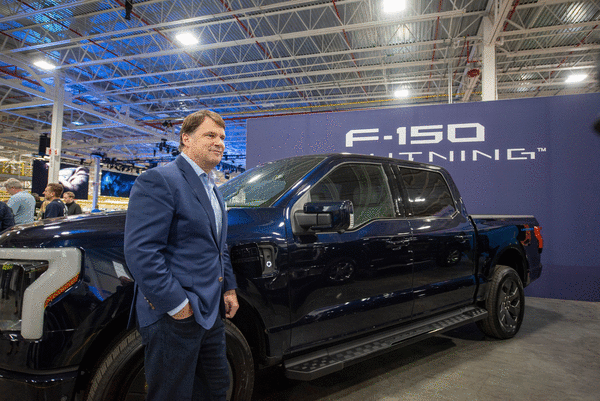
Growth in global sales of electric vehicles is expected to slow this year as China winds down some subsidies, Europe wavers on its phase-out of combustion engines, and U.S. producers and policymakers make a U-turn from the segment.
BloombergNEF expects drivers to buy 24.3 million passenger EVs this year, an increase of only 12% on 2025 and weaker than the 23% growth in sales last year.
In the U.S. in particular, electric vehicle makers are facing an “EV winter,” and will need to navigate bumpy months ahead before a likely revival in sales in 2027 and 2028, said Nathan Niese, Boston Consulting Group’s global lead for EVs and energy storage. Though the long-term trajectory for battery-powered vehicles remains positive, there isn’t “a 2026 story buried in there that says there’s lots to be optimistic about,” he said.
Ford Motor Co.’s decision in December to take $19.5 billion in charges related to a sweeping overhaul of its EV business — including the move to convert its flagship electric F-150 Lightning truck to an extended-range hybrid vehicle — highlighted the fragility of the sector’s short-term prospects, and capped a series of strategy rollbacks from major producers outside China.
The Trump administration’s withdrawal of up to $7,500 consumer tax credits in the U.S. after September and hollowing out of fuel-economy standards has sent the nation’s EV market tumbling. U.S. sales in November plunged 41% from a year earlier and the nation’s annual passenger EV sales are forecast to contract 15% in 2026, according to BNEF.
Even in China, the world’s top EV market, analysts are anticipating a slight slowdown in sales growth, due in part to narrowing government support for the industry. Beijing has cut the EV tax break in half for 2026, while a cash-for-clunkers program will include new restrictions limiting eligibility. Authorities have criticized “rat-race competition” in the nation’s crowded auto sector, and are cracking down on discounts offered to counteract waning demand.
“The Chinese government is definitely trying to cool the price war,” said Michael Dunne, CEO of Dunne Insights, a California-based auto industry consulting firm.
Fierce competition saw BYD Co., China’s EV champion, post its weakest annual sales growth since 2020 last year, as rivals including Geely Automobile Holdings Ltd. and technology giant Xiaomi Corp. begin to gain ground. The nation’s auto firms are also seeing growth slow as they try to expand in tougher markets, such as smaller cities and rural areas.
China’s passenger EV sales, including plug-in hybrids and extended-range hybrids, are expected to have reached 15.6 million in 2025, a 27% increase on the previous year, according to a Bloomberg Intelligence forecast. Sales for 2026 are projected to rise just 13%.
The country’s auto producers have aggressively tapped export markets as demand at home softens. In the first three quarters of 2025, Chinese companies sold nearly a million EVs overseas, a 54% increase from 2024.
Automakers have plans to continue to expand overseas sales in 2026. BYD alone is aiming to export 1.6 million vehicles, according to Citi analysts, while brands like Geely’s Zeekr, Chery Automobile Co. and SAIC Motor Corp. are all targeting offshore markets.
Despite European Union tariffs, the bloc remains the top destination for Chinese vehicles, according to BNEF. The EU recently softened its ban on combustion vehicle sales, though, and EV sales are slowing.
While EV policy is deteriorating, the sector’s economics are improving. Affordability has been among the largest barriers to EV adoption in the U.S., and battery prices — the most expensive part of any electric car or truck — fell another 8% in 2025, according to BNEF estimates. “Carmakers that can cut costs and offer affordable models in the most desirable vehicle segments are likely to see sustained sales growth,” BNEF analyst Huiling Zhou said in a recent report.
In the U.S., producers are expected to debut several models in 2026 with sticker prices far below the average price drivers pay for an internal combustion engine car. The sweet spot of the U.S. auto market is the midsize SUV that costs $35,000 or less. American drivers buy somewhere around 2.5 million midsize SUVs every year and 40% of them fall under that price threshold.
There will be at least five all-new or substantially overhauled models that will launch in or around that price point in 2026, including the Toyota C-HR BEV, Subaru’s Uncharted, the Kia EV3 and an all-new model from the startup Slate Auto.
©2026 Bloomberg L.P. Visit bloomberg.com. Distributed by Tribune Content Agency, LLC.










Comments