Despite active 2025, these auto policies remain on Trump's to-do list
Published in Business News
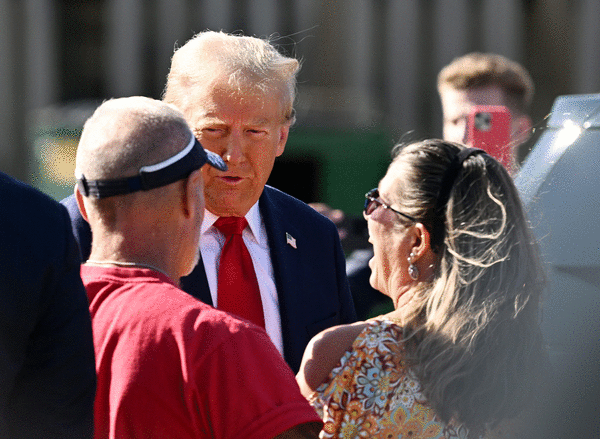
WASHINGTON — In his first year back in the White House, President Donald Trump made good on campaign promises related to the auto industry.
He slashed emissions regulations, ended federal support for electric vehicles and rained tariffs down upon trade-reliant automakers and suppliers in a bid to reshore manufacturing capacity. The Republican leader and his allies also created a tax break on auto loans that could save buyers hundreds annually.
After all that, what else is left for the Trump administration to pursue on automotive policy?
The year 2026, compared to the past 12 months, will likely feature less upheaval for Michigan's signature sector. But there are still several policy areas either with loose ends from a highly consequential 2025 or with unchecked boxes on the administration's to-do list.
The pending issues span across trade, safety, technology and more.
Trade
The auto industry is nervously awaiting a review of the United States-Mexico-Canada free trade agreement that Trump signed in 2020. The formal review, legally required to occur in 2026, could have multibillion-dollar implications for automakers.
Trump in 2020 hailed the USMCA as the "fairest, most balanced, and beneficial trade agreement we have ever signed into law. It’s the best agreement we’ve ever made."
He has since soured on the deal he negotiated. Trump levied steep new tariffs last year on automotive goods flowing across North America, with U.S. imports from Mexico getting hit especially hard. That has changed the complexion of the upcoming review.
Look back: Trump and tariffs dominated the top automotive stories of 2025
"What was once expected to be a routine assessment aimed at improving implementation is now likely to become a high-stakes negotiation," the Washington-based Center for Strategic & International Studies wrote in a brief.
The upcoming trilateral talks could result in meaningful changes, such as a long-term roadmap on import duties that makes it easier for businesses to plan for the future, updates to regional content requirements that reduce overseas participation in the industry, and mutual rules restricting Chinese business activity in North America.
There is a sense of urgency around the USMCA given Trump's 2025 tariff moves, but there are no firm deadlines — at least in law — that will force action. Even if the United States does not recommit to the trade deal, it does not expire until 2036.
That may matter little to Trump, though, who has already signaled that he has a different view on the law. "It expires in about a year," he said in the Oval Office on Dec. 3. "And we'll either let it expire, or we'll maybe work out another deal with Mexico and Canada. But look, Mexico and Canada have taken advantage of the United States."
Autonomous vehicles
The Trump administration, which has recently sought to "remove barriers to United States AI leadership" via an executive order, has also promised to update the nation's regulations around self-driving vehicles.
The issue has been a stated priority of officials and featured in the transportation section of Project 2025, a Heritage Foundation policy guide the Trump administration has closely hewed to.
Transportation Secretary Sean Duffy announced a "Automated Vehicle Framework" in April of last year and set a goal of having "a single national standard that spurs innovation and prioritizes safety."
He said in September that his agency is pursuing three rules to advance those goals, and National Highway Traffic Safety Administrator John Morrison announced in December that his agency has completed a multiyear research project on modernizing vehicle safety standards for the era of autonomous vehicles.
"America must lead the way in transportation innovation. If we don’t, our adversaries will fill the void,” Duffy said in a statement. “The rules of the road need to be updated to fit the realities of the 21st century. Our changes will eliminate redundant requirements and bring us closer to a single national standard that spurs innovation and prioritizes safety.”
There are also ongoing conversations in Congress to potentially include AV guardrails or directives in its 2026 Surface Transportation Reauthorization Bill, a sweeping legislative package due for periodic renewal that authorizes road funding, sets transportation priorities and issues safety directives.
Safety tech
Beyond AVs — which carry major safety implications on their own — there are two other pending, high-profile vehicle safety policies from the Biden era awaiting federal action.
The first is a controversial rule that would require automatic emergency braking technology in all new vehicles by 2029. The Trump administration said in January 2024 that it would review the rule but has not articulated a position on the topic.
The nation's top automotive lobbying group sued the Biden administration over the rule last year, claiming technological feasibility issues.
"This litigation by Alliance for Automotive Innovation should not be interpreted as opposition to AEB, a lack of confidence in the technology, or an objection to AEB’s widest possible deployment across the U.S. vehicle fleet," the organization wrote in a news release. "Rather, this litigation is about ensuring a rule that maximizes driver and pedestrian safety and is technologically feasible."
The second policy in limbo is a 2021 congressional directive for federal regulators to require anti-drunken driving technology on all new vehicles. Congress wrote in law that a proposed rule should arrive by 2024, but the deadline has come and gone without consequences.
The Trump administration has been actively engaged with advocates on the topic, sparking optimism from Mothers Against Drunk Driving officials who said their hope waned at the tail end of the Biden administration. Additionally, the technology in question is improving, there is growing industry buy-in, and bipartisan support for a rule continues on Capitol Hill.
There is still fierce opposition from some corners of Washington, however. First-term U.S. Sen. Bernie Moreno, R-Ohio, has emerged as a leading voice on automotive policy and a staunch critic of requiring anti-drunken driving tech amid rising new vehicle prices. His loud hostility toward a potential rule could further stall it in 2026.
Critical minerals
As China's power in the global auto industry has grown stronger, so has the country's dominance in harvesting and refining critical minerals essential to the production of vehicle parts like advanced EV batteries and motors.
The Trump administration and its allies have sought to cut into that dominance with $7.5 billion in new funding for critical minerals projects at the Department of Defense. Those funds, which include $5 billion for investments into supply chains and $2 billion for national defense stockpiles, were directed by Trump's One Big Beautiful Bill Act.
The United States is also, per Bloomberg, in talks to set up an additional $5 billion investment fund for mining and critical minerals deals.
How those developments play out could have an outsized influence on the future of the U.S. auto industry, even as its transition to electric vehicles slows. Automakers in the United States continue to rely heavily on China for battery technology and materials, in part because of the country's supply chain supremacy. That is a reality both Republicans and Democrats have bemoaned.
Critics have argued that Trump, despite recent moves, has done more to hurt U.S. progress on critical minerals thanks to the elimination of EV tax credits. Absent that program, there will be more attention on what kind of projects and investments the administration's new efforts yield.
Environment
Though the Trump administration declared victory over Biden-era "EV mandates," not all of its big 2025 moves on environmental policy have been finalized. Lawsuits still loom, and bureaucratic requirements remain.
On the legal front, California and ten other states sued the Trump administration in June over its move to rescind a key federal waiver allowing the Golden State to set strict and influential emissions regulations. The rules sought to mostly phase out gas-powered cars in California and conforming states by 2035.
The plaintiffs in the suit argue that Trump and his allies in Congress did not have the authority to rescind the waiver. If that argument succeeds in court, the ramifications would be significant. The outcome would blow a hole through the administration's deregulatory agenda, and automakers could suddenly have to comply with ambitious EV sales targets at a time when most scaled back plug-in investments.
There have also been court challenges — and likely more to come — over a Trump effort aimed at repealing a 2009 legal finding that gave the Environmental Protection Agency power to regulate greenhouse gas emissions from vehicle tailpipes. The finding, for now, stands as a pillar in U.S. climate policy.
The Trump EPA took action to repeal the finding last summer, putting forth a proposal and initiating a public comment period. A final move to nix the finding is likely to arrive in 2026.
The same is true of other Trump policies that have not yet been finalized, such as the administration's corporate average fuel economy rule proposal unveiled in December.
©2026 www.detroitnews.com. Visit at detroitnews.com. Distributed by Tribune Content Agency, LLC.







Comments