Bears say they're looking into building a new stadium in northwest Indiana
Published in Football
CHICAGO — The Chicago Bears are considering a move to northwest Indiana amid growing concerns that Illinois lawmakers will not approve the financial incentives needed to build a new stadium in Arlington Heights, a top team official told the Chicago Tribune.
In an exclusive interview, Bears President and CEO Kevin Warren confirmed the possibility of crossing state lines, but said the organization also would consider sites in other parts of Illinois. A letter to season ticket holders Wednesday outlined plans to look elsewhere, too, adding more fodder to the ongoing political debate over the franchise’s future and renewing an old threat to leave the state if the team doesn’t get its needs met.
“We’re looking at opportunities that may exist in the Chicagoland area including northwest Indiana,” Warren said. “We still believe that Arlington Park is the most viable location in Cook County, but now we’re putting everything back on the table and exploring all options.”
The news comes after Indiana lawmakers earlier this year created the Northwest Indiana Professional Sports Development Commission to attract a major sports organization such as the Bears.
“Northwest Indiana is in our home marketing area,” Warren said. “From a TV, media, radio rights standpoint and our fan base, it’s an extension of Chicago. It seems like it would provide a viable opportunity.”
Word that the team would begin exploring options across state lines appeared to come as a surprise to Gov. JB Pritzker’s office.
“Suggesting the Bears would move to Indiana is a startling slap in the face to all the beloved and loyal fans who have been rallying around the team during this strong season,” Pritzker spokesman Matt Hill said in a statement to the Tribune. “The governor’s a Bears fan who has always wanted them to stay in Chicago. He has also said that ultimately they are a private business that makes their own decisions, but the governor has also been clear that the bottom line for any private business development should not come at the full expense of taxpayers.”
Indiana Gov. Mike Braun welcomed the announcement.
“The Chicago Bears recognize Indiana’s pro-business climate, and I am ready to work with them to build a new stadium in Northwest Indiana. This move would deliver a major economic boost, create jobs, and bring another premier NFL franchise to the Hoosier State. Let’s get it done,” Braun said in a statement.
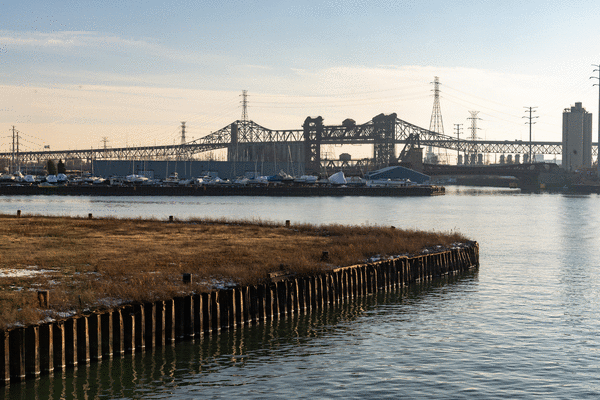
While the Bears did not name a specific site in Indiana, Hammond sits on Lake Michigan southeast of Chicago, and has a mayor who is vice chairman of the sports commission who is willing to play ball.
“I would bend over backwards to do anything I can to help the Bears come here,” Hammond Mayor Thomas McDermott Jr. said.
The mayor said he hasn’t talked to the team, but said business and residents increasingly are fleeing high taxes in Illinois for lower costs in Indiana and proximity to Chicago. While Hammond doesn’t have a site ready to host an NFL stadium, McDermott said he would “knock down buildings” to clear a spot.
It’s unclear whether the Bears would also consider moving its headquarters from Halas Hall in suburban Lake Forest if it played in Indiana.
To be sure, this isn’t the first time the Bears have threatened such a move. In 1995, the team explored moving to a proposed entertainment complex by Gary’s airport. But some fans expressed anger at the idea, and that plan went nowhere.
Critics then suggested the proposed move was a negotiating tactic to win more concessions to stay in Illinois. But Warren says it’s no ploy now, he still wants to build in Arlington Heights, but has to consider all options.
Warren had wanted to break ground on a new stadium in 2025, and finish the three-year construction in time for the 2028 season. The plan is contingent on the General Assembly letting the team negotiate its long-term property taxes with local schools and other taxing bodies.
Pritzker has expressed openness to the state paying for infrastructure costs, but said it’s up to the Bears, valued at nearly $9 billion, to pay for their stadium. Despite the team having the oldest and smallest stadium in the NFL, Warren said, state leaders have told the Bears that their project will not be a legislative priority in 2026.
The legislation would cost the state nothing, and could apply to any “megaproject,” like a stadium, large factory or corporate headquarters. But Chicago lawmakers have resisted the measure, with Pritzker and others suggesting the team should help pay off the more than $500 million debt from the renovation of Soldier Field in 2003. The debt was supposed to be paid off by the city’s hotel tax, but that hasn’t made a dent in the amount owed. The team is under no obligation to pay the debt, other than its yearly rent of about $7 million and an $84 million penalty if it leaves in 2026, before its lease is up in 2033. The Bears’ move to open the door to a possible move to northwest Indiana comes a few weeks after top team officials, including Warren, team Chairman George McCaskey and Chief Operating Officer Karen Murphy met with Pritzker and top aides in the governor’s Chicago office.
The Nov. 6 meeting, which team officials sought for months, lasted about an hour and was “a productive and honest conversation,” according to a source briefed on the discussions.
Pritzker and his staff shared their view of the political dynamics in Springfield and the challenges the team has faced in trying to gather support for proposed megaprojects legislation that Warren and other Bears officials have said is crucial to the proposed Arlington Heights stadium, said the source, who spoke on condition of anonymity to discuss the private conversations.
The biggest obstacle in the Bears’ path to Arlington Heights has been a lack of support from Chicago legislators for a proposal that would allow the team, and other businesses developing large-scale projects, to negotiate property tax payments directly with local taxing bodies.
Democratic lawmakers who represent Chicago are loath to aid the Bears in the team’s effort to leave for the suburbs.
Lawmakers were unimpressed with an offer from the Bears, which came late in the General Assembly’s fall veto session in October, to set aside $25 million to help pay down the debt.
Separately, the team met Friday with Cook County officials to hear a presentation on a proposal to build a new stadium on the former Michael Reese Hospital site. The team has long said the property near the Bronzeville neighborhood is too small for its needs.
Warren reiterated those reasons Tuesday in a letter to Cook County Board President Toni Preckwinkle, noting that “Arlington Park remains the only viable Cook County site for the project.”
“As we have shared privately and publicly, we are at a pivotal juncture to build a new world-class stadium for our Chicago Bears fans,” Warren wrote to Preckwinkle. “There are significant costs associated with further delays. We have great respect for you and your position as President of Cook County and your commitment to making the world a better place for the residents of the southside of Chicago. We want to maintain a strong relationship with you because we serve the same community regardless of where the new Chicago Bears stadium is built. We appreciate your time and leadership.”
In a statement Wednesday, Preckwinkle said she was “proud to have recently hosted a productive meeting between the State, City and County and the Bears. It was important for us to bring everyone to the table and have a conversation around making a serious commitment to keeping the Bears in Cook County and Illinois. We’re shocked and disappointed that the Bears would discuss moving to Indiana at this time.”
Indiana state Rep. Earl Harris Jr., the East Chicago Democrat who authored the law that created the sports commission, said he has heard rumblings about the Bears’ interest in the area.
The commission is in the process of raising funds from Lake County and local municipalities to put together a strategic plan to attract a professional sports franchise. He was aware of potential sites near the Hard Rock Casino and on the lakefront in Gary.
“I’m ecstatic to hear the news,” Harris Jr. said. “If this conversation is getting serious, we will dive deeper into this.”
The Bears have reversed direction before on their plans for a new, world-class enclosed stadium.
It’s been more than four years since the team announced plans to buy the 326-acre former Arlington International Racecourse as a stadium site. The team pledged to spend more than $2 billion to build its own world-class enclosed stadium there. Officials later pivoted to Chicago, proposing a $4.7 billion new domed stadium to replace Soldier Field on the lakefront. After state leaders said they had no money to offer, Warren said the team’s focus was back on Arlington Heights.
The team planned to present its formal proposal to the Arlington Heights village board this fall, but when state lawmakers chose not to help the team with legislation, officials put the presentation on hold.
Wherever the stadium ends up, team officials are looking for government help to build the necessary infrastructure for it, such as roads and utilities, as is common with large projects. The Arlington Heights site would need an estimated $855 million in new construction, including expressway ramps to and from adjacent Route 53.
While the Bears have been stymied in their hopes for a new stadium, public officials in Nashville, Tenn., and Buffalo, N.Y., have committed about $2 billion total for new NFL stadiums in each of those cities. Officials in Cleveland, Kansas City, Kansas and Washington, D.C., are also considering building new football stadiums.
The idea of moving to another state is not unheard of, as the New York Giants and New York Jets both play in New Jersey. Several other teams play outside their namesake towns, such as the Dallas Cowboys in Arlington, Texas, and the Los Angeles Rams in Inglewood, Calif.
Research by economists generally shows that publicly financed stadiums are not a good deal for taxpayers. Polls have shown residents of both Chicago and Arlington Heights would love to have the Bears, but don’t want to pay for a new stadium.
The Bears estimate the economic impact of the stadium’s construction at about $6.6 billion statewide, with 33,000 construction job years and 9,000 permanent jobs, and generating $220 million annually from stadium operations.
____
©2025 Chicago Tribune. Visit at chicagotribune.com. Distributed by Tribune Content Agency, LLC.






Comments