House clears whole milk for school menus
Published in Political News
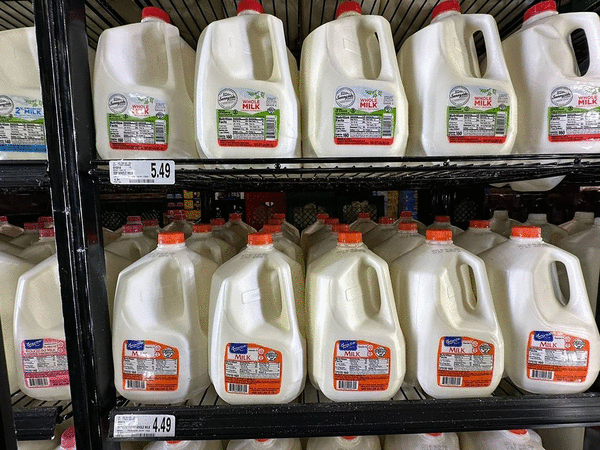
Whole milk is poised to return to the menu for schools participating in the National School Lunch Program for the first time in over a decade.
The House cleared a bill Monday for the president’s desk that would put whole milk back into K-12 schools. The chamber passed the measure by voice vote less than a month after the Senate passed it by unanimous consent.
“This is a win for kids, parents, Kansas dairy farmers, and common sense,” Sen. Roger Marshall, R-Kan., the bill’s sponsor, said in a statement Monday. “The Whole Milk for Healthy Kids Act puts nutrition back in the lunchroom, gives families more choice, and ensures our children have access to the nutrients they need to grow strong and healthy.”
The bill would allow public schools to serve flavored and unflavored, organic and nonorganic whole and 2 percent milk. The National School Lunch Program currently allows schools to serve only fat-free and low-fat, flavored and unflavored milk.
The measure has the backing of House Agriculture Chairman Glenn “GT” Thompson. The Pennsylvania Republican has for years tried to get whole milk back into schools. He sponsored the House version that was approved, 24-10, by the House Education and Workforce Committee in February.
The Senate bill includes a provision aimed at making it easier for students to get nondairy beverages that meet the Agriculture Department’s nutritional standards with “fortification of calcium, protein, vitamin A, and vitamin D to levels found in cow’s milk.” The Senate bill, unlike the House one, also would require training on food allergies for all local food service personnel.
But Thompson is happy with the Senate bill.
“Well, that’s my bill,” he said on Dec. 2. “I helped them make their tweaks. They reached out. I really appreciate Sen. Marshall, Sen. [John] Fetterman, Sen. [Dave] McCormick — they reached out whenever they knew that they had addressed certain things, and they engaged myself and my team, so I was very happy with what they passed.”
Whole milk was taken out of school lunch programs by a 2010 law, part of the Obama administration’s push to improve nutritional standards for school-aged children and first lady Michelle Obama’s Let’s Move! initiative.
The policy was met with opposition from Republicans, who have since emphasized the health benefits of whole milk. Marshall launched the Make America Healthy Again Caucus in 2024.
“As an obstetrician, I cannot stress the extensive list of benefits that comes from drinking whole — and most of all, it just tastes better,” Marshall said at the time of Senate passage, calling it a win for MAHA.
Saturated fat
The nutritional benefits of whole milk are contested.
The Center for Science in the Public Interest, a nonprofit organization, opposed the legislation, saying that 75 percent to 85 percent of children consume too much saturated fat and the bill would worsen that problem. CSPI worked with the Obama administration and Congress to pass the 2010 law.
“Whole milk is so high in saturated fat that experts at the American Academy of Pediatrics, Academy of Nutrition and Dietetics, and the American Heart Association, continue to say those 2 and older should only drink 1 percent or skim milks,” Erin Ogden, a policy associate on federal child nutrition programs at CSPI, said in a Dec. 2 statement.
Tim Hawk, the southwest group vice president at Dairy Farmers of America, said kids don’t drink skim milk and aren’t getting the benefits of drinking milk while at school.
“The argument that, ‘well, kids should still be drinking skim’ – they don’t, and they don’t want to. In fact, it’s rapidly declining,” Hawk said on Dec. 4. “Schools can continue to stay fat-free. They can continue to stay in 1 percent but now whole and 2 percent are an option.”
The Agriculture Department’s MyPlate tool to provide dietary guidelines recommends that children ages 4 to 8 consume 2.5 cups of milk daily and that children ages 9 to 18 consume 3 cups of milk.
Ogden said the bill also doesn’t count the 4.5 grams of saturated fat found in milk toward the saturated fat limits in school meals, “thus leaving room to go beyond that 10 percent [of total calories] limit, upping saturated fat consumption even more. This is magic math. Consuming saturated fat will always ‘count’ as consuming it regardless of the source, whether whole milk, butter, etc.”
The dairy industry cheered the legislation.
Gregg Doud, the National Milk Producers Federation’s president and CEO, said in a Monday statement that the bill “represents major progress in improving the nourishment of American schoolkids.”
Lactose intolerance
The bill’s path to final passage hit a bump over a lactose intolerance provision. Sen. Angela Alsobrooks, D-Md., held the bill up for over four months in the Senate because it continued to classify lactose intolerance as a disability. She removed her hold after receiving reassurances from Marshall and other bill backers including Sen. Peter Welchh, D-Vt., and Senate Agriculture Chairman John Boozman, R-Ark., that they would address the disability classification, an aide said.
Welch is one of five members of the Democratic Caucus who are among the 14 Senate co-sponsors.
Students with lactose intolerance currently need a doctor’s note documenting that their reaction to drinking cow’s milk would rise to the level of a disability, Diane Pratt-Heavner, the director of media relations for the School Nutrition Association, said. “That’s how students, currently and for a long time, have been getting either a lactose-free milk or, a nutritionally equivalent alternative, not dairy alternative.”
The bill would allow parents and licensed physicians to provide a written statement for a student to receive a nondairy milk substitute.
Thompson said he shares Alsobrooks’ concerns, calling the classification “ridiculous” and noting that it “needs to be” addressed in the future. They both said that tying lactose intolerance to disability could stigmatize students.
Andrew Jerome, the spokesperson for the International Dairy Foods Association, said that the organization supports lactose-free products.
“For students with lactose-intolerance, the bill follows existing regulations by retaining lactose-free milk options,” Jerome said in a November statement.
Some students may have to wait a while before whole milk appears in their school cafeterias.
“We’re not certain whether whole milk right away will be available to all schools as an option, just because milk processors aren’t currently making that option available across the country,” Pratt-Heavner said. “There are a wide variety of products offered in the K-12 industry that aren’t consistently available to all schools nationwide.”
©2025 CQ-Roll Call, Inc., All Rights Reserved. Visit cqrollcall.com. Distributed by Tribune Content Agency, LLC.



















































Comments