Key things to know about the US-Israel conflict with Tehran
Published in News & Features
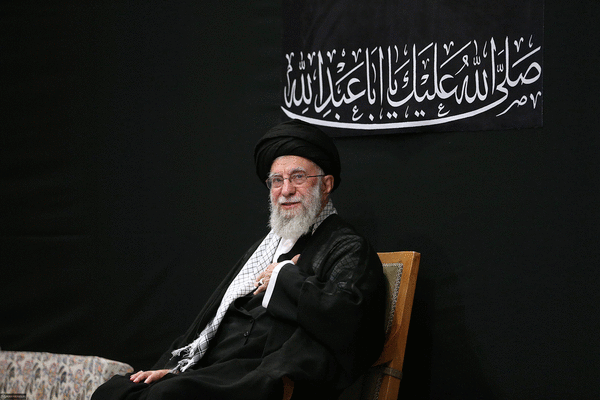
The U.S. reported the first Americans killed in a war with Iran as each side pledged escalating strikes in the days ahead.
Iran’s retaliation has spread across the region in the wake of massive missile attacks that killed Supreme Leader Ayatollah Ali Khamenei and other senior officials. President Donald Trump said the U.S. sunk nine Iranian naval vessels and “largely destroyed” its naval headquarters.
Oil and other markets could be in for more volatility, while OPEC+ agreed to resume oil production increases at a slightly accelerated pace and some digital assets have rallied on the tumult. Here is the latest as of noon New York time:
Khamenei & succession
Trump on Saturday announced the death of Khamenei, only the second supreme leader of Iran since the Islamic Republic’s founding in 1979, and it was later confirmed by Iranian state media. Trump called Khamenei “one of the most evil people in History” and reiterated his call for the Iranian people to rise up and overthrow the regime.
The killing of Khamenei raises the question of who will rule Iran next, as he had not publicly designated a successor. The Assembly of Experts is the clerical body responsible for selecting the supreme leader.
In the interim period, a council comprising the president, the head of the judiciary and a jurist from the Guardian Council will assume leadership duties. Ali Larijani, chief of Iran’s Supreme National Security Council, said a temporary leadership council will meet Sunday.
Targets
U.S. Central Command said the military had targeted Iran’s Islamic Revolutionary Guard Corps command and control facilities, air defense capabilities, missile and drone launch sites and military airfields. For the first time, the U..S used low-cost one-way attack drones in combat, according to the Centcom post on X.
Forty-eight Iranian leaders are gone “in one shot” and the U.S. knows how many targets are left, Trump told Fox News reporter Jacqui Heinrich, who posted his comments on X.
Three U.S. service members were killed and five “seriously wounded” during operations against the Islamic Republic, Centcom announced on X Sunday morning in Washington. The command said additional details would be withheld until the service members’ next-of-kin are notified.
Iran state television reported on Saturday that 201 people had been killed and 747 injured in the strikes, citing the Red Crescent. Some 85 people were killed by a missile that hit a primary girls’ school in Hormozgan province, the semi-official Iranian Students’ News Agency reported. Islamic Revolutionary Guard Corps Commander Mohammad Pakpour and Defense Minister Aziz Nasirzadeh were among other top officials killed in the strikes.
Widespread retaliation
Iran lobbed a wave of missile and drone attacks aimed at U.S. bases and allies around the region, including in the United Arab Emirates, Qatar, Kuwait and Saudi Arabia. Officials put up a show of defiance, with Larijani vowing that attacks on Sunday would be stronger than the day before. Even Oman, which was previously mostly unscathed, came under fire on Sunday.
Defense systems were fighting off missiles and drones from Dubai’s glitzy skyscrapers and wealthy enclaves, where residents reported hearing more blasts Sunday. Centcom confirmed some “minimal” damage to U.S. installations. Israel, which was also targeted, called up 100,000 reservists to help with the nation’s defense.
In a sign of Iran’s growing isolation, countries across the Gulf are stepping up their criticism of Tehran’s strikes.
Oil and shipping
Oil markets are pricing in a “widening escalation cycle” pushing Brent crude toward $80 a barrel after U.S. strikes on Iran, according to a Bloomberg Intelligence analysis. OPEC+ on Sunday agreed in principle to a slightly larger increase in oil production next month, delegates said, as the conflict threatened to bolster a rally in crude prices.
Meanwhile, the world’s largest shipping companies are avoiding the Persian Gulf, and DP World suspended operations at its main Dubai port.
Three ships were reportedly attacked near the mouth of the Persian Gulf, amid signs that tanker traffic through the vital Strait of Hormuz oil-and-gas chokepoint is halting because of conflict in the region.
Iran’s Foreign Minister Abbas Araghchi has said his country has no intention to close the Strait of Hormuz and has kept it open so far, according to an interview with Al Jazeera TV. Even so, oil and gas shipping remains largely paused in the Strait of Hormuz.
Travel disruptions
Airlines across the Persian Gulf extended their suspension of operations as retaliatory strikes from Iran enter a second day, causing major disruptions at some of the world’s busiest airports. Emirates, the world’s largest international airline, suspended flight movements indefinitely, while Etihad Airways extended cancellations until 2 a.m. on Monday. Qatar Airways said all flights are still halted and that it would provide an update 9 a.m. on Monday.
Several airports in the Gulf were hit in the crossfire, with Abu Dhabi Airport reporting that one person died and several were injured overnight after the emirate intercepted an Iranian drone. The main airports of Dubai, Bahrain and Kuwait were also struck
Impact on markets
All eyes will be on energy markets when trading fully reopens on Monday, macro traders said, with early indications of volatility also expected when the U.S. dollar and other currencies start to trade in Australia. The market chaos is reinforcing the greenback’s safe-haven status.
The UAE said its two key markets — in Abu Dhabi and Dubai — will close for the first two days of the week.
Already, the threat of military action had driven the price of oil up last week. Brent crude increased 2.5% to $72.48 per barrel on Friday, the highest closing price since July. It’s gained almost 20% this year.
Bitcoin meanwhile staged a tepid recovery. Prices rose as much as 2.2% to $68,196 after Iran confirmed the death of Khamenei, before falling back to about $66,500 at 6 a.m. in New York.
U.S. politics
Trump, who in announcing the strikes urged the Iranian people to rise up against the theocracy that has governed the country since 1979, told the Atlantic on Sunday that Iranian officials wanted to talk, and that he agreed to engage with him. The publication added that he declined to provide details.
So far, congressional reaction is falling mostly along party lines, with a few exceptions. Republicans are largely expressing support for the military action and Democrats calling for a vote on a resolution that would curtail the president’s authority to conduct strikes.
_____
(With assistance from María Paula Mijares Torres, Angela Cullen, Stanley James and Michelle Jamrisko.)
_____
©2026 Bloomberg L.P. Visit bloomberg.com. Distributed by Tribune Content Agency, LLC.





Comments