Iranians on Khamenei's death: mourning on state TV, public joy
Published in News & Features
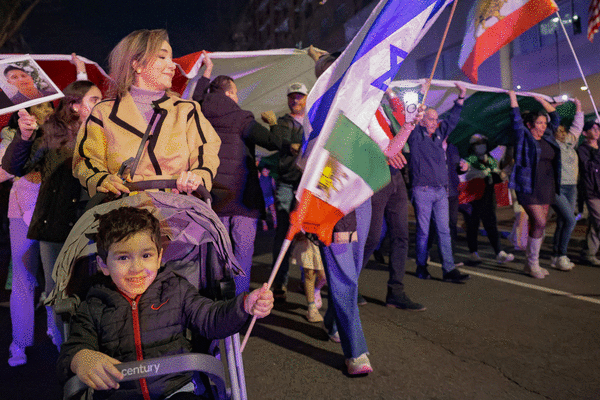
Millions of Iranians have lived their entire lives under the thumb of Ayatollah Ali Khamenei, the supreme leader of Iran. When reports of his demise began to trickle in, the response in the streets of Tehran was jubilation. The reaction by the authorities was denial, then mourning.
The death of the supreme leader of Iran was teased out over hours until declared as fact by U.S. President Donald Trump in a social media post. It marks the biggest turning point in the country’s complex history since the Islamic Revolution that overthrew the Shah and ushered in the clerics.
But there were dual narratives at play, inside and outside of Iran, that in the age of social media — with access to the internet hard to control or blacked out — were on stark display.
One was a regime in denial until Iran’s state television confirmed Khamenei’s death at around 5 a.m. local time. A news presenter delivered the statement with a trembling voice as the channel placed a black banner in the corner of the screen and broadcast recitations of Quranic verses — a visual cue traditionally used to signal national mourning.
Another narrative was the controlled messaging from Trump claiming one of the most consequential and controversial foreign policy decisions of any U.S. leader in living memory.
Many Iranian millennials, born after 1989, have never known a day with Khamenei not in charge. He was uncontested and no successor is likely to command the same level of power, institutional control or personal influence that he inherited from Ayatollah Ruhollah Khomeini and that over generations he consolidated.
His tight grip on power forced millions to leave the country and into exile, pushed thousands into prisons, and left countless ordinary citizens living in fear, making the idea of a post-Khamenei era almost unimaginable.
The immediate reaction to what could mark the unraveling of a system he spent decades fortifying from the outside world: Is it real?
Over the years, he repeatedly quashed reports of illness or frailty, appearing in public on foot, leaning on his cane, delivering long speeches, and threatening enemies abroad and dissidents at home.
He presided over mourning ceremonies for his most senior military officials and allies, praying in 2024 over the coffin of Ismail Haniyeh, a senior Hamas leader and key proxy ally killed in the heart of Tehran, and mourning the foreboding death of his top general, Qassem Soleimani, killed in a U.S. airstrike in 2020.
He quashed, time and again, any challenge to his rule — including when protesters started to publicly chant for his death during the 2009 election unrest. The most recent attempt against his authority was met with a brutal crackdown, as his security forces showed no restraint, killing thousands across the country during nationwide protests in January.
Trump’s claim of his death was swiftly repudiated in Iranian state media, which cited people close to the supreme leader’s office. The bet was that Trump’s track record of spreading misleading information would resonate.
Such statements, deployed over the years by members of the regime, are a psychological operation aimed at molding public opinion. This time they didn’t wash.
As the official messaging was being broadcast, videos from inside Iran were flooding social media, showing crowds filling the streets in the early hours of Sunday: cars honking, people dancing and chanting in celebration — even as the country’s political future and the more immediate issue of his succession remained immensely uncertain.
©2026 Bloomberg L.P. Visit bloomberg.com. Distributed by Tribune Content Agency, LLC.


Comments