'Pandora's box': Proposed Idaho constitutional amendment stirs confusion
Published in News & Features
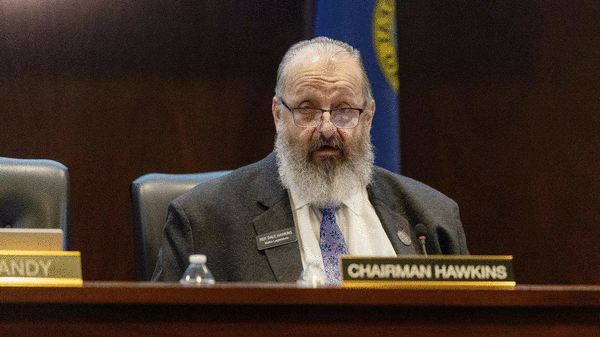
BOISE, Idaho — Idaho lawmakers are considering a resolution that would ask voters to remove a portion of the state constitution on compulsory attendance at schools.
Rep. Dale Hawkins, a Republican, proposed the constitutional amendment to nix a portion of the Idaho Constitution and replace it with a statement he argued would ensure parents always have the ultimate say over how to educate their children.
Idaho’s Constitution now says the Legislature may require that children ages 6 to 18 years old attend the state’s public schools “unless educated by other means, as provided by law.” State law requires education of children from ages 7 through 15.
Hawkins proposed instead, the Constitution should read: “The right of the people to educate their children without government regulation outside of the public schools of the state shall not be infringed.”
“When I first read this years ago, I thought, ‘Well, that’s really archaic and really kind of scary that a state could come and compel a parent, you will teach your children here,’ ” Hawkins told House State Affairs committee members. “So that was the beginning of me to do this. … I believe that the parents have the inherent right to direct the education of their children. I believe most of Idaho believes this.”
Lawmakers advanced the legislation to the House floor. A constitutional amendment must be approved by two-thirds of the House and Senate, and a majority of voters. The fiscal note on the bill’s statement of purpose estimates about $200,000 for costs associated with getting the initiative on the ballot if approved by the Legislature. Hawkins brought forward the same proposal last year, but it failed to garner the support of two-thirds of members.
Hawkins noted the resolution wouldn’t give parents the option not to educate their children.
“This would secure families’ rights to educate their children as they see fit, not how government sees fit,” Hawkins told committee members.
Hawkins fielded questions from committee members over how this would affect government regulation of schools and why he proposed the replacement language.
Rep. Monica Church, a Democrat, asked Hawkins why the proposal wasn’t simply to remove the compulsory attendance language. In response, Hawkins referenced the Second Amendment.
“That would be, suppose, like our Second Amendment right. Should we have printed nothing, or should we have the declaration of what we hold as God-given rights in our Constitution not to be infringed by government,” Hawkins said.
Church said she would be fine with asking voters about taking out the attendance language in the Constitution, noting it is “antiquated,” but she worried about issues that could arise if the proposed language was added.
“We know when we have these kind of amendments at the federal level, and certainly probably at the state level, that we end up in court cases and putting government against government. I think it’s a recipe for litigation,” she said.
GOP Rep. Erin Bingham asked how the amendment could affect regulation outside of public schools. The Legislature last year passed a $50 million tax credit program that directs taxpayer money toward non-public schools.
“I just know that when we have public dollars, that we ask for transparency and accountability for those dollars,” she said. “So I just am wondering if regulations would be disallowed outside of the public school for funding for education.”
Hawkins said that would be a question for an attorney.
Hawkins added that although this may not be an issue now, the amendment would enshrine people’s rights to educate their children as they want, even if the Legislature or its priorities change.
But the amendment could have larger consequences.
Ritchie Eppink, an attorney with Wrest Legal Collective, said it’s unclear what the purpose would be of spending money to get this on the ballot “if we don’t have a problem to solve in the first place.”
“As a litigator, I can tell you that the meaning of that is going to be litigated at public expense for years or decades to come,” he told The Idaho Statesman. “And it’s hard to say what the outcome of that will be.”
The proposed language could be susceptible to different meanings, he said, and litigants across the state are going to press the interpretations they want before the courts.
“It’s a bit of a Pandora’s box in that respect,” he said. “When you create a right like this, and say that it shall not be infringed, that means that the courts are going to have to create a standard to determine when that right is infringed, and where that line ends up, nobody can say at this point.”
John Rumel, a law professor at the University of Idaho College of Law, said the amendment is “putting more of an emphasis on deregulation” of non-public schools into the Constitution. But Idaho already has very little regulation of home schooling. If this constitutional amendment is approved, it could mean that even “reasonable” regulations could be challenged, he said.
“It strikes me that an eminently reasonable kind of regulation, like just making sure that kids are getting compulsory education somewhere, either home school or public school, that would raise a constitutional question,” he told the Statesman. If approved, he added, “then you’re going to have all manner of time spent trying to interpret that, when there’s no real question in Idaho right now that home schools are really not regulated at all.”
Eppink said this sets up the state for “lawsuits of all sorts.”
“It could mean that, ultimately, a court could say even the most reasonable of regulations can’t be imposed,” he said, “and it will probably take years to find out what this actually means.”
©2026 The Idaho Statesman. Visit idahostatesman.com. Distributed by Tribune Content Agency, LLC.






Comments