Trump administration looks to join suit alleging LAUSD discriminates against white students
Published in News & Features
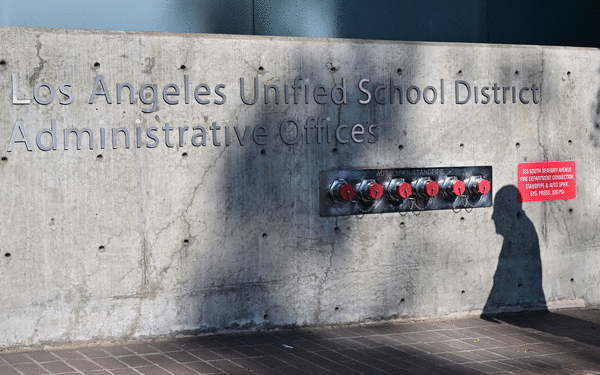
LOS ANGELES — The U.S. Department of Justice is seeking to join a federal lawsuit accusing the Los Angeles school district of discriminating against white students.
At issue is a long-running effort to help disadvantaged students of color in Los Angeles by providing somewhat smaller classes to the vast majority of schools — leaving out campuses with larger numbers of white students.
The lawsuit, filed in federal court in January by the 1776 Project Foundation, targets a decades-old effort to combat the harms of segregation without requiring families to attend integrated schools.
The nation's second-largest school district is acting illegally under both the California and the federal Constitution, the suit alleges.
The Justice Department agrees and wants to participate in the litigation because "the United States Attorney General has reviewed this action and determined it is a case of general public importance," according to the court petition filed Wednesday.
"This case will provide relief to the Plaintiff's members but will also relieve the entire LAUSD student population of the 'injury' of 'being forced to compete in a race-based system that may prejudice the(m).'"
Asst. Atty. Gen. Harmeet K. Dhillon, of the department's Civil Rights Division, was among several Trump administration officials who commented in a news release.
"Los Angeles County students should never be classified or treated differently because of their race. Yet this school district is doing exactly that by providing benefits that treat students — based on their race — as though they have learning disabilities," Dhillon said. "Racial discrimination is unlawful and un-American, and this Civil Rights Division will fight to ensure that every LAUSD student is treated equally under the law."
An L.A. Unified spokesperson said the district "remains firmly committed to ensuring all students have meaningful access to services and enriching educational opportunities."
L.A. school board member Nick Melvoin said the Justice Department is misdirected in its perception of justice for students in its claim "to champion equality in our schools."
He said its intervention in the suit "isn't about fairness; it's part of a broader effort to roll back civil rights for our kids. The programs were designed to address real inequities and are driving historic progress for students of color and for all students. We won't be intimidated, and we will defend what works."
The suit claims that 600 campuses have an illegal advantage, while about 100 do not. The lawsuit alleges that students in the targeted schools receive benefits that include smaller class sizes and that they also receive preferential treatment for entry into sought-after magnet programs.
"The District engages in — and publicly touts — a program of overt discrimination against a new minority: White students," the lawsuit states.
The Trump administration action is in line with its general interpretation of anti-discrimination laws in schools, claiming that programs and services that specifically benefit students of color harm white students or others not included in the program.
Under threat of losing federal funding, universities and school districts have moved to end, rename or reorganize diversity, equity and inclusion programs. California officials are among those who are opposing the federal mandates in court.
The U.S. Supreme Court has banned racial preferences in the college admissions process, emboldening other moves against diversity efforts or programs tailored to help particular groups of students.
Pedro Noguera, the dean of USC's Rossier School of Education, has called litigation such as the suit filed by the 1776 Project Foundation an "increasingly common" tactic from conservative groups "who want to claim reverse discrimination based on the idea that helping low-income kids of color hurts affluent white students. However, there is no empirical evidence to support this claim."
Magnet schools are special programs established decades ago to promote voluntary integration, largely by enticing white students out of their neighborhood schools. Magnet enrollment was once tied strictly to racial quotas. This framework frequently worked to the advantage of white students — because there were relatively fewer white students competing for the number of magnet slots reserved for them.
LAUSD is now about 74% Latino, 10% white, 7% Black and 3.3% Asian, according to state data. Total enrollment is about 380,000.
Today, magnet programs have become a general recruitment strategy in a school system with declining enrollment. Some magnets are virtually all students of color because few or no white students apply.
Magnet funding is mainly spent on providing bus transportation for students to attend these special programs outside their neighborhoods.
A separate component of L.A. Unified education efforts includes providing additional support to schools that are at least 70% nonwhite. As described on the L.A. Unified website, these schools have smaller class sizes. According to the suit, the difference is as much as 25 students per teacher compared with an average of 34.5 per teacher.
In the big picture, the district currently allocates extra resources based mainly on which schools are performing worse on academic measures, not race.
Federal funds also typically benefit such schools through Title I funding, which is set aside for schools with high concentrations of poverty. These extra federal resources are not based on race.
_____
©2026 Los Angeles Times. Visit latimes.com. Distributed by Tribune Content Agency, LLC.






Comments