How James Uthmeier became one of Florida's most powerful politicians
Published in News & Features
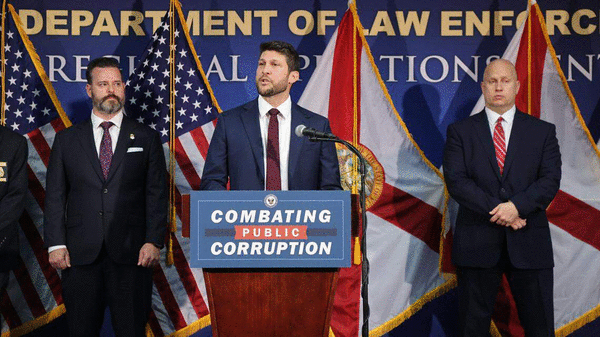
When James Uthmeier suddenly became one of Florida’s most powerful leaders, few people outside Tallahassee had heard of him.
Now, a year after Gov. Ron DeSantis made him the state’s attorney general, Uthmeier is a ubiquitous media presence as he seeks to ingratiate himself with Florida’s conservative-leaning electorate. He’s brought culture-war lawsuits against corporations. He’s helped create the immigration detention center that he dubbed Alligator Alcatraz. He’s talked tough in news conferences about prosecuting child predators, drug traffickers and assorted wrongdoers.
At the same time, Uthmeier hasn’t been able to shake questions and criticism over his connection to the Hope Florida political scandal. A state lawmaker has accused him of committing crimes related to the transfer of funds from a state settlement with a Medicaid contractor to a political committee he controlled while working for the governor. A grand jury investigation is underway. Uthmeier and DeSantis have denied wrongdoing.
Uthmeier’s politics and controversies are well known. The man himself, less so. At age 38, he stands at the pinnacle of an unlikely political ascent that has seen him change hats from government lawyer in Washington, D.C., and Tallahassee to behind-the-scenes strategist to state Cabinet official and candidate.
“Intense” and “fearless” are words some fellow Republicans use to describe him.
“Phony” and “bully” say others, also Republicans.
He got where he is largely because of his work with DeSantis. The governor appointed Uthmeier, his chief of staff, to replace Ashley Moody, the twice-elected attorney general who left to fill Florida’s vacant U.S. Senate seat.
Both Moody and her predecessor, Pam Bondi, had long careers anchored in the dour courtrooms of the Hillsborough County Courthouse Annex — Moody as a judge who oversaw thousands of felony cases, Bondi as a homicide prosecutor.
Uthmeier bears a comparative lack of experience, at least in Florida’s criminal courtrooms. What he does have is a tireless drive and an ability to influence the right people.
Born to run
Uthmeier grew up in Destin, in Florida’s Panhandle. It’s a largely conservative area, known mostly for the year-round tourist draw of its beaches. His parents moved there from Missouri in the 1990s. He has a younger sister.
His father ran an outdoor advertising business and later worked in real estate.
He earned straight A’s at Fort Walton Beach High School. He was part of various honor societies, Future Business Leaders of America and the Fellowship of Christian Athletes. He played guitar, trumpet and trombone and worked part-time for a beach clothing retailer. He served as treasurer of his high school chapter of Teenage Republicans.
He played on the school’s baseball team. But what defined Uthmeier’s youth more than anything else was running.
A standout track athlete, he became captain of the school’s cross-country team. He kept running when he went on to study business at the University of Florida.
Teammates spoke of his drive to win even in the face of crippling pain or midrace injuries. In 2005, the Northwest Florida Daily News named him its Runner of the Year.
“Your natural instinct is to back off from pain,” Uthmeier told the newspaper. “But I’ve found it’s not any easier doing it that way. If you feel it, you attack and challenge it back.”
Todd Morgan, who coached Uthmeier at UF, said that what Uthmeier lacked athletically, he overcame with his work ethic and determination. He and his teammates ran as much as 100 miles a week.
“He over-indexed on focus and toughness and composure,” Morgan told the Tampa Bay Times. “I always kind of felt like he had a clear vision of where he wanted to be and what he wanted to do.”
Despite that vision, Morgan said politics wasn’t a topic Uthmeier ever discussed. Uthmeier’s office did not respond to two emails and a voicemail message seeking an interview for this story. But in an appearance last year on the “Deeper Dive with Dara Kam,” a podcast of the News Service of Florida, Uthmeier spoke about his background. He said competition from other runners dashed his dreams of professional athletics.
“The Kenyans and Ethiopians that were running in the (Southeastern Conference) at the time, they smacked me around a little bit,” he said.
An encounter with then-U.S. Senate candidate Marco Rubio at a tailgating event put him on a different path, Uthmeier said on the podcast.
During Rubio’s improbable run against former Gov. Charlie Crist, Uthmeier worked the streets and handed out signs. After Rubio won, Uthmeier followed him to Washington, where he worked as a staffer in his Senate office. Barack Obama was president. Democrats partly controlled Congress. The U.S. Supreme Court, then almost evenly ideologically balanced, delivered progressive victories on issues like the legality of the Affordable Care Act and the constitutionality of same-sex marriage.
Uthmeier’s exposure to some of the nation’s most contentious political and legal controversies drew him to the nearby Georgetown University School of Law. He wrote a scholarly article that cited the nation’s founders to argue that Obama had limited authority to take military action in Syria without congressional approval. After graduating, he went to work in the Washington office of Jones Day. The sprawling, silk-stocking firm has helped foster the careers of many young conservative lawyers. Alumni include the late Supreme Court Justice Antonin Scalia.
Uthmeier would later recall a day in 2015 when Don McGahn, a Republican attorney and veteran Washington insider, asked if he’d like to work for the next president.
McGahn, who went on to serve as White House counsel in Donald Trump’s first administration, helped Uthmeier land a role at the Commerce Department. His work there included an unsuccessful effort to add a citizenship question to the 2020 census, which drew congressional scrutiny.
It was a job that sent him as far away as China. But political winds — and an ambitious congressman named Ron DeSantis — would push him closer to home.
The governor’s man
Uthmeier stood straight-backed, gripping a microphone before an NBC TV camera in a University of Alabama auditorium. Behind him, reporters milled near a large sign emblazoned with “DeSantis.”
It was December 2023. On a mission to turn around the governor’s sputtering presidential campaign, Uthmeier was asked about his boss’s performance in a Republican debate that had just ended. DeSantis had responded tepidly to questions about Trump’s policies and whether he was mentally fit to serve. Uthmeier was anything but tepid.
“I think the governor was very clear that the country needs a leader who is not going up into the 80s, who’s not lost his step,” he said. “One thing is clear. Donald Trump is not the same guy he was four or six years ago. He has definitely lost his step.”
The TV interview was, in retrospect, something of a milestone for Uthmeier. Until that moment, he had been a largely behind-the-scenes persona as one of DeSantis’ most trusted advisers. He’d joined the new governor’s legal team in 2019, working his way to become his general counsel and then chief of staff.
He’d helped DeSantis secure political wins navigating crises and policy challenges like the state’s response to the COVID-19 pandemic. He also helped orchestrate some of the governor’s attention-grabbing political moves — like when DeSantis removed Democratic Hillsborough State Attorney Andrew Warren or when he arranged to fly migrants from Texas to Martha’s Vineyard.
“He was a smart staffer,” said Jason Gonzalez, a Republican attorney and former general counsel in the governor’s office. “He didn’t get ahead of the governor. They’re motivated ideologically by the same things the governor is interested in. He could develop and implement a strategy for the governor, and there’s not going to be a lot of daylight that comes between them.”
So it made sense that when DeSantis saw his presidential campaign stall, he called on Uthmeier to run it. David Polyansky, a veteran political consultant, joined as a deputy campaign manager at the same time. He was struck by Uthmeier’s intense yet disciplined strategy for campaigning.
“He was a fierce and vocal advocate for what he thought was the right approach for the campaign and the governor,” Polyansky said. “You don’t actually always get that in campaigns, believe it or not.” On TV that December, Uthmeier criticized Trump’s handling of the COVID-19 pandemic. He praised DeSantis as a winner, a “fighter” and a leader who “spits nails.”
About a month later, as live results showed Trump beating DeSantis by more than 30 points in the Iowa caucus, Uthmeier — in a TV interview sporting a “DeSantis” cap — complained about media reports calling the race before voting concluded.
“Voters decide elections,” he said. “That’s foundational to our democracy.” He said DeSantis would keep campaigning. Six days later, DeSantis dropped out and endorsed Trump.
The seeds of a scandal
Uthmeier stood beside his wife, Jean, and their three young kids last February as DeSantis spoke glowingly of his tirelessness.
“James was a bulldog in our administration,” DeSantis said.
The governor mentioned Uthmeier’s role in defeating a pair of constitutional amendments — one that would have codified the right to abortion, another that would have legalized recreational marijuana. When voters rejected the amendments in 2024, it was seen as a win for DeSantis.
“We would not have succeeded in that fight if it wasn’t for James’ leadership,” DeSantis said. Almost as soon as Uthmeier took office, the Republican-controlled state House of Representatives began investigating the circumstances of how that fight was won.
The probe focused on $10 million in Medicaid funds that were given to the Hope Florida Foundation, a state-created charity, as part of a $67 million legal settlement with the state. The Tampa Bay Times and Miami Herald’s joint Tallahassee bureau uncovered how the foundation, which supports the Hope Florida program championed by first lady Casey DeSantis, quickly gave out the $10 million to two nonprofits, who then sent most of the money to a political committee that aimed to defeat the marijuana amendment. The committee was controlledby Uthmeier.
Last April, as the Herald/Times began publishing a series of stories about the spending, Uthmeier held a news conference in Tampa. He wanted to talk about a lawsuit his office brought against Snapchat over the social media app’s use by minors. Reporters wanted to ask him about the burgeoning scandal.
He tried to distance himself from the controversy while insisting there was nothing illegal about what occurred. As the inquiries kept coming, Uthmeier raised his voice.
“Anybody have a question about protecting our kids?” he said. “I’m kind of tired of these politicized narratives.” In another news conference a month later, Uthmeier kept talking.
He blamed the scandal on his political opponents, who he said were in bed with the marijuana industry.
“We did the right thing,” he said. ”Everything we did was lawful. We won. I’m proud we won, and I’m glad that we have kept Florida safe, free and open for business in a healthy manner.”
On a conservative podcast days later, he asserted he had to do what he did to defeat the marijuana amendment. “Government officials certainly have a right, maybe even a duty, to protect the state against things like this that will change our laws and potentially harm us,” he said.
Alex Andrade, the Republican Pensacola representative who led the House investigation into the spending, has accused Uthmeier of fraud and money laundering.
“He doesn’t strike me as the kind of guy who would put his name on the ballot if he wasn’t handed the job first,” Andrade told the Times.
“He’s like an ‘ends justify the means’ guy,” he said. “You can’t be an ‘ends justify the means’ guy and be in a position like the attorney general.”
This week came new criticism after the Herald/Times revealed Uthmeier had secured a $100,000 salary for a two-hour-a-week teaching gig at UF’s law school, vastly more than an adjunct professor typically makes. While such controversies may have sunk a politician of yesteryear, Uthmeier hasn’t shown any significant dip in support.
A year after he formally launched a bid to get elected to the office he already holds, he has amassed close to $5 million in contributions to his campaign and an affiliated political committee.
His most sizable backing came from the state Republican Party, which has given him close to $1 million. His second biggest contribution — $325,000 — came from an organization called First Principles. The Nashville-based super PAC has been linked in media reports to Leonard Leo, the conservative legal activist credited with helping to shift the U.S. Supreme Court to the right.
Uthmeier’s other heavyweight contributors include William James Mateer, a hospitality executive whose father was a top DeSantis donor.
He also took in $270,000 from CDR Enterprises, a Miami-based engineering corporation that was one of several companies contracted to build Alligator Alcatraz, according to campaign finance records and news reports. The company’s married chief executives, Carlos Duart and Tina Vidal-Duart, are close with DeSantis. She was on the Hope Florida Foundation board but left amid the growing scandal.
Two Democrats and one Republican have also filed to run for attorney general. None has come close to matching Uthmeier’s war chest.
Jose Javier Rodriguez is one of the Democrats. He’d raised close to $400,000 as of late December, according to campaign finance reports. The other Democrat, Fort Lauderdale lawyer Jim Lewis, reported raising no money but for a $2,000 loan to himself.
Rodriguez, a former state senator from Miami, lost his seat in what is widely believed to have been the result of a criminal ghost candidate scheme orchestrated by Republicans. He has vowed to “stand up to the powerful” and said the attorney general’s job is “not to be the governor’s lawyer.”
“The current attorney general is probably the least independent attorney general we have ever had,” Rodriguez told the Herald/Times last year, calling Uthmeier “corrupt.”
Steven Leskovich is the other Republican in the race. He’d raised about $80,000 as of December between his campaign and associated committee, according to state records.
He’s a Charlotte County attorney who started practicing law when Uthmeier was in middle school. Leskovich calls Uthmeier “pompous” and “arrogant” and a “playground bully.”
“He claims Florida is the free state,” Leskovich said. “It’s only the free state if you believe in what he believes in.” He sees Uthmeier as unwilling to enforce certain laws — like when he urged the U.S. Supreme Court to strike down a measure passed in the wake of the Parkland school shooting that raised the minimum age for gun purchases from 18 to 21. Leskovich doesn’t like that law, but he said the attorney general is obligated to defend it.
He also accused Uthmeier of putting pressure on local governments, which he says is not the role of the attorney general.
Soon after he took office, Uthmeier threatened members of the Fort Myers City Council with removal from office if they didn’t make their police department cooperate with federal immigration enforcement.
In May, he waded into a debate over whether a Clearwater roadway should be sold to the Church of Scientology. He told the city’s mayor his position against the sale could be unconstitutional and discriminatory. He sent a letter to Pensacola officials in November, urging them to cancel a drag-themed Christmas show at a city-owned theater.
With Uthmeier’s financial might, the endorsement of Florida’s voters could be little more than a formality. But there was another endorsement that may have been his heaviest lift.
Uthmeier lobbied hard as speculation swirled about Donald Trump, whom he had criticized as part of the ill-fated DeSantis presidential bid, possibly backing an opponent.
In September, he released a sleek video featuring footage near the Freedom Tower at Miami-Dade College — the perfect place, he said, for a Trump presidential library.
“I can think of no better location to tell the story of Donald Trump, a story of strength,” Uthmeier said in the video. “One of redemption. One of victory. One of sacrifice for the American people. It is the greatest political comeback story in history.”
A little more than two weeks later came words of praise from the sitting president.
“James Uthmeier is a Strong Conservative Fighter and Prosecutor, and has my Complete and Total Endorsement,” Trump wrote on Truth Social. “HE WILL NOT LET YOU DOWN!”
_______
(The Herald/Times Tallahassee Bureau contributed to this report.)
©2026 Miami Herald. Visit at miamiherald.com. Distributed by Tribune Content Agency, LLC.






Comments