Trump argues again that hush-money case belongs in federal court
Published in Political News
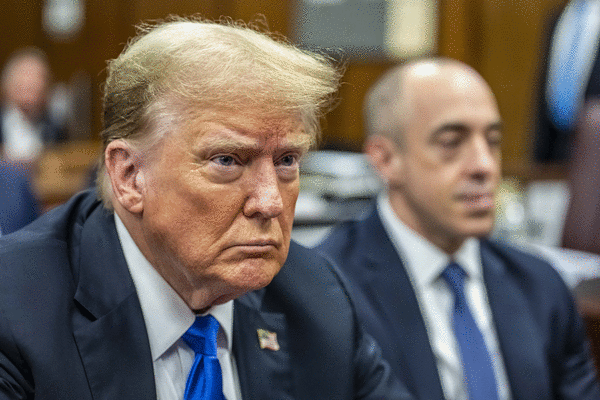
NEW YORK — Donald Trump’s lawyers asked a U.S. appeals court Monday to move his so-called hush-money case, in which he was convicted of 34 felony counts, to a federal court, where they argue that presidents enjoy broader immunity from prosecution.
The arguments focused on technical aspects dealing with procedure and timing relating to the process of moving a criminal case from state to federal court, and the unique elements of a U.S. president trying to clear his name. Trump was challenging an August ruling by a federal judge, who had rejected the president’s bid to move the case for a third time.
“I recognize that it’s unprecedented for a state criminal appeal to be brought to this court, but everything about this case is unprecedented,” Trump’s lawyer, Robert Giuffra Jr., said to a three-judge panel of the U.S. Second Circuit Court of Appeals.
Trump was convicted in May 2024 of concealing a $130,000 payment to adult film star Stormy Daniels to keep her quiet ahead of the 2016 election about an alleged sexual encounter between them. A Manhattan jury found Trump guilty of 34 counts of falsifying business records to hide the payment. Trump denies any affair or wrongdoing.
Trump wants the case moved because a federal court would put the case on a faster track to the U.S. Supreme Court, which could be his best chance to clear his name. Weeks after the conviction, the high court ruled in a separate criminal case that a president can’t be prosecuted for official acts while in office.
In addition to Monday’s appeal to move the case to federal court, Trump is also appealing the underlying conviction. Giuffra argued that case before a separate panel of state appellate judges earlier this month, claiming that prosecutors improperly applied campaign-finance law to elevate misdemeanor charges of falsifying business records to a felony prosecution.
Trump could challenge any decision by those judges with the New York Court of Appeals, the state’s highest court. But Giuffra has said Trump will appeal his conviction to the Supreme Court.
At the trial, Manhattan District Attorney Alvin Bragg said the charges could rise to a felony if the conduct involved one of three possible crimes, including violating federal campaign finance law. At Monday’s hearing, one of the three judges on the panel, U.S. Circuit Judge John M. Walker Jr., appeared highly skeptical of the charging decisions by Bragg’s office and the judge who oversaw Trump’s trial.
“You seemed to be kind of making it up as you went and the trial judge was all for that,” Walker told an appeals lawyer for the prosecution. “It seemed to me that one can argue that the district trial judge was biased.”
The arguments, which were scheduled for 20 minutes, spanned more than an hour as Walker and U.S. Circuit Judge Raymond Lohier Jr. peppered Giuffra and Bragg’s lawyer, Steven Wu, with questions. It wasn’t apparent how Lohier or the third judge, Jose Cabranes, were leaning on whether to grant Trump’s request.
During the questioning, Lohier asked Wu how a state defendant should proceed if the “need for a federal forum becomes clear well after trial.”
If it comes up after sentencing, “the right forum to raise that federal law issue is on direct appeal in the state courts,” Wu said. “State courts are fully equipped to adjudicate federal law issues.”
Giuffra argued that prosecutors used evidence — including social media posts and testimony by a key aide — that was covered by presidential immunity. He said that elements of the hush-money case are related to events that took place while Trump was president.
In ruling against the president in August, U.S. District Judge Alvin Hellerstein said that “paying hush money to an adult film star or engaging in a cover-up of an embarrassment are not subsumed in presidential immunity.” He died last month at the age of 92.
The case is People of the State of New York v. President Donald Trump, No. 26-2427, U.S. Court of Appeals for the Second Circuit.
_____
©2026 Bloomberg L.P. Visit bloomberg.com. Distributed by Tribune Content Agency, LLC.




















Comments