US refugee policy for white South Africans is part of a century-long effort to keep some English-speaking nations white
Published in Political News




Whiteness appears to be an official immigration credential in the eyes of the United States government.
The Trump administration in late 2025 slashed the annual cap on refugee admissions to 7,500 for budget year 2026, down from the 125,000 cap set in 2024 by the Biden administration. That’s a historic low that will shut out thousands of global refugees from war and persecution, such as the victims of Taliban repression in Afghanistan or the Rohingya minority in Myanmar facing documented mass violence.
The new refugee cap, however, will mostly benefit white South Africans, known as Afrikaners. The State Department is building infrastructure to process 4,500 refugee applications per month from Afrikaners, a pace that would easily exceed the administration’s global cap.
The Trump administration’s justification are claims of racial persecution.
Elon Musk, born in South Africa, posted on X in March 2025 that “there is a major political party in South Africa that is actively promoting white genocide.” President Donald Trump agreed. “They’re being killed,” he said in May 2025. Casting blame on the news media, he said, “It’s a genocide that’s taking place that you people don’t want to write about.”
Tucker Carlson had spent years on Fox News pushing the claim that white South Africans were being murdered en masse. Trump had apparently been listening. The white genocide claim moved from fringe websites to cable television to the Oval Office.
As a historian who has spent years studying how racial supremacy gets weaponized as policy, I’d say these claims are worth examining carefully. The numbers don’t support the claims.
Over a year in 2023-2024, AfriForum, an Afrikaner civil rights organization, recorded 49 murders of Afrikaners. That’s .2% of the 27,621 murders across the country. As the Institute for Security Studies in Pretoria concluded, “The idea of a ‘white genocide’ taking place in South Africa is completely false.”
White genocide is a contemporary rallying cry for a project that predates it by over a century: keeping English-speaking nations white. The claim persists because it’s useful. Claims of white genocide, partly rooted in the fear that nonwhite populations are growing while white ones are shrinking, has been a far-right organizing concept for decades. But that fear was called “replacement theory” well before that.
Afrikaner lobby groups have successfully embedded their cause within a transnational far-right network, projecting South Africa as a warning for the U.S. and Europe. The Afrikaner myth is supposed to be a warning: white people are already being crushed in South Africa, and the same fate awaits whites everywhere unless something is done.
This has a specific history, one I’ve traced in my latest book, “White Supremacy: A Short History.”
Some English-speaking settler colonies explicitly identified themselves as “white men’s countries.” And in the early 20th century they coordinated immigration restrictions to keep them that way through a succession of acts passed in Australia, Canada, New Zealand and the United States between 1901 and 1924.
These were pieces of a linked ideological network, as I trace in the book, with ideas and personnel circulating between countries that understood themselves as outposts of the same white civilization.
Australia passed immigration acts from 1901 onward that largely barred people from East Asia, Eastern Europe and the Pacific Islands. Attorney General Alfred Deakin justified the restrictions to Parliament in 1901 in the name of “the purity of race.”
In that same September 1901 debate, another member of the Australian House warned that Black political power in the United States offered a cautionary lesson: “The black people there have increased to such an extent, and have gained such power, that the jurists and statesmen there pause and look with fear upon them.”
Canada’s Immigration Act of 1910 gave the government authority to exclude “any race deemed unsuitable to the climate and requirements of Canada,” implementing what historians call the “White Canada” policy. The aim was to limit immigration to “healthy, white, preferably British or American agriculturalists.” By the early 1920s, most nonwhite people were categorically excluded.
New Zealand’s Immigration Restriction Amendment Act of 1920 required entry permits for anyone “not of British or Irish parentage,” establishing what contemporaries called a “white New Zealand” policy.
The United States passed its own Immigration Act in 1924 to preserve what its proponents called an “unadulterated” and “Nordic breed,” restricting immigration from southern and eastern Europe and barring most Asians entirely.
South Africa was part of this network. The career of one eugenicist, who promoted the theory that humans can be improved through selective breeding of populations, shows how it worked.
Harold Fantham, who lived from 1876 to 1937, was educated in London, taught zoology at Cambridge, then moved to South Africa in 1917. There, he took a leading role in promoting racial immigration restrictions, arguing in the South African Journal of Science in 1924 that the goal was “safeguarding our nation from racial deterioration.”
He praised the U.S.’s 1924 act for barring “idiots, feeble-minded, paupers,” and admired Germany’s compulsory sterilization laws. He became president of the South African Association for the Advancement of Science. Fantham bore his ideas across the English-speaking world, picking up American and German models along the way.
Behind all these restrictions was a shared fear: that growing numbers of nonwhite people would overwhelm white populations. Eugenicists imagined a race to make babies that whites were losing. They believed democracy itself was a liability, because more nonwhite immigrants could mean more nonwhite votes.
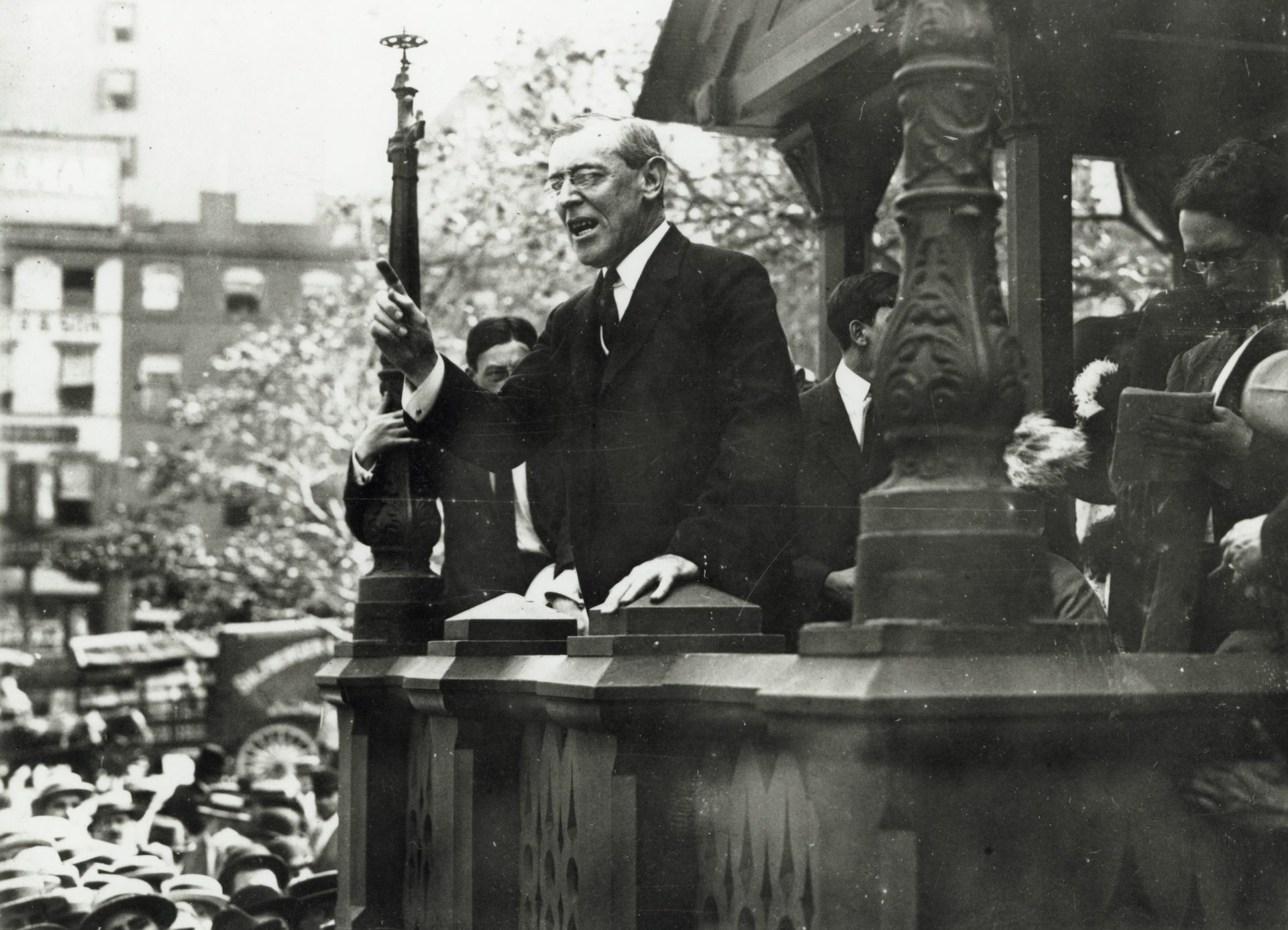
Woodrow Wilson, who resegregated the federal civil service after taking office in 1913, agreed. His intellectual framework was plain. As he wrote in The Atlantic in 1889, only “races purged of barbaric passions” could be entrusted with self-governance.
The Afrikaner program reactivates this logic. It treats whiteness as a refugee status and frames a former colonial ruling class as victims. It sits alongside a deportation campaign targeting people the president says are “poisoning the blood of our country.”
The countries that coordinated a century ago to build white nations are doing the same work again, with the same tools.
The majority of people suffering violence in South Africa are Black South Africans. They are not invited to the United States as refugees.
And while the Trump administration builds a race-based welcome for white South Africans, it’s also building a race-based enforcement apparatus.
In September 2025, in a 6-3 decision, the Supreme Court ruled in Noem v. Vasquez Perdomo that federal agents could use “apparent race or ethnicity” as a factor when stopping people to check their immigration status. Critics call the resulting detentions “Kavanaugh stops,” after Brett Kavanaugh, the justice who wrote the concurrence.
As justice Sonia Sotomayor put it in dissent, “We should not have to live in a country where the Government can seize anyone who looks Latino, speaks Spanish, and appears to work a low wage job.”
Whiteness is functioning as a credential on the streets of American cities. And white skin qualifies Afrikaners for expedited entry. Darker skin qualifies you for a stop.
This article is republished from The Conversation, a nonprofit, independent news organization bringing you facts and trustworthy analysis to help you make sense of our complex world. It was written by: John Broich, Case Western Reserve University
Read more:
ICE immigration tactics are shocking more Americans as US‑Mexico border operations move north
How the 9/11 terrorist attacks shaped ICE’s immigration strategy
Legal refugees now face long detention after DHS reinterprets law on applying for a green card after a year
John Broich does not work for, consult, own shares in or receive funding from any company or organization that would benefit from this article, and has disclosed no relevant affiliations beyond their academic appointment.







































Comments