Trump's budget would boost defense and slash domestic programs
Published in Political News
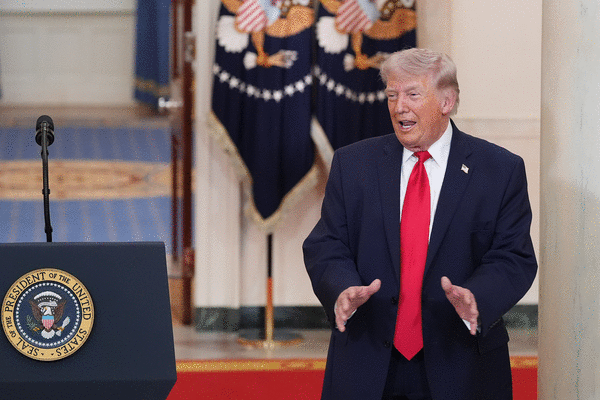
WASHINGTON — President Donald Trump unveiled on Friday a nearly $2.2 trillion discretionary spending request for the coming fiscal year, a nearly 21% increase over the current year’s level because of a dramatic proposed boost in defense funding.
The election-year spending blueprint doubles down on an administration drive to pump up the Pentagon’s budget while making major reductions to various domestic programs. It also calls for passing another filibuster-proof reconciliation bill to boost defense and homeland security funding outside of the regular appropriations process.
Here are some key takeaways from the 92-page budget request:
—National security funding, which includes some Energy Department programs, would total $1.5 trillion, a 42% increase. But the administration is counting on the Republican-controlled House and Senate to pass a reconciliation bill that would fund $350 billion of that amount.
—Nondefense discretionary programs would again be put under the White House chopping block. The budget calls for $73 billion in net cuts to those programs, or roughly 10% from current levels.
—Cuts to certain departments would be far more dramatic than the overall average. The EPA would be slashed by 52%, a $4.6 billion cut. The Small Business Administration would be chopped by 67%, or by $700 million. The State Department would be cut by more than 30%, or $15.5 billion. And the Labor Department would be slashed by nearly 26%, or $3.5 billion.
—Discretionary funding for nondefense programs would total $660.1 billion, compared to $733.5 billion approved for the current fiscal year. While the proposed cuts aren’t quite as steep as those the administration sought last year, Congress largely rejected those cuts in fiscal 2026 appropriations bills.
—Only a few departments would receive higher budgets. The Justice Department would get a 13%, or $4.7 billion, increase. The Department of Veterans Affairs would get an 8.7%, or $11.5 billion, increase. And the Pentagon would see a 43.7%, or $440.9 billion, increase.
—After accounting for disaster relief, wildfire suppression and other programs that don’t count against annual spending limits, the total discretionary request would be nearly $2.18 trillion, an increase of 15.3% from this year’s level.
—The administration is also expected to request a supplemental funding package for the Iran war that could amount to $200 billion, though that does not appear to be included in the budget.
—The White House also assumes it could continue to cut nondefense spending by 2% annually to keep total discretionary spending declining over 10 years. The nearly $2.2 trillion in discretionary spending in fiscal 2027 would fall to $1.93 trillion in fiscal 2036.
—The administration also projects a fairly rosy economic outlook for the coming decade, with gross domestic product growing 3.1% in fiscal 2027 and declining only modestly, to a 2.9% growth rate, in the latter half of the decade. It projects a 3.9% unemployment rate in 2026, falling to 3.7% in 2027 and throughout the decade. The current unemployment rate for March is 4.3%. And inflation, as measured by the consumer price index, would be 2.3% this coming fiscal year, dropping to 2.2% for the rest of the decade.
©2026 CQ-Roll Call, Inc., All Rights Reserved. Visit cqrollcall.com. Distributed by Tribune Content Agency, LLC.




















































Comments