Editorial: Supreme Court appears ready to jeopardize how we vote by mail
Published in Political News
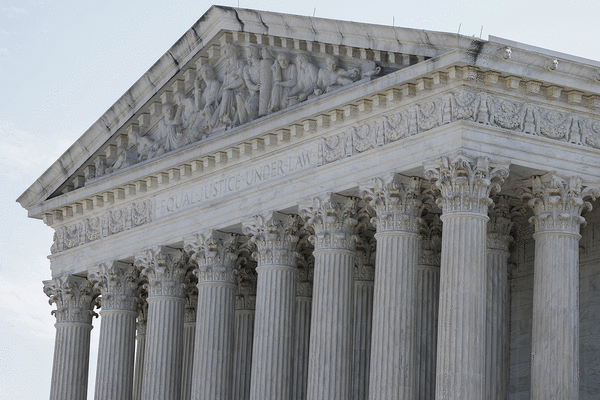
On Monday, a majority of the U.S. Supreme Court appeared poised to threaten voting by mail, as Washington and other states do it, during oral arguments in Watson v. Republican National Committee.
This troubling development comes at the same time the RNC, with President Donald Trump’s backing, is pressing Congress to pass the Safeguard American Voter Eligibility Act, which would suppress the votes of women, the elderly and the poor by requiring passports or birth certificates to register to vote.
Clearly, these are part of a multipronged approach to disrupt the nation’s electoral process.
The RNC, along with the Libertarian Party and some conservative Mississippi voters, want the court to overturn a lower-court ruling that allowed mail-in ballots in Mississippi to be counted after Election Day, as long as they are postmarked by, and received, within five business days.
They contend the state rule conflicts with federal statutes that established Election Day as the day for elections. There are 17 states and the District of Columbia that have similar grace periods, including Washington, whose grace period is 20 days after Election Day. Those states and D.C. filed an amicus brief in the case.
A ruling in favor of the plaintiffs would invite chaos in how elections are conducted nationwide. States and thus counties, many of which are already financially stretched, would have to change their processes to receive ballots on or before Election Day with no grace periods. In addition, they would incur unexpected costs to create education campaigns to inform voters of the changes.
“Our framers put elections in the hands of the state. The default is that states get to decide what policies are best for its voters,” said Leah Tulin, senior counsel at the Brennan Center, which also filed an amicus brief in the case.
A decision against Mississippi would also negatively impact military voters stationed outside of Washington, including overseas. The courts should consider the hardship for out-of-state voters and the cost and time it would take to make such a change as it forms its decision, which is expected in June or early July. Such considerations would follow the Purcell principle, the idea that the courts should not change voting or election rules too close to Election Day.
Should the RNC prevail, the obvious next challenge would likely be to early voting, which was mentioned during Monday’s arguments.
“It all comes down to what Election Day means,” said Tulin. “The logic of their theory absolutely calls into question early voting. If they adopt the plaintiff’s position I would hope they would try to address the early voting question” in their decision.
The Constitution gives the states the responsibility to conduct and regulate elections, though Congress has the right to alter those regulations. The process of voting in today’s world has changed since the 1700s, when there were fewer than 2 million people occupying the colonies — many of whom did not have the right to vote.
The court should consider how the nation has advanced when it comes to how, when and where we vote. Any disruption to the process would not constitute progress in voting but instead make it more difficult to conduct elections, and to vote.
_____
©2026 The Seattle Times. Visit seattletimes.com. Distributed by Tribune Content Agency, LLC.





















































Comments