Rubio as star witness in Rivera's Venezuelan-agent trial stirs up jury selection
Published in Political News
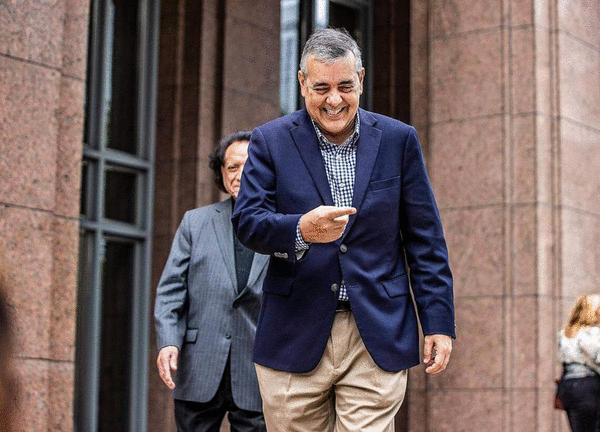
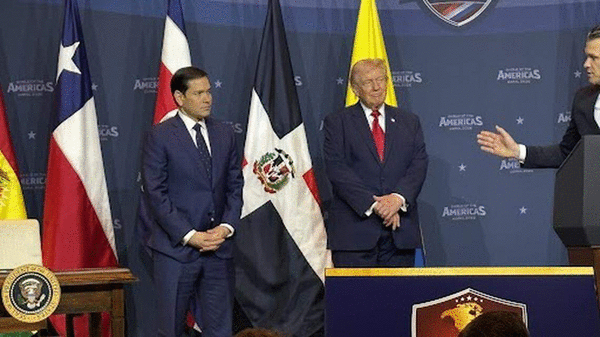
MIAMI — Secretary of State Marco Rubio is expected to appear on Tuesday as a central witness in the Miami federal trial of his longtime friend, David Rivera, a former Republican congressman who decades ago shared a house with Rubio in Tallahassee when both were members of the state Legislature.
Rivera, 60, and political consultant Esther Nuhfer, 51, are charged with acting as unregistered foreign agents for Venezuela’s government in 2017-18, when U.S. relations with the country frayed as the first Trump administration began imposing sanctions on its national oil company and several senior officials.
This week, the process of choosing a dozen impartial jurors for the defendants’ trial has been anything but routine because of Rubio’s role as a witness.
On Monday, one prospective juror said he knew Rubio from attending high school with him in Miami and couldn’t be “fair” because he cannot trust a word coming out of the former GOP senator’s mouth. The juror, identified only by a number, was dismissed for cause.
Then, on Tuesday, another prospective juror said she cannot believe anything Rubio says to be true, accusing him of committing “war crimes” and “violations of international law,” adding that she would have a hard time viewing him “as a man of integrity.” She was also excused for cause.
In another instance on Tuesday, Rivera’s defense team sought to remove the entire pool of prospective jurors after learning there were so few registered Republicans among the 100-plus candidates, but U.S. District Judge Melissa Damian rejected their bid. Jury selection resumes Wednesday.
Meanwhile, officials with the U.S. Marshals Service and Diplomatic Security Service examined the 10th floor courtroom of the James Lawrence King Federal Justice Building where the trial will unfold, starting Monday with opening statements. The Marshals Service, which is responsible for court security, and the DSS, which protects Rubio around the clock, are teaming up to ensure his safety when he testifies about his past interactions with Rivera and Nuhfer.
$50 million contract
Both defendants are accused of failing to register as foreign agents with the U.S. Attorney General in March 2017 when Rivera’s consulting company signed a $50 million contract with the Houston-based subsidiary of Venezuela’s national oil company, PDVSA, which operates as CITGO. The contract was ostensibly for promoting CITGO’s expansion in the United States, including resolving oil-drilling disputes with U.S. behemoth Exxon, whose holdings had been nationalized by Venezuela.
Both Rivera and Nuhfer counter that they were working directly for the U.S. subsidiary of Venezuela’s state-owned oil company, PDV USA —not for PDVSA itself — and therefore they didn’t have to register as foreign agents for the Venezuelan government. Rivera’s consulting firm received $20 million from PDV USA before the U.S. subsidiary ended the contract after a falling out in 2017, and Rivera shared that income with Nuhfer and two other associates.
However, federal prosecutors say a senior Venezuelan official close to President Nicolás Maduro arranged the highly profitable contract between Rivera’s consulting firm, Interamerican, and PDV USA as a cover so that Rivera, Nuhfer and others could be compensated for lobbying to gain political support for Venezuela to “normalize” relations with the United States.
As part of that scheme, prosecutors say, Rivera and Nuhfer sought to prevent sanctions against Maduro and other high-ranking officials.
Lobbied Rubio
In June 2017, Rivera, Nuhfer and others joined forces to lobby Rubio, then a Republican U.S. senator from Miami, and lawyer Kellyanne Conway, a White House advisor to then-President Donald Trump, according to an indictment. Rivera and Nuhfer were unable to meet with Conway, but they did arrange two meetings with Rubio.
In the first meeting, Rivera met with Rubio at a private residence in Washington. Rivera told Rubio that a wealthy Venezuelan businessman “had persuaded President Maduro to accept a deal whereby he would hold free and fair elections in Venezuela,” according to the indictment.
In the second meeting, held at a Washington hotel, Rivera, Nuhfer and the Venezuelan tycoon Raul Gorrin discussed “matters relating to Venezuela,” the indictment says. Also participating in the meeting by phone: Henry Ramos Allup, a Venezuelan politician opposed to Maduro.
By mid-July, however, Gorrin informed Rivera, Nuhfer and a Miami associate that “President Maduro had refused to agree to hold free and fair elections in Venezuela in exchange for reconciliation with the United States.”
According to the indictment, Rivera also collaborated with Gorrin to arrange a meeting between Texas Congressman Pete Sessions, a Republican, and Maduro in Caracas.
On April 2, 2018, the indictment says, Rivera, Gorrin and Sessions met with Maduro and other Venezuelan politicians to discuss normalizing relations between the United States and Venezuela. As part of the meeting, Sessions agreed to carry a letter with that proposal from Maduro to then-President Trump, who was serving in his first term, but their efforts were unsuccessful.
Defense, prosecutors each wanted Rubio to testify
Rubio’s testimony has been a source of fierce contention between the prosecutors and defense since Rivera and Nuhfer were charged in late 2022 with conspiring to defraud the U.S. government, failing to register as foreign agents for Venezuela’s government and money laundering.
At first, Assistant U.S. Attorney Harold Schimkat said he was going to call Rubio as a witness, but then he changed his mind — only to reverse course this year after the defense subpoenaed Rubio at the State Department.
Defense lawyers said they were seeking to call Rubio to show that Rivera and Nuhfer were not acting as unregistered agents for the Venezuelan government to normalize relations with Maduro’s regime, as the indictment alleges. Instead, they say, at the meetings with Rubio in 2017 and 2018, the defendants were trying to develop an exit strategy for Maduro so he could be replaced by an opposition leader in Venezuela who would be supported by the United States.
To that end, Rivera’s lawyers, Edward Shohat and David Weinstein, and Nuhfer’s attorneys, David O. Markus and Margot Moss, also wanted to call Venezuela’s former president, Maduro, after he had been seized by U.S. military forces in early January to face drug-trafficking charges in New York. But Maduro, through his lawyer, said he refused to be a witness for the defense, saying he would invoke his constitutional right to remain silent if he were compelled to testify.
In February, Damian, the presiding judge, said: “I think this issue is dead for now.”
Susie Wiles’ involvement
The defense team also wanted to call White House Chief of Staff Susie Wiles because she had been a lobbyist for the influential Tallahassee-based firm, Ballard Partners, in 2017-18 when it was representing Gorrin, who wanted to expand his Caracas TV station into the U.S. market.
But Damian, along with a magistrate judge, granted the prosecution’s request to quash the defense subpoena for her testimony.
Magistrate Judge Edwin Torres said “the Chief of Staff has become the second most powerful and important person in the operation of the Federal Government” and that requiring her to testify for two days “would disrupt Ms. Wiles’ work duties.”
In his order, Torres also called into question the value of her testimony, saying: “Defendants have not shown that Ms. Wiles has a direct connection to this case.” Damian, the federal judge, said she agreed with Torres’ analysis.
Besides Rubio, another key witness for the government is Miami real estate developer Hugo Perera, who came to know Rivera through Nuhfer and then introduced the former Miami-Dade congressman to Gorrin. Both Perera and Gorrin owned homes on exclusive Fisher Island.
In turn, Gorrin provided access to Maduro and another high-ranking official, Delcy Rodriguez, who prosecutors say ordered the U.S. subsidiary of Venezuela’s national oil company to hire Rivera’s consulting firm as a lobbyist in the United States. Rodriguez replaced Maduro as president of Venezuela after his ouster by the U.S. government.
Miami connections
Court documents in both the criminal case and a parallel civil lawsuit revealed that Rivera diverted more than half of his PDV USA income — $13 million — to three subcontractors in Miami who supposedly provided “international strategic consulting services” for the U.S. subsidary of Venezuela’s national oil company. The three recipients of the proceeds were Gorrin, Nuhfer and Perera.
On the eve of trial, Rivera’s defense team has accused Perera’s lawyers of collaborating with prosecutors to revise his initial statements to FBI agents in 2020 to shore up his testimony against the former U.S. representative. Rivera served in Congress between 2011 and 2013 after spending the previous decade as a state Legislature when Rubio was the House speaker between 2006 and 2008. During that period, Rivera and Rubio shared a home in Tallahassee.
Gorrin, who is not charged in Rivera’s case, was indicted by a Miami federal grand jury on foreign corruption and money laundering charges in 2018. He was also charged in another Miami money laundering case in 2024. In court papers, prosecutors describe Gorrin as a “fugitive.”
Gorrin does not appear on the witness list for either the prosecution or the defense in the Rivera-Nuhfer case.
©2026 Miami Herald. Visit at miamiherald.com. Distributed by Tribune Content Agency, LLC.

Comments