University of California president defends diplomacy, calling it the 'better course' amid Trump attacks
Published in Political News
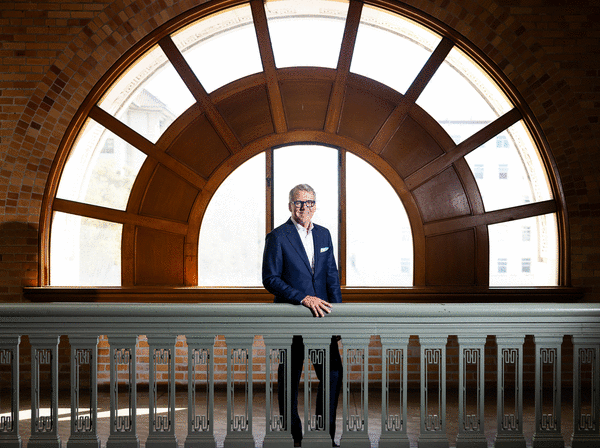
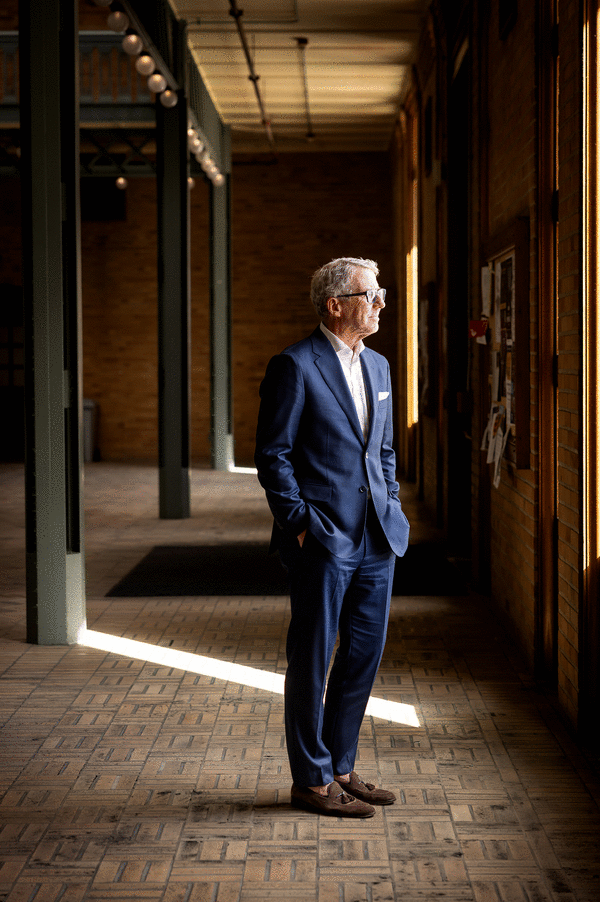
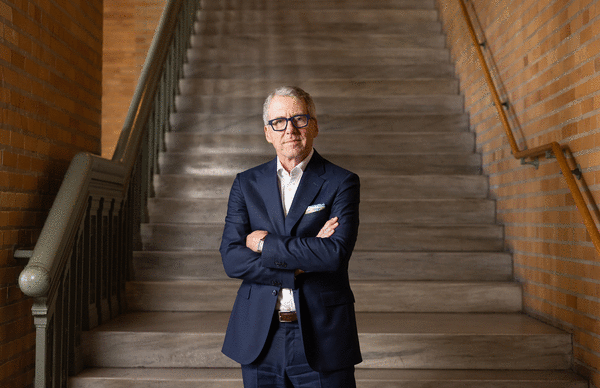


BERKELEY, Calif. — University of California President James B. Milliken, in his first extensive interview since taking the helm of the nation’s premier public higher education system, defended UC’s diplomatic approach to President Donald Trump’s fusillade of actions against the institution — contrasting it with the more aggressive fight Harvard is waging with the government.
UC has not repeatedly sued the federal government or publicly criticized Trump, while Harvard battles the administration in and outside court amid billions in White House funding freezes.
“We could have said, ‘We’re going to sue tomorrow.’ We saw that movie with Harvard,” Milliken said of his first seven months on the job dominated by federal attacks. “Harvard is still in negotiations to settle the federal government’s actions, but they have had a series of devastating enforcement actions taken ... Given our responsibility to the university and to the state of California, the better course for us was to engage.”
Yet days after the interview, the U.S. Department of Justice leveled another strike against UC in a lawsuit alleging UCLA “routinely ignored” and “failed to report” employee complaints of antisemitism since 2023.
In a statement after the interview, Milliken said UC has already committed to combating anti-Jewish hatred without court interference.
“Antisemitism has no place at UC and we have taken important actions to protect our Jewish students, faculty and staff ... We will always have work to do, and our commitment to our community is unwavering,” the statement said. “In light of this — and our oft-cited willingness to work with the government in good faith — the new lawsuit is unfortunate and, in our view, unnecessary.”
In a wide-ranging interview at UC Berkeley’s Grimes Engineering Center, Milliken, 68, offered his assessment of Trump’s actions to overhaul higher education and declined to say whether UC would pay an amount smaller than the $1.2-billion proposed fine over UCLA’s alleged campus antisemitism.
On federal talks, Milliken said UC would “never compromise” on its independence, governance, values and academic freedom.
He touted UC’s accomplishments despite the challenges: Four faculty members received Nobel prizes last year — the largest ever number from one institution — and UC secured more patents for inventions last year than any university in the world.
Aside from Trump, UC faces internal pressures: multiple campuses, including UCLA, are in deficit. Labor unions are demanding better job conditions. Members of the UAW 4811 academic workers union have authorized a potential strike.
Milliken spoke in favor of diversity, celebrated immigrants and said he wanted to expand student access to the university. He said UC should lead on artificial intelligence.
Milliken started in August after more than six years as chancellor of the University of Texas system. He previously held top roles at the City University of New York, the University of Nebraska and the University of North Carolina. A news and history buff and former Wall Street lawyer who prefers reading paper over pixels, he often cites his study of “The Gold and the Blue,” a two-volume chronicle of UC’s ascent in the 1950s and struggles during the political turmoil of 1960s written by former UC Berkeley Chancellor turned UC President Clark Kerr.
He said his job is “to do everything we can to demonstrate the value that’s delivered by these amazing places ... I don’t want to underestimate the difficulty in the current political environment,” but, he added, universities have been a national boon “over generations.”
Trump and higher education
Adjusting to the possibility of further retrenchment of Washington’s university research funding is among Milliken’s top concerns.
UC relies on$17.5 billion annually in federal monies, including research grants, Pell grants and hospital payments for Medicare and Medicaid. Last year, the government suspended$584 million in UCLA federal medical, science and energy research grants before a UC faculty-led lawsuit restored the money. But roughly $170 million in grants is still on hold systemwide.
Another independent faculty- and union-led federal suit has temporarily halted the$1.2-billion UCLA settlement demand seeking rightward ideological change on campus. But UC remains open to talks to quash federal probes on its own terms.
Milliken was vague on the status of negotiations and whether UC would pay a fine — such as the$200 million Columbia University signed off on last year — to settle federal investigations.
“It would be foolhardy of me to speculate on what ultimately might be proposed to the University of California or what we might find acceptable,” he said.
He declined to specify how he would uphold his promises to protect UC’s independence, governance, values and academic freedom.
“I’m not going to go into detail on those because it gets pretty close to the line of what could be a discussion with the federal government,” Milliken said.
Educational access
Milliken was more verbose on the role of higher education and his big-picture visions for UC.
College “helps make sure that we have an educated citizenry that is prepared to actively participate in a democracy that understands our civic traditions, that understands our political system, that understands how our economic system works,” Milliken said.
“Talent is universal,” he said, “but opportunity often isn’t.” Universities “match this talent with the opportunity.”
But federal moves have threatened to change access to education. The Trump administration has sued California’s public universities and community colleges for allowing undocumented immigrants to pay in-state tuition. A Trump travel ban on dozens of countries has stalled student and faculty applications from Asian, African and South American nations, while a $100,000 fee for new H-1B visas for highly skilled foreign hires could hurt university and hospital recruitment.
Milliken pledged to protect immigrants.
“I think we need to take a step back and recognize how fundamental the country’s embrace of people from around the world has been,” Milliken said. “It has been an enormous boon in terms of talent and culture and the kinds of things that make this country what it is today. I know people are worried, they’re anxious. In some cases, they’re afraid ... One of the things that our university presidents and chancellors think about every day is keeping these communities safe.”
Lifelong learning
UC — home to several of the most selective and prestigious campuses in the nation — continues to grow in size and popularity. The system set a record enrollment of about 301,000 students in 2025. And 252,000 high school and transfer students have submitted applications for the coming fall, another record high. Yet, vast numbers of academically qualified students do not get in, especially to UCLA and UC Berkeley.
Campuses, including UCLA, have upped professional certificate programs and extension school offerings in recent years. Milliken said universities should further embrace learning programs outside of the undergraduate experience. UCLA is developing a plan called“UCLA for Life” to reimagine the Westwood campus’ role for professionals.
“A four-year baccalaureate experience is not enough to prepare you for 40 years or 50 years of a career. You’re going to need to retool, going to need to re-skill. And I look at universities. Students ought to turn to their alma maters. There’s a relationship that you ought to have for life,” Milliken said.
The university’s future and evolution
Milliken wants UC to take on a lead role in AI.
“The continued adaptation of AI is inevitable, and there are good things and not so good things about that. But UC is the most important, impactful university in the world, and it should not be following others in developing what is the ethical and responsible,” Milliken said. “… We’re in a place where I think leadership, whether we wanted it or not, is a responsibility.”
More Californians should take stock of UC’s role outside of undergraduate education, he said.
“Two-thirds of our students are undergraduates. It’s a hugely important thing. But so is the research we do. So is the health care that we do across the state. So is the work we do at national laboratories which support incredible innovation and national security,” he said.
Milliken said he hoped the cuts to university research were a short-term “aberration.”
New research funding state bond bill
UC has put its weight behind a $23-billion bond proposal that will be on the November ballot to create a California Foundation for Science and Health Research, which would fund university and private institutions in ways similar to the National Institutes of Health.
If voters pass it, Milliken said the measure would “go an enormous way” toward making up for federal losses but that it was “impossible to speculate” on the extent as federal research funding, priorities and procedures fluctuate.
“I hope we never get to the question of whether California can replace federal funding,” he said. “Would I like to see it supplement, ensure that disruptions — even if shorter term — don’t derail the important science that’s going on here and the preparation of the next generation of scientists? Yes, I think that’s an incredibly worthwhile endeavor for the state.”
©2026 Los Angeles Times. Visit at latimes.com. Distributed by Tribune Content Agency, LLC.




















Comments