Editorial: Congress must act on air safety
Published in Political News
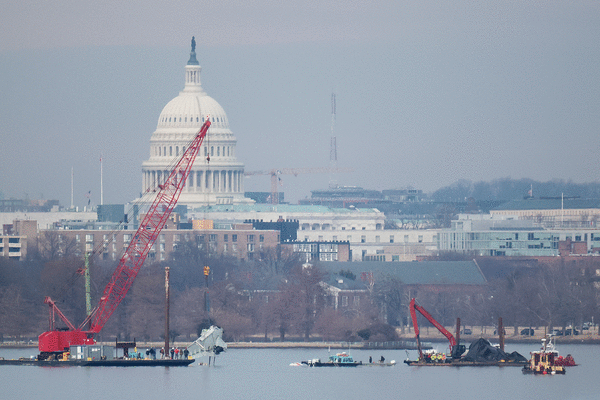
One of the great conveniences of living in Central Maryland is the abundance of air travel options. We may not be home to a top-10 airport, but, collectively, BWI Marshall, Dulles International and Ronald Reagan National average more than 900 departures per day, or roughly the same as Hartsfield-Jackson Atlanta International, the nation’s second busiest.
So the horrifying mid-air collision over the Potomac River one year ago, when an American Airlines passenger jet struck a U.S. Army Black Hawk helicopter on the threshold of a National Airport runway, required a prompt response from the federal government to ensure so many civilian and military aircraft could share airspace safely.
Thus far, that effort is falling woefully short.
Last week, the U.S. House of Representatives failed to pass an air safety bill known as the Rotor Act by a needed two-thirds majority to fast-track it. The bill had been approved unanimously by the U.S. Senate in December and was strongly backed by the families of the 67 people who died in the crash — some of whom were in the gallery as 132 GOP lawmakers abruptly abandoned the bill, which continues to be championed by Republican U.S. Sen. Ted Cruz and others.
The obstacle? Last-minute objections from Pentagon officials who claim that requiring most military aircraft to use tracking technology would be costly and carry “operational security risks” that might undermine national security.
At the heart of the debate is ADS-B surveillance technology and whether there are circumstances when Pentagon helicopters should not be required to broadcast their locations to domestic carriers. Apparently, requiring such technology by 2031 — for the purpose of allowing military aircraft to be properly tracked — is now perceived as too burdensome.
Does that mean an “on-off” switch is beyond the military’s capabilities?
We certainly don’t claim to be experts on transportation infrastructure, but we can add to 67. That’s the number of people who died in that Jan. 29, 2025, collision over the Potomac River, which has given the U.S. Department of Defense a full year to propose safety reforms. The Black Hawk couldn’t be seen by the American Airlines pilot, and mandating tracking technology in this busy airspace hardly seems too great a burden. Or could it be that civilian safety isn’t the highest of priorities with DOD?
Some GOP leaders claim an alternative measure, the ALERT Act, which wouldn’t require tracking technology on every military aircraft, would offer a more sensible solution. We are all ears, but the clock is ticking.
There is no doubt about what caused that terrible crash. The National Transportation Safety Board pointed a finger at a lack of tracking technology and poor coordination between military and civilian flights in the region’s crowded airspace. Why must a solution be so elusive and delayed?
Perhaps members of Congress could simply be reminded that they occupy this same patch of airspace when they head back to their home states and districts. This is not rocket science. Let’s make public safety a higher priority or, as Sen. Cruz told reporters after the failed vote, “keep pressing” until President Donald Trump signs it into law.
_____
©2026 The Baltimore Sun. Visit at baltimoresun.com. Distributed by Tribune Content Agency, LLC.



















































Comments