California State objects to some new community college degrees, igniting debate over who can teach what
Published in Political News


Constance Duffle, a paramedic in Siskiyou County at the Oregon border, serves a vast wilderness region woefully in need of health professionals. She has enrolled in a bachelor's degree program in paramedicine, newly offered at College of the Siskiyous.
A degree offers pathways to a raise, improved service to her community and opportunities to train future paramedics. Without this close-to-home education, there would be "no way" she could work a full-time job and care for her children, Duffle said.
"I went through medic school before I was married, before I had kids," Duffle said. If the program had been available to her then, she would have pursued it "in a heartbeat."
Duffle's experience is a promising story in the state's five-year-old higher education venture that has allowed community colleges to offer bachelor's degrees. But as the degree programs have grown in popularity, disagreements continue to emerge between California State University and California Community Colleges as competition for students tightens.
In the latest stress point, CSU has objected to 16 community college degree proposals, contending that they run counter to state law provisions designed to protect its own university degree offerings. Community college officials disagree and say their programs are uniquely designed to serve the needs of their district, as intended by the law.
The tensions have brought into focus the changing role of community colleges since the adoption of California's 1960 Master Plan for Higher Education. The vaunted plan laid out three distinct public systems, with local community colleges primarily offering two-year associate's degrees and serving as transfer launching pads to CSU and the University of California.
Today, however, community colleges are moving to fill local career training needs — and a bachelor's degree typically provides students with better opportunities in their job markets, officials say. In recent years, state lawmakers have largely supported these goals and have created opportunities to broaden the mission of community colleges.
In an effort to bring accessible and lower-cost bachelor's degree programs to more students, a 2021 Assembly bill allowed all 116 community colleges to offer bachelor's degrees to address "unmet workforce needs" in the districts they serve. The law expanded a 2014-approved pilot program, that allowed the California Community College Chancellor's Office to develop bachelor's degrees on 15 campuses.
But both laws contain an important caveat: UC and CSU officials can object to any proposed degree that is "duplicative" of their offerings. Once an objection is raised, the program must be modified or dropped by the California Community Colleges chancellor's office until the sides reach an agreement.
To date, 54 bachelor's programs have been approved at 44 community colleges, including industrial automation at Bakersfield College, biomanufacturing at Moorpark College and healthcare information management at Shasta College.
Statewide, 1,375 community college students are enrolled in community college bachelor's programs — a small fraction of the 2.2 million total California community college students, said James Todd, the vice chancellor for academic affairs in the California Community Colleges chancellor's office.
Since 2023, the CSU has objected to 16 other proposed bachelor's programs, saying the programs are duplicative, effectively putting them on hold.
Community college officials say they are following the law. They contend that their programs uniquely serve job demands in their districts. Also, students who want to pursue a bachelor's degree at a local community college generally do not have the financial means or social mobility to attend a similar CSU program.
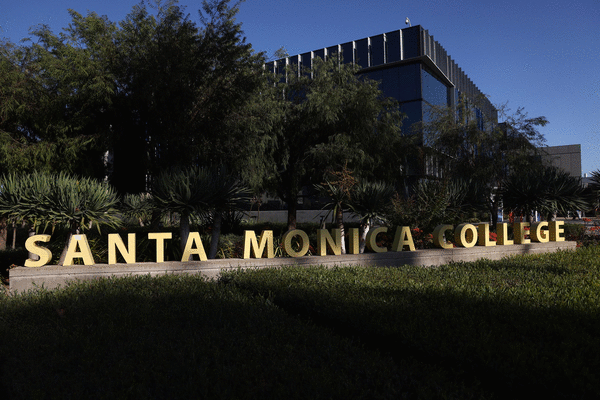
The community colleges have proposed degrees in essential industries: field ironworker supervision at Cerritos College, modern police science at Porterville College, digital infrastructure at Santiago Canyon College and cloud computing at Santa Monica College.
"Community college baccalaureate programs open the door to affordable, high-quality bachelor's degrees," Todd said. "For students, this access often determines whether advancement is possible at all."
An outside opinion muddles the debate
In the hopes of reaching agreements on the 16 disputed majors, California Community Colleges contracted WestEd, a nonpartisan education research agency, as a neutral third party to review the proposals.
Their report — much like the California Community Colleges arguments — said that some of the programs, although similar, were not duplicative, adding that community college bachelor's degrees could fulfill hyper-local workforce needs that the CSU could not. It also highlighted the rising costs in the state, which could force students to pay at least three times more in tuition per semester if they attend the CSU over a community college.
However, CSU officials involved with the review process said the WestEd study considered factors beyond the scope of the law, such as student distance from a CSU campus.
"WestEd evaluations included more data and information than just duplication. … They brought other information that is not in the legislation," said Nathan Evans, vice chancellor for academic affairs at the CSU office of the chancellor.
All three higher education systems agree that deciding what constitutes duplication is at the heart of their disagreement, Evans said.
"Our system and our campuses are trying to work within the law that's written today," Evans said.
Until the disputed programs are modified by the individual community colleges and brought back for review by the CSU and UC, they will remain in limbo.
For example, six CSU campuses — San José State, Sacramento State and Cal State L.A. — have objected to the proposed cloud computing bachelor's program at Santa Monica College.
Jason Beardsley, Santa Monica's vice president of academic affairs, said CSU has taken issue with lower division level classes that are similar to CSU courses.
He said Santa Monica must offer these fundamental courses to prepare its students for the highly specialized, experiential training, adding that feedback from CSU has not been "constructive," and it has left the proposed program without any feasible direction.
"They're just in a different lane from ours," Beardsley said.
One community's need
Feather River College in rural Plumas County has awarded 99 bachelor's degrees for its Ecosystem Restoration and Applied Fire Management Program. Todd, of the community college chancellor's office, said that without this program, students and the surrounding environment would continue to experience workforce shortages.
"These are not abstract programs; rather, they are workforce practitioner-centered degrees that respond to real needs in local communities," Todd said in a statement. "The nearest public university is CSU Chico, more than 80 miles away. … For many students in that region, pursuing a bachelor's degree elsewhere simply is not feasible."
The conversations between the systems over duplication are usually cordial and collaborative, but he, too, sees the need for fine-tuning the law to ease decision-making.
Some lawmakers have been trying to craft legislation focused solely on workforce demands in an individual community college district.
Assembly Bill 664, which passed 69-1 on the Assembly floor last month and will head to the Senate, seeks to establish bachelor's degrees at Southwestern College to help fulfill workforce gaps in the area.
Lawmakers are also rallying around an effort by Assemblymember David A. Alvarez (D-San Diego) to change some of the policy points laid out in the Master Plan for Higher Education more than 60 years ago, which he said are antiquated.
"I represent a region in California which, on paper, appears to be well served, but the reality is quite different," Alvarez said. "There's a demand, and there's an impact that occurs because [San Diego State and UC San Diego] aren't growing."
As chair of the education finance budget subcommittee, Alvarez said that he and other lawmakers have realized community colleges can no longer be restricted to primarily serving as pathways to CSU and UC. They must also be free to address local workforce needs — a change he said many students are desperate for.
The Master Plan for Higher Education has evolved before, Alvarez said. In 2005, Gov. Arnold Schwarzenegger signed legislation authorizing CSU to offer its first doctorate degrees.
"In my opinion, the time has come to no longer just try and cobble together programs here and there just to get by," Alvarez said. "We should look at opening up the doors of higher education in any which way we can."
©2026 Los Angeles Times. Visit at latimes.com. Distributed by Tribune Content Agency, LLC.




























Comments