1 year in, Hispanic voters in Central Florida are conflicted on Trump
Published in Political News
ORLANDO, Fla. — President Donald Trump entered office last January thanks in part to a wave of Hispanic voters, enough in one solidly-Democratic Central Florida County to turn it GOP red. But the tide may be changing.
A year into his presidency, the driving factor for many Hispanics — Trump’s campaign promise to improve the economy — is not fulfilled. Immigration raids across the country have also sparked fear in many Hispanic communities, even among those who are U.S. citizens.
“Mess around and find out,” said Ediberto Roman, a law professor at Florida International University who predicted before the 2024 election that Trump’s mass deportation plans would result in “a reign of terror” for anyone “existing while brown.”
“People think, ‘We’re not them, this is about the other [Hispanics],'” Roman said. “But it’s time for the Latino and Latina communities to wake up. It’s about all of us.”
About 70% of Latinos disapprove of the way Trump is handling his job as president, while 65% disapprove of the administration’s approach to immigration and 61% say Trump’s policies have made economic conditions worse, according to recent polling from the Pew Research Center.
Trump’s approval among his own Latino voters remains positive, but it has declined since he took office. Any erosion of support could play a major role in November’s midterm elections.
Erin Huntley, GOP chair of Orange County, said she believes Trump’s support will hold, as Republicans focus on the values that Hispanic communities align with most: faith and affordability.
“Republicans are talking about ways to cut government spending and cut taxes,” Huntley said. “Right now all the proposals coming from the Democrats side are, ‘We want to tax you more.'”
In 2024, Osceola County — where less than 28% of voters are registered Republicans and the majority of the population identifies as Hispanic — narrowly voted for Trump, flipping from 2020’s double-digit victory for Democrat Joe Biden there.
While Republicans hail the shift in Hispanic voters as a lasting realignment, Samuel Vilchez Santiago, a Venezuelan American and the Orange County Democratic chair, argued that’s not the case.
As he runs for the state House, Vilchez Santiago says Hispanics have told him they voted for Trump because they wanted change in the country. But now they’re worried his priorities are not what they expected.
“They are creating an environment of fear across communities that honestly feels very racially-targeted,” Vilchez Santiago said. “There’s a lot of mixed-status families here in Florida …and a lot of people, including those that voted for Trump, are seeing their families or those close to them directly impacted by the mass deportations.”
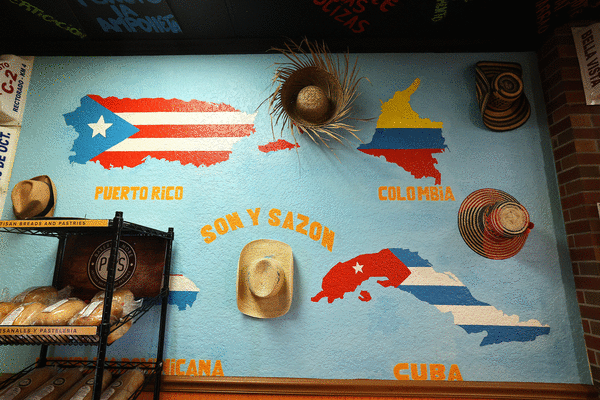
Puerto Ricans, Cubans and Venezuelans are three key Hispanic demographics who have had very different experiences amid Trump’s immigration crackdown, as the three groups’ immigration status varies widely.
Puerto Ricans have enjoyed U.S. citizenship since 1917, while Cubans — once embraced for fleeing communism — became the largest GOP supporters among Hispanics. But Venezuelans are one of the newest major demographics, with many having fled Nicolas Maduro’s regime in recent years.
For Puerto Ricans, immigration is “not really a concern,” said Fernando Rivera, the director of the Puerto Rico Research Hub at the University of Central Florida. Most who voted for Trump did so for his stated economic agenda, he said.
“I think it shows how good the Republican messaging is,” Rivera said. “But if things don’t improve soon that support is going to go away.”
Annette Perez, a Kissimmee finance worker originally from Puerto Rico, voted for Trump in 2024 because of his friendly rhetoric towards business owners. While she says the economy is not doing well, she’s optimistic about the ultimate impact of Trump’s tariffs.
“Prices in the grocery store being so high is worrisome … but I’m confident it will eventually get better,” Perez said in Spanish. “We are going to see things get worse before they get better.”
Ramon Diaz, a Puerto Rican pastor in Kissimmee, voted for Trump in 2024 because he “is not a politician but a businessman.”
“He’s managing the presidency like a business and trying to get the economy out of the hole it is in,” Diaz said in Spanish.
Church members “tell me, ‘Pastor the prices keep going up, but my wages do not,'” Diaz said. “I see that people are not going out to eat as much because they have to save money, and this will continue to happen. But it will pass.”
Both said only undocumented immigrants who have criminal records should be deported — a policy not followed by the administration. Those without criminal records have become the majority among those detained, according to The Guardian.
“A lot of people focus on the bad things, like immigration, but they don’t understand the good he’s doing with the economy,” Perez said. “I’m a citizen, so immigration doesn’t impact me.”
Mary Vega, also from Puerto Rico and who works at a credit repair company in Kissimmee, agreed.
“I don’t feel at risk,” said Vega.
Venezuelans, meanwhile, long saw appeal in Republican ideology as refugees from a socialist regime but have since become targets of the Trump administration, which revoked temporary protection status for thousands in Florida.
At the same time, the midnight capture of Venezuelan President Nicolas Maduro earlier this month sparked mixed emotions in the community.
At a gathering in Orlando one day after Maduro’s capture, Diego Oliva, a Venezuelan American Valencia College student, applauded Trump’s action but stopped short of saying he would vote Republican.
“I thank God that he allowed the end of the regime and he manifested it by using President Trump like an instrument for his glory,” Oliva said in Spanish. “I’m very thankful to Trump.”
But Maria Puerta-Riera, a Valencia College politics professor from Venezuela, says the Venezuelan community is not likely to vote for the GOP amid the immigration crackdown just because of Maduro’s removal.
“Many of them are going to vote [Democratic], not because they like the Democratic Party but because they see it as a way to punish the Republican Party,” Puerta-Riera said.
Puerta-Riera said despite their small voting power, Venezuelans may be able to influence a shift among other Hispanic voters.
“We are like a proxy vote for the rest of the Hispanic community,” Puerta-Riera said. “We are putting pressure on some voters, especially Cuban American voters.”
Cubans, once the immigrant backbone of the GOP in Florida, previously enjoyed more protections from deportations than any other Hispanic group. But under Trump, just over 1,600 Cubans were deported in 2025, the New York Times reported, more than during the three previous administrations.
Miami’s historic vote for Eileen Higgins, its first Democratic mayor in 30 years, highlights what could be a major political shift. She beat Trump-backed Emilio Gonzalez in the Hispanic-majority city.
Gilbert Lima, 49, a Cuban American from Miami visiting a friend in Kissimmee, said he voted for both Kamala Harris in 2024 and for Higgins. Still, he said he understands why many Latinos voted for Trump, adding the instability in the economy right now doesn’t scare them.
“For better or worse, Latinos are used to hiccups in the economy or things going awry,” Lima said. “You just figure things out, as opposed to people that are more Americanized who tend to freak out more.”
But Lima said Cubans who voted for Trump should not be “surprised” by how he’s handled immigrants, stripping many of their status.
“He was going to [find] a loophole, ‘Well, you came here legally [but] you’re now a criminal,'” Lima said. “Anyone who can put two and two together saw that coming from a mile away.”
©2026 Orlando Sentinel. Visit orlandosentinel.com. Distributed by Tribune Content Agency, LLC.

































Comments