Supreme Court sounds ready to back transgender athlete bans
Published in Political News
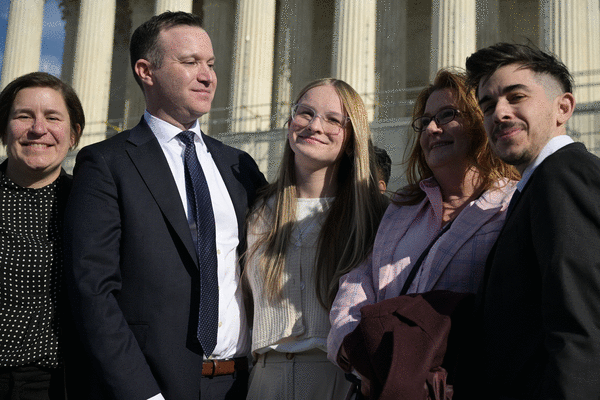
WASHINGTON — The Supreme Court’s conservative majority sounded ready to uphold bans on transgender girls competing in girls’ sports, during oral arguments Tuesday in challenges to state laws in Idaho and West Virginia.
Across more than three hours of arguments in the two cases, the justices probed arguments from the states, the Trump administration and athletes over the legality and constitutionality of those laws and similar statutes in more than two dozen states nationwide.
The lawyers for two athletes challenging the laws argued they violate Title IX of the Civil Rights Act, which states no one should be discriminated against in education programs “on the basis of sex,” as well as the Equal Protection clause of the 14th Amendment to the Constitution.
Some justices also expressed caution about how a decision in these cases could ripple through the legal landscape of transgender rights.
Chief Justice John G. Roberts Jr., who previously voted in a separate case in favor of finding workplace discrimination protections for transgender individuals, said that finding in favor of the athletes in the two cases “would apply across an entire range of things” and “not simply to the area of athletics.”
Roberts and other members of the court’s conservative majority frequently brought up whether ruling in favor of the athletes would allow cisgender boys to try out for girls’ teams if they did not make a boys’ team or endanger rules that keep locker rooms separate.
The Trump administration, which has sought to enforce a nationwide ban on transgender girls participating in girls’ scholastic sports, participated in the arguments and asked for the justices to uphold the state laws.
Hashim M. Mooppan, arguing for the DOJ, said the Constitution and Title IX both support dividing sports teams based on sex assigned at birth rather than gender identity.
“The regs expressly authorize sex-separated teams. The other side isn’t challenging those regs. When those regs use the word sex they obviously use the word sex to mean biological, sex in the reproductive biology sense,” Mooppan said.
Justice Brett M. Kavanaugh pointed out that in some cases school sports are zero sum — team rosters, college scholarships and the like are limited — and some girls may miss out if transgender girls participate.
“I think we can’t sweep that aside,” Kavanaugh said.
Kavanaugh also questioned “why would we at this point jump in and try to constitutionalize a rule for the whole country” if there is still disagreement between states and experts about where to draw the line on participation of transgender girls in sports.
Kathleen R. Hartnett, attorney for the Idaho athlete, argued that the statute keyed off of not just the definition of sex, but biological advantage of boys over girls that was mitigated by her client undergoing gender-affirming treatment.
“That’s why we are here, not proposing a rule of absolute inclusion, but saying that, in the case with people like our client who have mitigated their exclusion, that doesn’t match the statutory interest,” Hartnett said.
At the same time the justices indicated they may not delve into broader issues surrounding sex discrimination. Justice Amy Coney Barrett, during a discussion about what upholding the state bans would mean for sex-separated classrooms, said the court may avoid questions of what it means for men and women to be “similarly situated” in discrimination law.
“I think it opens a huge can of worms that maybe we don’t need to get into here,” Barrett said.
The justices also questioned whether they could rule on the legality of the laws in West Virginia and other states without impacting the state laws that do allow transgender girls to compete. Both sides said the justices could do so.
The court’s Democratic appointees questioned what a ruling in favor of the states would mean for transgender Americans. Justice Sonia Sotomayor challenged an argument from the Trump administration that transgender athletes made up too small a portion of the population to challenge a mostly lawful divide in sports.
“What is percentage enough? There are 2.8 million transgender people in the United States. That’s an awfully big figure,” Sotomayor said. “The numbers don’t talk about the human beings.”
Mooppan acknowledged that the administration has argued in lower courts that Title IX prohibits transgender girls from participating in girls’ sports, but he asked the justices not to reach that issue in the two cases argued Tuesday.
Republicans in Congress have sought to legislate a nationwide ban, and Speaker Mike Johnson, R-La., said as much in a speech outside the court Tuesday encouraging the justices to uphold the state laws.
“House Republicans will always stand for American women and girls and we hope and pray that this Supreme Court will do exactly the same,” Johnson said.
The cases are Bradley Little, in his official capacity as Governor of the State of Idaho, et al. v. Lindsay Hecox, et al. and West Virginia, et al. v. B.P.J.
_____
©2026 CQ-Roll Call, Inc., All Rights Reserved. Visit cqrollcall.com. Distributed by Tribune Content Agency, LLC.
















































Comments