Editorial: Trump's broadband moves save billions
Published in Political News
Even government programs can get strangled by red tape.
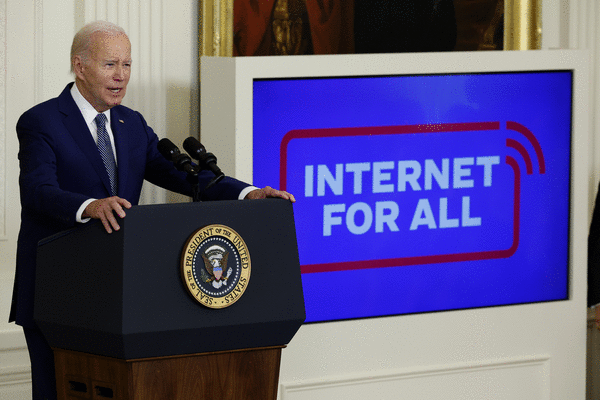
Think back to 2021. That’s when President Joe Biden signed the Infrastructure Investment and Jobs Act. It directed more than $1 trillion toward transportation and infrastructure projects. That included more than $42 billion to expand broadband internet.
“Access to high-speed internet is essential,” Biden said in November 2021 when he signed the bill. He continued, “This law is going to make high-speed internet affordable and available everywhere.”
But as is so common with these types of government programs, progress was virtually nonexistent. As of the summer of 2024, that $42 billion hadn’t connected a single home to high-speed internet. Blame a number of factors.
One, the Biden administration prioritized fiber projects. They take longer than expanding access with satellite or wireless internet providers. Two, the Biden administration imposed a host of hoops that slowed down the process and drove up the cost.
“States receiving funds had to consult with unions, Native American tribes and ‘local community organizations’ on their plans to expand broadband,” The Wall Street Journal noted.
Further, the Biden team demanded that broadband companies prioritize the hiring of a litany of supposedly underrepresented groups, including prisoners, racial minorities and LGBTQI+ individuals.
One might think that the most important characteristic for those seeking to undertake this endeavor would be their ability to do the job. Not so among the country’s intersectionality-obsessed leftists.
Absent government mandates, competition forces private companies to prioritize merit. But government doesn’t face that pressure. Fortunately, the Trump administration has taken a different approach. Assistant Commerce Secretary Arielle Roth trashed most of the Biden administration’s requirements and focused on projects with private companies making larger capital investments. This deregulation effort is projected to save taxpayers $21 billion, she said recently.
In some cases, the savings have been dramatic. Under the Biden administration’s rules, Louisiana’s most costly project ran $120,000 per new connection. The Trump administration’s streamlined efforts dropped that cost to under $8,000. Overall, the average cost of a new connection in Louisiana went from $5,245 to $3,943.
The government never should have subsidized broadband access. Private companies — motivated by profit — were already expanding coverage. But kudos to the Trump administration for ensuring taxpayer money is being spent far more efficiently.
_____
©2026 Las Vegas Review-Journal. Visit reviewjournal.com.. Distributed by Tribune Content Agency, LLC.





















































Comments