Trump's tirade puts San Diego Somali community on edge. 'We are not garbage. We are neighbors.'
Published in Political News
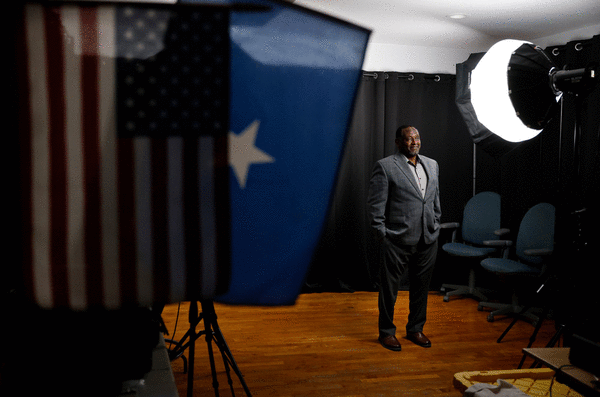
It was the words of President Donald Trump, spoken 2,300 miles away, that prompted Mikaiil Hussein — a U.S. citizen who first came as a refugee from Somalia over 30 years ago — to take steps to protect himself.
The labor leader said that he now carries his U.S. passport card with him wherever he goes, in case he is stopped by federal immigration agents. He encourages other Somalis in San Diego to do the same.
“It’s unfortunate,” said Hussein, who is president of the United Taxi Workers of San Diego. “Right now, we have to tell our children, ‘Be vigilant,’ and those who are adults, we tell them to take your passport card at least.”
Somalis in San Diego have been on edge since earlier this month, when Trump called people from the East African nation “garbage” and said repeatedly during a Cabinet meeting that he did not want Somalis in the United States. He used the same word when talking about Somali-born Rep. Ilhan Omar, a Minnesota Democrat.
The Dec. 2 comments were made as news reports emerged of a U.S. Immigration and Customs Enforcement operation planned in the Minneapolis-St. Paul area, which has the largest Somali population in the country.
Trump continued to criticize Minnesota officials and Somalis the following day, saying, “They’ve destroyed our country, and all they do is complain.”
When asked for comment about community concerns after the president’s remarks, White House spokesperson Abigail Jackson said in a statement to the Union-Tribune: “President Trump is right. Aliens who come to our country, complain about how much they hate America, fail to contribute to our economy, and refuse to assimilate into our society should not be here.”
Trump’s rhetoric struck a chord with residents of City Heights, one of San Diego’s most diverse communities and home to one of the country’s largest Somali communities. Local Somali leaders estimate that around 15,000 people of Somali descent reside in San Diego.
Said Abiyow, a Somali community leader in San Diego, said that fear and confusion are already widespread in the local immigrant community due to the Trump administration’s policies. But recently his nonprofit organization, Somali Bantu Association of America, has been receiving 60 to 70 calls per day, he said. There is not enough staff to adequately respond to them.
“There’s a lot of demand right now,” he said.
Somali asylum seekers and naturalized U.S. citizens alike want to make sense of the ever-changing immigration policies, and, more urgently, if they might be specifically targeted.
“They’re asking, ‘What happened? What are we going to do? What happened to us?’” Abiyow said.
Somalia is one of the countries included in the Trump administration’s now-extended list of travel bans, with partial or, in the case of Somalia, full restrictions. In his June proclamation, Trump argued that there is a “terrorist threat” coming from Somalia, as well as that the Somali government refuses to accept its removable nationals back.
Earlier this month, The New York Times reported on the administration’s plan to conduct operations targeting Somali immigrants with no permanent legal status in the Twin Cities area. News outlets have been documenting the surge of ICE agents to the area, as well as clashes with local advocates supporting the Somali community there.
There have been no reports or indications of similar actions in San Diego. But uncertainty lingers.
Department of Homeland Security Assistant Secretary Tricia McLaughlin said in a statement when asked for clarification about operations targeting the Somali community in the Twin Cities area: “Every day, ICE enforces the laws of the nation across the country. What makes someone a target of ICE is not their race or ethnicity, but the fact that they are in the country illegally.”
‘Stand with us’
On Dec. 7, days after Trump’s string of insults directed at Somalis, a group of activists gathered in front of the City Heights Library to show their solidarity with the Somali community. “Stop the hate. Somalis are welcome in City Heights,” read one sign.
“An attack on the Somali community is an attack on all of us,” said Damaris González, an advocate with the City Heights Defense Committee, which organized the community rally.
“We share the same streets, we share the same schools, and we share the same future. We will not stand by while our neighbors are threatened,” she added.
Abiyow took the megaphone and called on those present to show their support.
“Step up, stand with us,” said Abiyow, who founded the Bantu Association nearly 20 years ago to assist local refugee families.
“Remember, we are neighbors,” he said. “We are your co-workers, we are San Diegans and we are Americans.”
Chants of “You are not alone!” erupted from those present.
Abiyow also touched on the community’s contributions. “Here in San Diego, Somalis work in government, health care, retail, child care, transportation, small business and other work fields,” he said. “We pay taxes like everyone.”
San Diego Councilmember Sean Elo-Rivera, who represents City Heights, posted a message of solidarity.
“Over the past couple of weeks, Donald Trump has repeatedly attacked the Somali community,” the letter reads in part. “It’s not the first time, but it has been the worst example yet.
“To the Somali community: thank you for all you’ve done and continue to do. I could not be more proud to be in community with you and to call so many of you my friends,” he added.
Finding refuge in San Diego
Many Somalis arrived in California as refugees when civil war erupted in their home country in the early 1990s. Some families later moved elsewhere.
Hussein first settled in Orange County. He recalled arriving in the U.S. with only his immigration documents. He found a job as a machine operator and later became a U.S. citizen.
Hussein later moved to San Diego, where he started working as a taxi driver. An advocate for workers’ rights, he became the leader of the local taxi drivers union and now represents hundreds of drivers.
“We are contributing … in so many ways,” he said about the Somali community. “We are not immigrants who came in yesterday.”
Abiyow lost nine siblings in the civil war. He eventually arrived in the United States as a refugee and moved to San Diego in 2009 to start the nonprofit organization. He is also a U.S. citizen.
Standing next to the Somali and American flags during the rally, Abiyow said that the statements coming from the White House affect “our safety, our confidence, and our sense of belonging.”
“We are hardworking people, family-centered, respectful and good, moral people,” he said. “We are not garbage. We are neighbors.”
City Heights resident Ahmed Malinomar, a community organizer who came to the United States as a refugee from Somalia at age 13, said his children, who are all U.S. citizens, have asked him why Somalis were called that.
“It’s sad,” he said. “That’s not the American value.”
Malinomar, who became a community organizer and works as a project manager for the taxi union, said those words have created fear.
He said that every group has “bad and good,” but that shouldn’t lead to the generalization of an entire community.
Malinomar first arrived in City Heights with his mother in 1993 as a young boy who did not speak English. At the time, there were about 10 Somali families in the neighborhood, he recalled. Since then, he has seen many others come and go.
Growing up in City Heights, he helped other refugee families, whether at school, with doctor’s appointments or filling out paperwork. He remembered that his family needed help when they first arrived, too.
“City Heights is a place where you can find all cultures and all walks of life,” he said. “If you go and look at every house and they close their door, a different language other than English is spoken.”
That sense of community is present every week at the food distribution program organized by the Somali Bantu Association of America.
Abiyow’s brother, Kusanje, runs the program, which provides hundreds of meals each week in City Heights.
From early in the morning, people sort food and diapers into boxes, and others hand them out to people standing in line. A diverse group of people from all backgrounds comes together for the effort. A Haitian woman who picked up her box recently said in Spanish she was grateful for the food, especially “during these times.”
Ken Lavigna from Tierrasanta is one of the volunteers. He was driving by one day and saw the line that forms every Thursday. He stopped to ask if they needed a hand. Volunteering has allowed him to connect with the Somali community. Lavigna referred to Trump’s comments as “very ignorant.”
In addition to the food distribution program, the organization also provides to the community legal services, employment, youth mentoring and women empowerment, among other programs.
_____
©2025 The San Diego Union-Tribune. Visit sandiegouniontribune.com. Distributed by Tribune Content Agency, LLC.




Comments