Commentary: Let's end felony disenfranchisement. Virginia may lead the way
Published in Op Eds
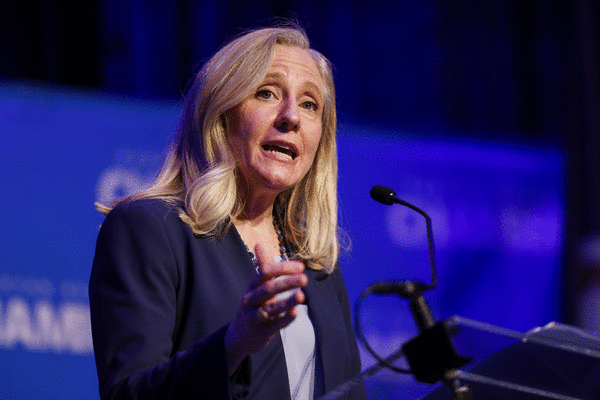
When Virginia’s Governor-Elect, Abigail Spanberger, takes office next month, she will have the chance to make good on her promise to do something about her state’s outdated system of felony disenfranchisement. Virginia is one of just three states where only the governor has the power to restore voting rights to felons who have completed their prison terms.
It is the only state that also permanently strips a person’s rights to be a public notary or run for public office for a felony conviction unless the governor restores them.
Spanberger’s predecessor, Republican Glenn Youngkin, did everything in his power to make it very difficult for any felon to get their voting rights restored. During her campaign, Spanberger said that she would follow the examples of the governors of Iowa and Kentucky, who, as NPR reports, “Have signed orders to make the process automatic for most people with felony convictions.”
That is a step in the right direction, but it does not go far enough.
Executive action can be undone by Spanberger’s successor, just as Youngkin reversed the effort of his predecessor to ease the path for ex-felons to vote. Additionally, a pending federal lawsuit seeks to have the state’s felony disenfranchisement law invalidated for violating one of the provisions of the post-Civil War Virginia Readmission Act of 1870, which prohibited disenfranchising voters.
Beyond what Spanberger can do and whatever happens with the lawsuit, Virginia should amend its constitution to end felony disenfranchisement. That process is already underway, but in the meantime, efforts should be made to end the practice nationwide.
Doing so would require removing or circumventing a provision in the Fourteenth Amendment to the United States Constitution. That provision allows states to abridge voting rights "for participation in rebellion, or other crime."
In 1965, when Congress passed the Voting Rights Act, it enacted a nationwide ban on poll taxes or the use of literacy tests as voting qualifications. But it did nothing about felony disenfranchisement.
Some advocacy groups think that Congress could address this issue by enacting legislation, while others believe it would require a formal constitutional amendment. Whatever route is taken, the decision on whether felons should lose their right to vote should not be left to states like Virginia to decide.
Today, the voting rights of ex-felons depend on where they live. In Maine, Vermont, and the District of Columbia, felons can vote even while they are incarcerated. In 23 states, the voting rights of felons are automatically restored when they finish their prison terms.
In other states, felons lose their voting rights while on parole and/or probation, but these rights are restored once the parole and/or probation processes are completed. In addition, they may also have to pay outstanding fines, fees, or restitution before they can vote.
In still others, of which Virginia is one, felons may never be able to vote, depending on the crime they commit. Alternatively, they must obtain a pardon from the governor or go through some other process before their voting rights can be restored.
As of 2024, approximately four million people were barred from voting due to felony disenfranchisement laws, although this number may have decreased due to recent changes in those laws in a few states. The non-profit Sentencing Project reports that “nationally, one in 22 eligible Black voters is disenfranchised… a rate more than triple the rate of other voters.”
However, regardless of the number of people affected, denying the right to vote for any group is such a fundamental problem that it warrants a national response.
It will not be easy to do away with felony disenfranchisement, whose roots date back to the colonial period. In the post-Revolutionary period, from 1776 to 1821, 11 states adopted constitutions that allowed or required the practice, with Virginia being the first to do so.
In its first constitution, Virginia stripped the franchise from those who committed “infamous crimes” that reflected “moral turpitude.” Its 1851 constitution added bribery to that list. Seventeen years later, Virginia made a conviction of treason or corruption grounds for disenfranchisement.
Professor Jean Schroedel and her colleagues note that by the outbreak of the Civil War, Virginia had a lot of company in its enthusiastic embrace of felony disenfranchisement: “Three-quarters of states,” they say, “had criminal disenfranchisement statutes. These laws were based on ‘legal moralism’ principles, which limited the franchise to those in good standing in the community."
Felony disenfranchisement was so widespread that the people who drafted the Fourteenth Amendment took it for granted, even as they sought to dismantle other vestiges of slavery.
In Virginia, more than 300,000 Virginians are currently unable to vote due to their criminal record. As Brittany Amadi, one of the lawyers who brought the pending federal lawsuit, says, “In Virginia today, we (still) disenfranchise people for things like drug offenses…By disenfranchising all people with felony convictions, Virginia is breaking federal law and disproportionately excluding Black and brown people from the ballot box.”
That is one reason why Governor-elect Spanberger plans to take executive action to address felony disenfranchisement and why she supports amending the state constitution to end it altogether. If she does so, it will add momentum to efforts to enhance democracy by challenging felony disenfranchisement everywhere.
____
Austin Sarat is the William Nelson Cromwell professor of jurisprudence and political science at Amherst College.
_____
©2025 The Fulcrum. Visit at thefulcrum.us. Distributed by Tribune Content Agency, LLC.
















































Comments