Llamas are big pharma's secret weapon to find new drugs
Published in Science & Technology News
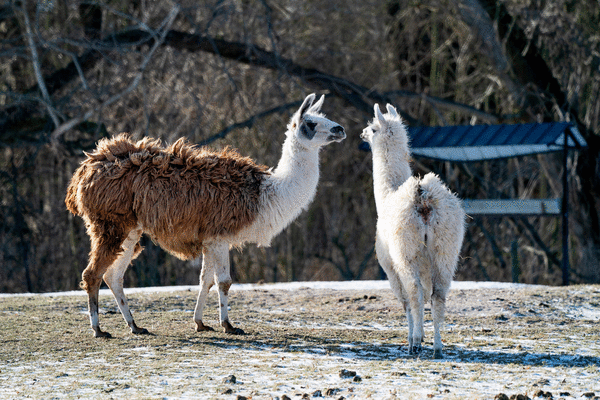
One llama is sprawled on the grass with its neck craned, basking in a patch of sunshine. Another stands on a dirt hill, ears flattened defiantly. A third rushes to greet visitors with a friendly nuzzle.
This isn’t a petting zoo. The furry beasts are in Belgium for work.
Scientists have discovered the potential of the animals’ antibodies to thwart multiple diseases, and now drug developers are collectively plowing billions of dollars into a field that may yield a fresh generation of life-changing medicines. The targets include some hard-to-treat conditions like cancer, nerve pain and a chronic skin ailment.
The llamas are a vital part of the experiment. In between dust baths and grazing, they get injections to trigger the production of their precious antibodies. The animals are some of the few to produce the tiny proteins, dubbed nanobodies, which scientists praise as easy to produce, manipulate and engineer.
“They have this Lego-like nature that you can just snap them together any way you want to, which is really unique,” says Mark Lappe, the chief executive of U.S. biotech Inhibrx Biosciences Inc. “If you try to do that with regular antibodies, it’s wildly complex.”
The field is burgeoning, albeit quietly for now. A Sanofi drug for a rare autoimmune blood disorder was the first medicine developed using llama antibodies to hit the market. AstraZeneca Plc recently released results for an experimental medicine to treat another autoimmune dysfunction that could be a potential blockbuster. And U.S. pharma giant Eli Lilly & Co. has partnered with Belgian biotech firm Confo Therapeutics to gain rights to a product exploring a new approach to pain management.
“I do think nanobodies will be a mainstay of many portfolios going forward,” says Michael Quigley, Sanofi’s chief scientific officer. “Sanofi from our perspective is leading the field.”
Inhibrx, for its part, is working on a therapeutic that can induce the death of some tumor cells while sparing healthy tissue — a progress over some existing cancer regimens. The shares more than doubled after a study showed patients with a rare type of bone cancer and no treatment options lived longer on the experimental drug without the disease progressing. The treatment is undergoing tests for several types of tumors.
The immune system of all mammals produces antibodies to thwart viral and bacterial attacks. Those made by llamas and other members of the camelid family can squeeze into tighter spots and better penetrate tissue than human ones, because they’re smaller and simpler. Some have been reported to cross the blood-brain barrier, eliciting hope for neurological diseases.
For the llamas, it’s not necessarily a bad job. They get injected with an antigen a couple of times and some weeks later, when their immune system has reacted, a vial of blood gets drawn that contains antibodies scientists will then tweak in the lab.
When they get older, they might go on to a second career in wildfire prevention or as livestock guardians. Some will get adopted, while others will simply retire.
“We have a llama pension plan,” Cedric Ververken, the chief executive officer of closely held Confo, said in an interview. “Once we’ve immunized them and have generated the antibodies, we want to make sure that the llama still has a happy life.”
A look behind the scenes confirms the animals at one large farm in Belgium live freely on a big, partly wooded terrain divided into multiple enclosures, each with a shed.
The llamas live in herds with one dominant member. They are social animals and their mobile ears betray their state of mind, much like horses’: ears slanted forward, they’re curious, ears flattened back, they’re alert and somewhat suspicious. Unlike horses, they can kick sideways. One testy female, Jane, is known to spit at her carer if her daily serving of hay and pellets isn’t delivered fast enough.
The exact location of the farms is often kept secret, though the use of llamas in medical research is regulated.
The beasts also play a big role when it comes to branding. Inhibrx has a picture of the furry creatures in a brochure about its clinical pipeline. The investor presentation of Swiss company MoonLake Immunotherapeutics includes friendly-looking cartoon animals. Dutch-incorporated biotech Argenx SE, which deals with another type of llama antibody, also shows cartoon images on its website, including one wearing a beret to denote some of the animals they use live in the south of France.
“People love the llama,” Tim Van Hauwermeiren, Argenx’s chief executive officer, said in an interview. “They want to know all about the llama. Retail investors want a stuffed llama when they go home.”
Much of the nanobody activity is rooted in or near Belgium because the Free University of Brussels is where the antibodies were first discovered. The original findings related to dromedaries, but researchers soon found that other types of camels, llamas and alpacas shared the same properties, as did sharks.
The university, a large block of mismatched buildings on the outskirts of Brussels, has given birth to a number of the field’s first biotechs along with the Flemish Institute for Biotechnology. One example is Ablynx NV, which Sanofi bought in 2018 for €3.9 billion ($4.6 billion) after outbidding Novo Nordisk A/S. Lilly’s partner Confo is another.
The Brussels campus still houses work on nanobodies — a term trademarked by Ablynx. VIB Nanobody VHH Core, which engineers these camelid antibodies for pharma and biotech clients, works out of a set of barracks in a leafy corner of the campus. The group focuses mostly on treatments and diagnostics for cancer and inflammatory diseases, but it’s also investigating nanobodies for other applications, including a new type of contraceptive for the Gates Foundation.
“Everywhere you have a target an antibody can bind to, you can have a nanobody application,” says Steve Schoonooghe, one of VIB’s scientists. “Give us a target on a cancer cell and we can make a nanobody against it.” One goal, like at Inhibrx, is to tackle tumors while avoiding the damage wrought by chemotherapy.
For now, the nanobody world has yet to prove it can deliver a blockbuster. Sanofi’s Cablivi drug was a trailblazer, but after about seven years on the market for a blood-clotting disorder it has only garnered sales of €202 million in the first three quarters of last year. The French drugmaker has stopped research on five experimental nanobody drugs in recent years, although it’s still working on others. Two in particular are undergoing tests for ailments including asthma, diabetes and inflammatory bowel disease.
The field has endured setbacks as well. MoonLake’s market value crashed in September after a study of its experimental skin treatment prompted analysts to conclude it was no better than a rival medicine.
“It’s important to remember the overarching arc of drug discovery and development, and the maturation of any given platform, which takes time,” says Quigley, Sanofi’s chief scientific officer.
A big hit could help turbo-charge things, and AstraZeneca’s experimental rare-disease drug gefurulimab is billed as having that potential. The medicine could become a blockbuster in 2031 and is one of four nanobody medicines the UK drugmaker is developing.
“From my perspective, nanobodies represent a very important new tool in our toolkit,” said Seng Cheng, head of research and product development at Alexion, Astra’s rare-disease business. “We still haven’t tapped all the potential of what it can offer.”
The need to work with actual llamas could soon be made obsolete by artificial intelligence, but for now the animals still serve a purpose.
Inhibrx’s Lappe estimates the California-based biotech has immunized more than one hundred llamas located in rural San Diego County. Like some others, they lease the animals instead of owning them because “we’re drug developers — we’re not really farmers.”
—With assistance from Ashleigh Furlong.
©2026 Bloomberg News. Visit at bloomberg.com. Distributed by Tribune Content Agency, LLC.






Comments