Trump reinforces NASA's moon plans, eliminates Space Council
Published in Science & Technology News
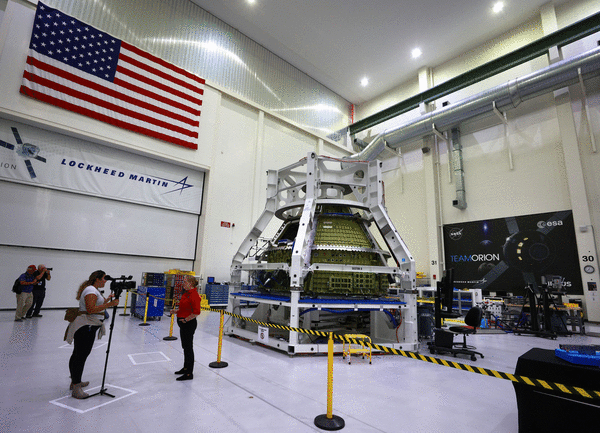
President Donald Trump signed an executive order that aims to return astronauts to the moon through NASA’s Artemis space program with an eye toward building a permanent lunar presence.
The directive reinforces NASA’s current plans for sending Americans back to the moon by 2028 and for Americans to begin establishing the outpost by 2030. It also reaffirms NASA’s plans to develop nuclear power in space, including readying reactors for launch by 2030.
Thursday’s order also calls for the elimination of the National Space Council with plans to transition its authority to the Office of Science and Technology Policy. The National Space Council is a White House body first created in 1989 to advise the president on issues of space policy and implementation.
The order further seeks to develop next-generation missile-defense technology by 2028 as part of Trump’s Golden Dome project and calls for developing capabilities to detect and track threats to the U.S. from low-Earth orbit and cislunar space.
The directive is a comprehensive plan that touches a number of aspects of space policy, including coming up with ways the government can reform how it acquires space assets and investing in technology areas. It envisions the U.S. attracting at least $50 billion of additional investment in American space markets by 2028.
Earlier this year, the administration proposed phasing out the current Artemis architecture for returning humans to the moon and replacing it with more cost-effective commercial replacements.
A number of Republican and Democratic lawmakers have since rallied around the Artemis program, warning that cutting it would put the U.S. in a weaker position in its space race with China.
Beijing plans on sending its astronauts to the moon for the first time by the end of the decade.
NASA’s Artemis moon-landing program has been criticized by prominent figures like SpaceX Chief Executive Officer Elon Musk and NASA Administrator Jared Isaacman, who was a billionaire fintech executive before joining the agency. Both have argued that there are more cost-effective ways to return to the moon.
Artemis, which relies on Boeing Co.’s Space Launch System rocket and Lockheed Martin Corp.’s Orion crew capsule, is expected to cost $93 billion by 2025 and has only flown a single mission.
NASA has delayed the first Artemis moon landing several times, most recently announcing that the landing on the lunar surface won’t take place until 2027.
In July, Congress allocated nearly $10 billion to Artemis in President Trump’s signature tax and spending package to help fund the fourth and fifth flights of SLS for the program, missions the administration had originally considered cutting and replacing with more economical commercial alternatives.
In his second confirmation hearing on Dec. 3rd, Isaacman reassured lawmakers that he believed the current Artemis architecture is the fastest way back to the moon.
Development of the Artemis architecture also supports tens of thousands of jobs in Republican-controlled states like Texas, Alabama, Mississippi and Florida.
_____
(With assistance from Tonya Garcia.)
_____
©2025 Bloomberg L.P. Visit bloomberg.com. Distributed by Tribune Content Agency, LLC.






Comments