How Democrats in four key Pa. districts plan to use Medicaid cuts to win back Congress
Published in Health & Fitness
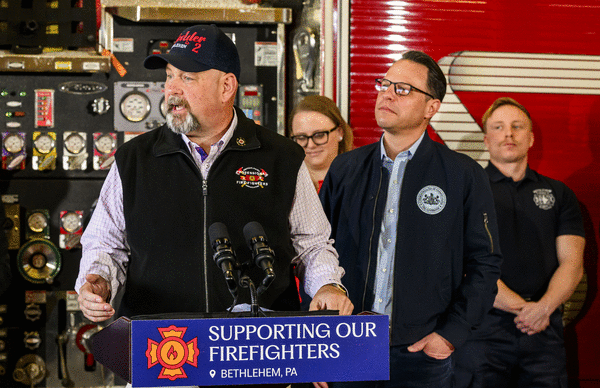
As Democrats look to flip four key swing congressional districts in Pennsylvania, they’re centering their message on health care and the cost of living.
Part of that message will involve reminding voters that congressional Republicans approved $1 trillion in cuts to Medicaid over 10 years to help pay for Trump’s signature tax cuts, potentially eliminating health coverage for 300,000 Pennsylvanians, according to state estimates.
The cuts to the popular entitlement program won’t take effect until January 2027, two months after the midterm election. The timing creates a lag that could shield Republican incumbents who can navigate election season without having to face disgruntled constituents grappling with lost benefits.
But Democrats want to make sure voters understand that pain postponed is still pain.
“People will hear that Republicans put us in this spot,” said Eugene DePasquale, chair of the Pennsylvania Democratic Party. “They made huge Medicaid cuts in exchange for tax cuts for billionaires. That’s why health care will be a central theme in this election season.”
Throughout the next nine months, party leaders say, Democrats will look to broaden Medicaid eligibility, cap drug costs, close gaps in rural health care, and fight for reproductive rights. They will also be pledging to address a spike in insurance premiums by restoring enhanced Affordable Care Act subsidies, a COVID-era policy which expired at the end of last year.
A national poll released by NBC News this week found that voters favor Democrats over Republicans to handle health care by a 20-point margin, the party’s biggest advantage on any issue.
“Crowds erupt and people get loud when I mention health care and how Republicans are using it to pay for tax breaks,” said Bob Brooks, a Democrat running for Congress in the Lehigh Valley.
“For Democrats, health care is the message.”
Brooks, a Bethlehem firefighter and the president of the Pennsylvania Professional Fire Fighters Association, is part of a crowded fielded seeking the party’s nomination to take on freshman U.S. Rep. Ryan Mackenzie, who was recently ranked the most vulnerable Republican in the country by the National Journal.
Mackenzie, who voted for Trump’s signature law, has more than 17,500 people in his district who could lose Medicaid coverage, according to the state Department of Human Services, which administers the federally funded program in Pennsylvania.
White House spokesperson Kush Desai pushed back on Democratic messaging in a statement Wednesday, painting the policy changes as a way to safeguard the program in the long-term.
“The Trump administration is not cutting Medicaid, but implementing commonsense work requirements, citizenship verification, and other reforms to slash waste, fraud, and abuse. This historic undertaking to protect and preserve Medicaid as a lifeline for the Americans who truly need it naturally takes time to implement,” Desai said.
Trump’s new law established new Medicaid work requirements, which require people aged 19 to 64 on Medicaid to file paperwork every six months to show they work 20 hours a week to qualify for the program, unless they meet exemptions for physical or mental disabilities.
The majority of people expected to lose coverage as the result of this policy change will be people who fail to complete paperwork even if they are working the required hours, Benjamin Sommers, a health economist at Harvard University’s School of Public Health, noted last year when the law was passed.
Hoping for change in November
Adrian Parker, 53, of South Philadelphia, works as a caregiver for her 32-year-old daughter Danielle, who suffered a traumatic brain injury 15 years ago and receives Medicaid. The program allows beneficiaries to use their funds to pay for care administered by family members.
Even though her daughter’s disability should keep her Medicaid coverage intact, Parker said she worries that she might not be able to keep up with increased paperwork under the new law, which could jeopardize her daughter’s benefits.
“With what I’m seeing, I don’t know what the future holds with Medicaid,” Parker said. “I’m hoping the November elections will change who’s in charge of the government. I’m a voter, and what I’m seeing being done to Medicaid is horrible.”
Parker lives in retiring U.S. Rep. Dwight Evans’ district, the most Democratic-leaning district in the state. And while the district won’t be competitive in November, Medicaid and how Republicans have reshaped it will be at the top of Parker’s mind when she heads to polls to pick Evans’ successor in the May Democratic primary.
In Philadelphia, an estimated 73,000 residents on Medicaid won’t have it beginning next year, according to the state.
And across the four collar counties, a projected 40,000 people will be affected, including nearly 11,000 in U.S. Rep. Brian Fitzpatrick’s district, which covers Bucks County and part of Montgomery County.
Fitzpatrick, R-Bucks, represents one of the four GOP-held district Democrats are targeting in the fall.
He’s the only one of the four swing-district Republicans to vote against the final version of Trump’s One Big Beautiful Bill Act, though he voted for an earlier version of the legislation.
Fitzpatrick cited deeper cuts to Medicaid in the final bill as the reason he voted no, but Democrats still plan to hammer him for his initial vote to move the bill forward.
Bucks County Commissioner Bob Harvie, a Democrat running for Fitzpatrick’s seat, said he’s received questions at town halls about the Medicaid cuts from older people.
“Prices at nursing homes will go up for everyone,” he said, “and it’ll be harder to find quality assisted care, making health care an affordability issue.”
Neither Fitzpatrick nor Mackenzie’s campaigns responded to a request for comment on the upcoming Medicaid cuts.
Spokespeople for Pennsylvania’s two other swing-district Republicans, U.S. Rep. Rob Bresnahan and Scott Perry, also did not comment. Bresnahan and Perry have nearly 22,000 and nearly 19,000 residents, respectively, in their districts at risk of losing coverage.
Cuts to the Supplemental Nutrition Assistance Program (SNAP) under the new law already began in January for around 46,000 people in the state — many of them are likely residents who will also lose Medicaid, according to figures released by Gov. Josh Shapiro’s office.
Julia Hinckley, director of policy strategy at the Leonard Davis Institute for Health Economics at the University of Pennsylvania, viewed the decision to delay the Medicaid cuts until after the midterms as a political tactic.
“These cuts aren’t politically popular,” she said. “For Republicans, it makes sense not to have Medicaid changes go into effect while people are making decisions in voting booths.”
_____
©2026 The Philadelphia Inquirer. Visit inquirer.com. Distributed by Tribune Content Agency, LLC.






Comments