Review: 'Downstate' opens on Broadway, all its gut-wrenching dilemmas intact
Published in Entertainment News
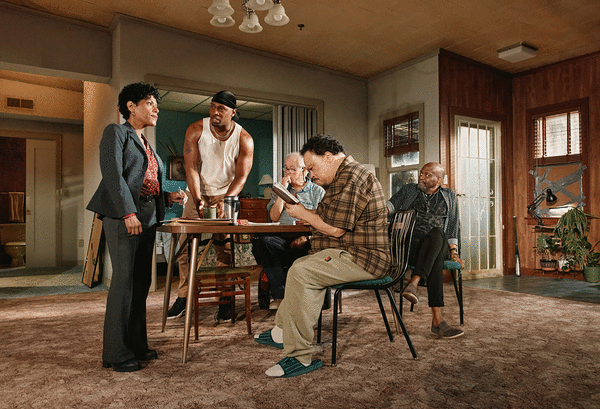
NEW YORK — When I first saw Bruce Norris’ riveting “Downstate” at its 2018 Steppenwolf Theatre premiere, the Chicago audience came primed and set its teeth. Steppenwolf had produced one incendiary Norris play after another in those heady pre-pandemic days, and a drama about a motley crew of sex offenders living in a halfway house in downstate Illinois was nothing if not on-brand.
So was the play’s inciting incident: An adult man decides to confront his childhood sexual abuser in person.
Angry spouse in tow, the victim carries with him paperwork that he wants his now elderly target to sign, both apologizing and accepting responsibility. This is a desperate, therapist-approved attempt to gain some modicum of closure and stop the roaring in the man’s head. Or maybe, the play suggests, merely to gain some good old-fashioned revenge on an even-tempered, long-incarcerated man who has already paid a heavy price.
Norris makes very clear from the start that this is a mostly hopeless endeavor, thus making his two central points — that few of us get to banish our demons, and even fewer of us deserve absolution.
Both things that playwrights have written about since ancient Greece, albeit not with the combination of guts and craft that Norris employs here.
But on Broadway, which is where you can now find “Downstate,” people wander in from Times Square, maybe with a last-minute half-price ticket in hand, some with little awareness of what they just bought, maybe after the musical they planned to see on their date night was sold out.
Several of those people surrounded me at the Booth Theatre on Nov. 14 — folks clearly unaccustomed to a play so incautious, so uninterested in political correctness and so determined to let none of its characters off the hook, running entirely contrary to the current expansion and deification of victimhood, at least in theater-going circles.
More simply put, these were theatergoers who had not told their date they were attending a play that argues that being a victim does not remove all your flaws, and that sex offenders are people, too.
They got a shock or three in director Joe Mantello’s new Broadway staging. This is a play expertly designed to solicit empathy, even applause, for one character expressing a point of view, only to then subvert that response as their destructive defense mechanisms roar into gear and reignite their power to hurt.
I was amazed at first by how much laughter I was hearing early on, although I quickly came to see that Norris, and especially now Mantello, have consciously built in that safety valve. Indeed. I was so fascinated by what had replaced that laughter, I had to remind myself the action was on designer Scott Pask’s intentionally prosaic set. Most of it, anyway.
This new production is stocked with formidable actors, some reprising their roles from Steppenwolf eight years ago, some new. In the former category is K. Todd Freeman, playing an actor-choreographer, or a former actor-choreographer, who fell in love, so he says, with a young boy on a national tour of “Peter Pan.” This character is the most eloquent and protective of his peers, and Freeman, who is yet better this time around, plays him as a coiled spring, a man destroyed by that unique blend of personal circumstances for which he carries no responsibility, and a personal action for which he does.
That’s a good chunk of our criminal justice system, of course.
Better yet, Mantello turns Freeman’s character into a kind of seer, a harbinger of tragedy to follow.
This phenomenal piece of acting is matched by Francis Guinan, another holdover whose increased age has only deepened his work and whose gentleness stands in total contrast. Guinan plays the offender who gets confronted, a character responding with such tolerance and sweetness that you cannot relax for fear that it is merely another form of abuse. As it turns out to be, inevitably.
There also are three main newcomers, all superb.
Adrian Martinez movingly plays a character ripped, by his own actions, from the daughter he is convinced he loves.
Al’Jaleel McGhee is a loquacious Chicago performer who plays the sweetest of talkers, again designed to keep you wondering about whether society was unfair or whether he deserved all he had to pay. And Thomas Sadoski plays the visiting victim, a character who is the most important in the play because he asks most of the questions of the audience.
Sadoski is remarkable too, not least for his rich understanding of how victims of abuse often seek out their abusers, never knowing whether to berate them or forgive them.
That’s a gut-wrenching dilemma to watch in real time in the theater, but then “Downstate” is the rare Broadway play specifically designed to wrench the gut.
Yet there is no reason to fear its content, dear reader, or worry about a conclusion with which you might not agree. These questions are why thinking people like to go to the theater.
When you have a director and a cast who understand not only the complexity and causality of human feeling but also the impact of passing time, with its own pressures of forgiveness and the pressure to “move on,” you have something well worth your time.
———
At the Booth Theatre, 222 W. 45th St., New York; downstateonbroadway.com
———
©2026 Chicago Tribune. Visit chicagotribune.com. Distributed by Tribune Content Agency, LLC.











Comments