Melissa Auf der Maur joined Courtney Love's band Hole, and she took notes
Published in Entertainment News
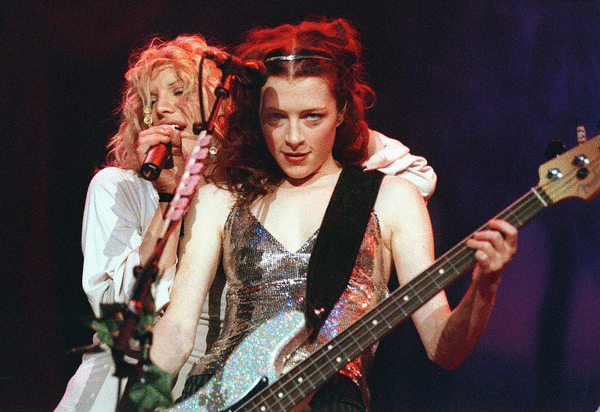
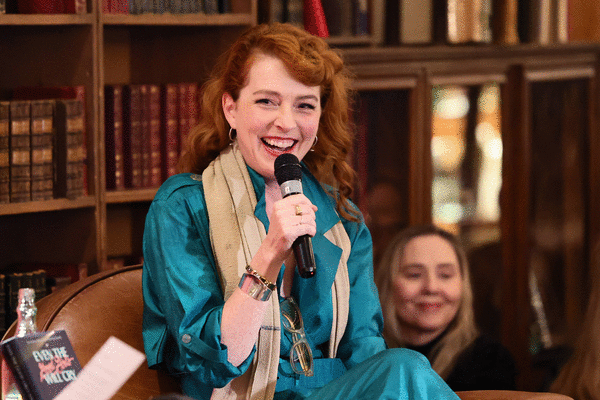

ANAHEIM, Calif. — Melissa Auf der Maur was a music-mad Montreal teen when in the summer of 1991 she found herself at tiny local shows by the fledgling alternative rock bands Hole and Smashing Pumpkins.
Hole was first to play the Canadian punk club Les Foufounes Électriques, and Auf der Maur was so impressed by the band and its force-of-nature singer Courtney Love that she invited them all to crash at her apartment — an offer the band accepted but her roommate nixed.
Twelve days later, Smashing Pumpkins arrived at Foufounes where a crowd of maybe 20 turned out. Auf der Maur was mesmerized by the striking sounds. Not so much the person who threw a beer bottle at singer-guitarist Billy Corgan’s head, an act that so offended the 19-year-old that she found Corgan after the show to apologize on behalf of all Montreal.
And that might have been that, fodder for a few fun stories as Hole and Smashing Pumpkins’ fame grew.
But fate had other ideas, as Auf der Maur writes in “Even the Good Girls Will Cry: A ’90s Rock Memoir,” which arrived on Tuesday, March 17, as well as Auf der Maur’s 54th birthday.
Over the next 10 years, Auf der Maur would join both Hole and Smashing Pumpkins and tour the world as their bass player. She’d find her first true love in Foo Fighters’ Dave Grohl. And then, as a new century began, heartbroken by personal losses and disillusioned by the corporatization of the indie scene, Auf der Maur would walk away from it all.
“It was primarily an act of reflection, self-reflection and healing,” she says of the decision to write the book. “And really, a gift to my daughter, which is why I dedicated it to her.
“I wanted to finally take the time to unpack not just the ’90s and the drama — the chaos, the drugs, the death, the fame, the world of rock — but also my father’s death,” Auf der Maur says.
“I kind of went running for a couple of decades to reinvent myself and to come out of the shadows of the ’90s,” she says. “And I was a lucky one, you know. I wasn’t a drug addict, but I was surrounded by a lot of challenging and painful things, and I needed a lot of time to pass for me to really understand the impact it had on me.
“That 20-, 25-year perspective I think is really a sweet spot for gaining both personal and cultural objectivity. Because, ‘Wow, the world has changed since that moment of my life ended.’ That’s why I end at 9/11. I was like, ‘That’s it, the life you know, the world is not going to be the same anymore.
“I’d been sitting back watching it happen, and I wanted to reflect on both the big picture and the little one,” Auf der Maur says. “I was ready.”
Courtney loved
In late 1993, Auf der Maur’s first-ever band Tinker had played around Montreal for a few months. When Smashing Pumpkins, now rising stars, announced their return to Montreal, she wrote Corgan and asked if he’d consider Tinker as an opening act.
He did just that, and a few months later, in the summer of 1994, did something more.
Earlier that year, Love had just suffered a pair of devastating blows, first the death of her husband Kurt Cobain in April 1994, followed two months later by the fatal overdose of Hole bassist Kristen Pfaff.
Corgan, who’d dated Love before she met Cobain, called her and told her she should hire Auf der Maur as her bassist. Then he called Auf der Maur and told her she was joining Hole.
And Auf der Maur? She said no.
“I was a fine art student, and I was going to do my master’s in photography,” Auf der Maur said over an hourlong conversation as she drove from a public radio interview in Albany, New York, to her home in Hudson. “Why would I join a rock band?”
Love, an unstoppable force when her sights are fixed on a target, changed Auf der Maur’s mind. A few weeks later, she made her debut playing songs from Hole’s “Live Through This” in front of 90,000 or more at the Reading Festival in England.
One of the wonders of “Even the Good Girls Will Cry” is how much empathy Auf der Maur has for her often tempestuous boss, and how much her record-correcting can shift a reader’s feelings, too.
“Obviously, I have a very unique lens on her,” Auf der Maur says of the onslaught of the negative, often misogynistic and cruel publicity Love received. “I’m her longest-standing right-hand woman of any of her bands. I make what people would call a credible witness.
“I’m not a drug addict. I didn’t disappear into escapism. I witnessed. I documented. I photographed. I kept notes.
“I had a very active and engaged relationship with a very, very misunderstood and incredibly challenging human whose MO, based on her own wild upbringing, is to push the envelope and break every glass ceiling,” she says.
“Which is what they don’t want you to do,” Auf der Maur continues. “She does everything society has told women not to do. And she’s an incredibly undervalued feminist, if you know those anthems and songs. People love to hate her, but you cannot deny the power of those lyrics.”
Besides finding healing and understanding for herself, the chance to correct the record of Love was a major goal for her memoir, she says.
“Not just because she deserves it, and my time in Hole deserves it, but for all women,” Auf der Maur says. “I witnessed people just participate in the burning of this woman at the stake and not be aware of it.
“Now I finally feel like people realize, ‘Oh, whoa, [bleep], that poor woman. She was a widow, mental illness, drug addict, single mother with nothing but a machine that wanted to exploit her.’”
Love’s grief was often met with unbelievable cruelty, such as the night someone threw shotgun shells onstage; Cobain died by suicide via a shotgun, and there were conspiracy theories that aimed to blame Love.
“Look at the unbearable behavior of men in rock bands,” she says. “She didn’t rape anybody. She didn’t do anything. She just did [things] her way. She was not hurting anyone.
“She is difficult. That’s her thing. You don’t have to like her style, but you have to respect and admire her bravery.”
Dreamy dream girl
When Auf der Maur stepped away from it all at the start of a new century, one of the things she felt she had lost was the innocence and purity of who she’d been before she stepped onto that careening carousel of rock and roll in the ’90s.
“The biggest joy [of writing the memoir] was returning to the innocent young woman and girl who fell in love with music and found her calling,” she says. “The goal was to reconnect with that innocence again because I was very much pushed through a ring of fire for music.
“I lost a lot of purity, especially with music, and so the joyful part [of writing] was returning to that part of me.”
Auf der Maur grew up the child of a feminist mother who raised her alone until she turned 1 and her mother told her father, a popular Montreal newspaper columnist and future city councilman, he had a daughter.
“I was a shy girl growing up in the shadow of two of the coolest parents that a girl could ever ask for,” she says. “My parents were unbelievably inspiring, and I always felt intimidated by how am I going to live up to this?
“I could feel that life was exciting and big, but I didn’t have any idea how I would make my life exciting and big,” Auf der Maur says. “Hopefully, I paint a picture of an exceptionally open dreamer. That’s a big theme in my book of these sort of dreamy dreams that quite literally injected themselves.”
She attended an alternative school with its curriculum built around the arts. At a young age, she was out in the city with her father — he often took her along when he barhopped through city, plying her with Shirley Temples and quarters for the video games while he had drinks with friends or sniffed out column ideas.
As a teenager, Auf der Maur found her way into the city’s music scene with friends, dancing at the Club Thunderdome, Montreal’s goth bar, catching new acts at Foufounes, and eventually landing a gig as a cassette DJ at Bar Le Bifteck, a former Portuguese steakhouse turned dive bar.
“I was just taping ‘The Drew Barrymore Show’ [Barrymore dated Hole guitarist Eric Erlandson in the mid-’90s] and we were bonding over our nontraditional upbringings,” she says of an episode that aired on Wednesday, March 18. “She asked me, ‘What is your greatest advice for parenting, what’s your philosophy?’
“Through the writing of this book, and witnessing kind of how my dreamy kind of independent spirit worked for me and made these almost fairytale fantastical things happen, it was that my parents never told me who I was,” Auf der Maur says.
“They just let me become.”
Fears and friendships
Throughout the book, Auf der Maur periodically shares vivid, often terrifying dreams she experienced during the ’90s.
In the fall of 1991, she describes a figure silhouetted in the darkness of her room, perched on her chest, whispering, “Even the good girls will cry,” the future title of her memoir, over and over again.
In another, a leather-winged creature crashes through her bedroom window, screaming, “Your emptiness is calling me!”
“I had literally never been so scared in my life,” Auf der Maur says. “I was scared to put it on paper.”
That sense of magic realms, of portents and dreams and the signs in the stars, came to her young, a personal discovery by a girl whose parents let her chart her own journey of beliefs.
“I was seeking, because I felt something missing, and then these dreams started happening,” she says, discussing how she began to look for meaning.
“There was something bigger than your practical mind. You don’t need to believe astrology [works] or read about mythology to agree that if you love rock music or any music, there’s an element of the gods.
“Like the concept of the rock gods and the rock star, and it’s out of this world, that realm where humans play that out,” Auf der Maur says. “You can’t deny that Courtney’s like a warrior goddess or a Medusa.”
At the time of the winged creature, Auf der Maur’s life had fallen into darkness. Hole was touring with Marilyn Manson. Her father, a lifelong smoker, died from cancer. Her best friend in Hole, drummer Patty Schemel, disappeared into her own addiction for years.
“That dream was what I needed for the wake-up call of, ‘Hey, lady, get back to yourself. “I realized, ‘Oh my God, this is darkness within. Whatever the messenger is, I’ll take it. I need to make changes.”
But there was lightness in that time, too. Auf der Maur writes throughout the book that she often preferred making music to physical intimacy. Then she and Dave Grohl fell in love.
“Dave was my first love,” she says. “There’s no question it changed the course of my heart.”
In the book, she shares “love faxes,” hand-written then faxed, love notes, that she and Grohl exchanged for several years when their bands took them to opposite parts of the country and world. They remain open-hearted and sweet in excerpts printed in the memoir.
“Dave is very aware of the book,” Auf der Maur says. “When I started writing the book, I reached out to all three of them [Grohl, Corgan and Love] as the biggest rock gods and goddess in my life. I got a thumbs up before they even got a copy because they know I’m not here to be famous or rich. I’m not here to exploit them.
“I love them all, and they trust me,” she said, noting that recently she’d appeared on Corgan’s podcast and sung backing vocals for a Love song. “They all gave me their blessing, like, go testify.”
Throughout the ’90s, Auf der Maur photographed her life as a musician obsessively. In the fall, a companion art book, “My ’90s Rock Photographs,” presents 250 images from the 10,000 negatives she made during the decade.
A Toronto museum exhibit also opens later this year, and will tour other museums in the future, with an accompanying musical installation created by Auf der Maur in her first new music since she put down her bass to raise her daughter 14 years ago.
She is comfortable in her not-so-celebrity skin today at home in Hudson on the edge of the Catskills, where she and her husband created the alternative arts center Basilica Hudson in a renovated 19th-century factory 16 years ago.
Once upon a time, Nirvana’s “Nevermind” was a call to arms for young music lovers like her, Auf der Maur says.
“Either go join your generation or stay home,” she says. “And I was going to go join it. You don’t need to believe in dreams and astrology to read the book and listen to how I was guided.
“I was guided by dreams I had about the power of sound. I was guided by feelings I had that there was something beyond this Montreal girl. It was calling me to a to go to a bigger place.
“I rely very deeply on my intuition and my passion to get me to the right place,” she says. “Like, if it feels that powerful and that magical, I’m not going to deny it.
“I’m going to go for it.”
©2026 MediaNews Group, Inc. Visit ocregister.com. Distributed by Tribune Content Agency, LLC.









Comments