'Sinners' and Ryan Coogler won something deeper
Published in Entertainment News
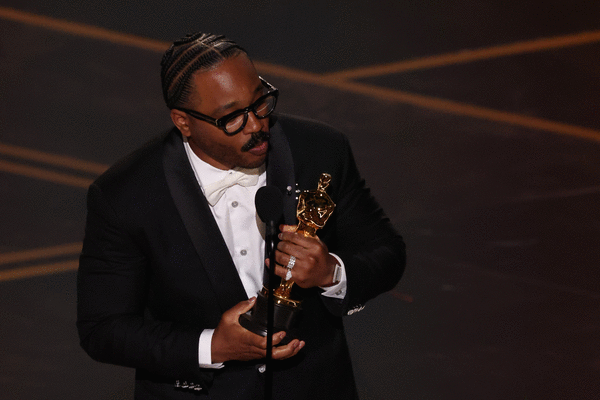
LOS ANGELES — Put a cold-blooded spin on it and “Sinners” is now the biggest loser in Oscars history, ceding 12 of its 16 record-breaking nominations to other films. But Ryan Coogler still won the night.
In another year, I might have said “Sinners” lost to “rivals” or “competitors.” But on Sunday, anyone with an ego got swatted on the nose. Last year’s best actor, Adrien Brody, made amends for flinging chewing gum at his wife by swallowing a fresh wad of it (and his pride). Meanwhile, this year’s thirstiest aspirant, Timothée Chalamet, sat in the front row and gamely took his lumps as the only contender who got repeatedly roasted, including an awkward gag when the band wheeled out a “Marty Supreme”-style “bum drum” that stood in for his public spanking.
The dominant mood was gratitude. Victors went beyond checking off a list of hastily scrawled names to thanking entire categories of people: women, ancestors, Koreans, audiences. Coogler was the ambassador of generous vibes, flashing the ASL sign for “I love you” to his colleagues and presenting a united front with the evening’s other dominant figure, “One Battle After Another’s” Paul Thomas Anderson, suggesting that it’s less important which quality movie wins than that more quality movies get made in the first place.
One of the many things I admire about “Sinners” is its acknowledgment that artists, dreamers and visionaries like Coogler still have to exist within a system they might disagree with, possibly even hate. Michael B. Jordan’s identical twins Smoke and Stack have the “grown-men money” to purchase the property for their juke joint in full. But the brothers’ cash goes straight into the pocket of the Grand Dragon of the Klu Klux Klan, who more than likely spends it on the bullets he plans to murder them with in the morning.
Constrained by a few square miles of 1932 Mississippi, Coogler’s genre-bending movie covers an astonishing amount of turf: sex, race, monsters, grief, ambition, spirituality, sacrifice, freedom and community. Yet almost every scene is also about money. Money is why Smoke and Stack flee Chicago to hide down South and why Miles Caton’s Sammie wakes up at dawn to pick his daily quota of cotton. Money gets Delta Slim’s good friend lynched and forces Grace and Bo Chow (Li Jun Li and Yao) to operate two segregated grocery stores on opposite sides of the same street.
Some of the best scenes in “Sinners” involve characters negotiating the value of their creative energy, from painting a sign to playing a concert, or simply just selling someone their time, as when Stack teaches the teenager watching his truck not to settle for less than her worth. Likewise, Coogler has done the math on his own career and tallied what he’s called the “steep price” of his success, including missing the death of his great-uncle James, the relative who introduced him to Mississippi Delta blues, because he was away shooting “Creed.”
Coogler isn’t whining. He knows a bit of heartbreak is the deal, no different than how he gave over a decade of his life to launching the “Creed” and “Black Panther” franchises which belong to the studios that hired him. But he also knows that the $2 billion those hits earned afforded him the clout to make, and someday own, “Sinners,” and that all these years he’s patiently been a company man have been an investment not only in himself, but in all of the other actors and crew members he’s raising up with him.
As host Conan O’Brien alluded to in his opening monologue, Coogler declined to join the Academy of Motion Picture Arts and Sciences 10 years ago, explaining to the Hollywood Reporter that “If I’m going to be a part of organizations, they’re going to be labor unions, where we’re figuring out how to take care of each other’s families.” Also, Coogler continued, he loves movies and simply doesn’t want to rank them or “buy into this versus that.”
Despite Coogler’s rejection of the evening’s fundamental premise, the crowd rose to its feet when “Sinners” won its four awards for score, cinematography, original screenplay and lead actor. Coogler sprang faster than everyone when Autumn Durald Arkapaw became the first female director of photography to earn an Oscar, proving that he meant those words about taking care of each other’s families by racing up the aisle and back to scoop her son Aidan onto his shoulder and carry the boy closer to his mom’s history-making moment.
The other lovely salute to Arkapaw’s craft came when the Oscars restaged “Sinners’” centerpiece musical sequence more or less exactly as she did, sending a camera swirling through the onstage performance of “I Lied to You.” Smartly, the show’s director positioned another camera at the back of the Dolby Theatre to witness yet another standing ovation for its celebration of the blues’ influence on rock and funk and hip-hop and, by extension, even “KPop Demon Hunters” which wound up beating that number for best song.
“Sinners” composer Ludwig Göransson brought that point of catalytic inspiration full circle when he accepted his Academy Award and retraced how his father’s purchase of a John Lee Hooker album in Sweden inspired him to pick up a guitar and eventually led to his longtime collaboration with Coogler. (Speaking of family ties, here’s a fun fact: Coogler officiated at Göransson’s wedding.)
Awards totals aside, on Sunday night it felt like Coogler — and by extension, his collaborators, especially his wife and producer Zinzi, who famously sprung $300 for his copy of the screenwriting software Final Draft when they were in college — have an idea of how they’d unite Hollywood’s often-conflicting needs to make money and create art (and that maybe it isn’t even that hard).
When the rights to “Sinners” revert to him in 2050, its 16 Academy Award nominations may still be second to none, a master class in how to triumph in defeat.
----------
©2026 Los Angeles Times. Visit at latimes.com. Distributed by Tribune Content Agency, LLC.









Comments