Rick Kogan: How Billy Branch bought a harmonica, found the blues and changed his life
Published in Entertainment News
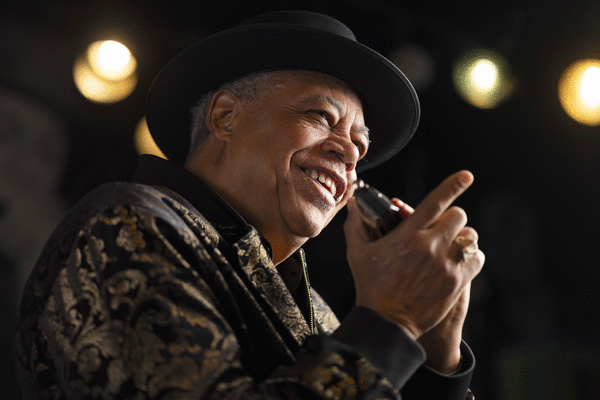
CHICAGO — The blues world was changed forever on a sunny day around 1960 when a little boy walked into a five-and-dime in Los Angeles.
“I was 8, maybe 9 when I saw it, all shiny in a display case,” says Billy Branch. “It was a harmonica. I had never heard one played live but it seemed to talk to me. It cost a dollar and as soon as I put it in my mouth, I played the only songs I knew, folk songs and Christmas carols.”
That harmonica, a Valencia, cost Branch $1. That was money well spent.
Branch is now 74, an elder statesman in the blues world, a contemporary and friend of the 89-year-old Buddy Guy, both of them living links to the foundational years and pioneering players of the blues.
He has a sunny disposition and a bright smile. He has been nominated for Grammys and won many awards. I didn’t know until recently that he was born here, more precisely at Great Lakes Naval Hospital in North Chicago, moving with his family to California when he was 5. He has played on hundreds of albums, teaches in schools with his Blues in Schools program and is, in every imaginable way, a tireless booster of the blues.
So it is almost impossible to believe that when Branch came here in 1969, a 17-year-old about to begin his freshman year at the still under construction University of Illinois Chicago, he had “zero knowledge of the blues, and I mean zero.”
But he soon had what he calls “a life-changing experience” when he went to Grant Park for “Bringing the Blues Back Home,” a day-long concert. He remembers the date, Aug. 30, and he remembers, “Willie Dixon produced the whole thing and they were all there, Buddy, and Junior Wells, Muddy Waters, Bo Diddley, Koko Taylor, James Cotton. … I remember all the names.”
That concert, intended in part as a means of healing the city’s image after the bloody troubles of the previous year’s 1968 Democratic National Convention, changed Branch.
“All days in school, nights at blues clubs,” he says, “And I was never without my harmonica.”
This was at a time before the blues had become popularized and migrated to clubs on the North Side, and so Branch spent nights at such South and West Side clubs as Pepper’s Lounge, Checkerboard, Theresa’s Lounge and no-name basements and informal spaces.
He played here and there and hung out with such musicians as Homesick James, Big Walter Horton, Jimmy Walker. “I was drawn to them,” he says. “Their sounds and their stories. I learned every day and night.”
He graduated from college with a bachelor’s in political science. He also practiced and played harmonica and only seven years after attending that Grant Park blues bash, he was asked to become a member of Willie Dixon’s band, the Chicago Blues All Stars, traveling the globe, soaking it all up.
It was in the late 1970s that, at the suggestion of a music festival promoter in Germany, he formed his own band, the Sons of the Blues, composed of the sons of acclaimed blues musicians, such as Dixon’s son, bassist Freddie Dixon; drummer Garland Whiteside, the son of Clifton James (who was Willie Dixon’s drummer); and singer-guitarist Lurrie Bell (son of harmonica virtuoso Carey Bell).
“It was the first time any of us had been to Europe and I was the only one not the son of a bluesman,” he says.
While listening to Branch talk about the past is a richly rewarding experience, so is listening to his latest album, “The Blues is My Biography.” “It was time, It had been a long time since my last record,” he says.
That would have been 2019’s “Roots and Branches: The Songs of Little Walter,” Little Walter being the toweringly influential harmonica player who died at 37 in Chicago. That album was prompted by the 50th anniversary of Little Walter’s death. But what really helped make it happen were the persuasive powers of Branch’s wife, Rosa Enrico, musician and producer, who told my former colleague, jazz critic Howard Reich, “I started telling Billy, ‘This is something you need to do.’ He was so hesitant because Walter is so revered.”
Of the latest album, Branch says, “I wanted to make a more personal statement, including some songs of social commentary.”
That he has done. The current mix of songs, joined by such special guests as Bobby Rush, Shemekia Copeland, and Ronnie Baker Brooks, sounds terrific and Branch better than ever. The songs are tough, provocative and they can be playful. For example, the first line of the first song is, “If you don’t love the blues, you probably don’t love your mama.”
Rock & Blues Muse writes, “The title track to these ears sounds somewhat like a throwback to Count Basie and Big Joe Williams, a potent vocal backed by the horns sounding like a big band, as Branch sings such verses as, ‘I’m always accused / I’m innocent as can be. / Tell me what in the world / must I do to be free.’”
He was pleased with the reception and talked about playing some of its offerings recently at Rosa’s Lounge, the terrific and venerable club that has just started a record label. Its first release, fittingly, is Branch’s latest.
“I played there on opening night, 42 years ago and I just played there for the anniversary,” he said.
Though there are some who lament the current state of the blues, Branch is not among them, saying, “I am very optimistic. There seems to be a renaissance of sorts, a steady stream of players, especially African Americans, which wasn’t happening for a long while. I met them on stage at Rosa’s. There’s Stephen Hull. He’s great. In his 20s. And there’s Harrell Davenport. He’s so good. He’s from Mississippi. Plays guitar and harmonica. He’s only 19.”
The beat, the blues, go on.
———
(Rick Kogan is a columnist for the Chicago Tribune.)
———
©2026 Chicago Tribune. Visit chicagotribune.com. Distributed by Tribune Content Agency, LLC.











Comments