Your guide to the 5 Oscar-nominated documentary shorts
Published in Entertainment News


LOS ANGELES — Some of this year’s Oscar-nominated documentary shorts hit so hard, viewers may be grateful to come across one that simply follows donkeys visiting an observatory in the desert — even if it bumps up against the very boundaries of the genre.
‘All the Empty Rooms’
Director Joshua Seftel hadn’t spoken with his former colleague, longtime CBS News correspondent Steve Hartman, in 25 years. Then Hartman, famed for stories of human kindness and compassion, reached out: He and photojournalist Lou Bopp had been documenting bedrooms left behind by children killed in American school shootings.
“I said to him, ‘This could be a great film,’” says Seftel, though Hartman asked not to be in it. “I said, ‘You are the “Good News Guy” and people trust you. If the Good News Guy is telling you he’s got some bad news, people are going to listen.’ ”
The rooms provide silent testament to those who once lived there. One is festooned in SpongeBob memorabilia; another contains the rack on which a girl would arrange her outfits for the week.
“You meet these families and hear the stories and there’s a heaviness” in the rooms, says Seftel. He says he could see them weigh on Bopp and Hartman. A filmmaker friend, on seeing the film, told Seftel, “Steve Hartman is a haunted man.”
‘Armed Only With a Camera: The Life and Death of Brent Renaud’
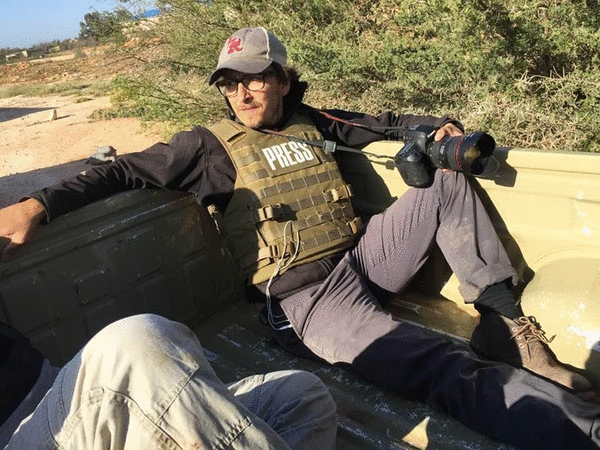
Brent Renaud and his brother, Craig, made documentaries in Haiti, Egypt, Iraq and other hot spots, and won awards for their portrait of a troubled Chicago school. Then, while covering the war in Ukraine, Brent was killed by Russian soldiers.
“For Brent, it was always a focus on people caught in the middle of conflicts,” says Craig Renaud. “Going back to the front lines over and over again, we often had to be on the ground for months at a time in these war zones.”
Included in the clips of Brent Renaud’s work: a weeping Iraqi woman clutching the bloody jeans of her slain son; Renaud interviewing a Honduran boy embarking on the hazardous trek to the U.S. on his own; and a Somali man telling Renaud, “The way you hold the camera, you’re doing it from your heart.”
It also includes casual mention of his diagnosis as neurodivergent.
“He’s calm as a monk in a firefight,” Craig Renaud says, “but a cocktail party in Brooklyn is absolutely terrifying.”
‘Children No More: Were and Are Gone’
In Tel Aviv, a group of Israeli protesters stands silently, holding posters emblazoned with the faces of Palestinian children who have been killed in Gaza by the Israeli military.
“They didn’t choose to be part of this war,” says Israeli filmmaker Hilla Medalia. “They were killed not because they brought it on themselves, but because someone decided they needed to die.”
Medalia’s film follows activists whose silent vigils draw both support and condemnation. So far, despite sometimes having to abandon their protests when situations become potentially threatening, they remain undaunted.
“Their focus is to stop the war and this war crime and other things that are happening in our name, and to force the general public to confront those images and to look at the kids and to feel for them,” Medalia says. “It’s amazing to me how humanity and compassion become an act of resistance.”
‘The Devil Is Busy’
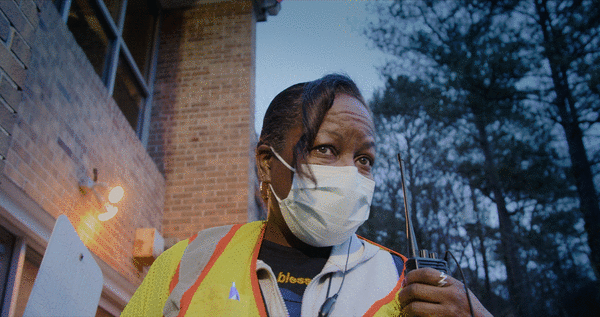
At a women’s health clinic in Atlanta, a typical day includes religious protesters on megaphones (“All men,” points out co-director Geeta Gandbhir) and women seeking help only to discover their pregnancies are just past the six-week mark, making terminating them illegal in Georgia.
“We decided to focus on the providers,” says Gandbhir. “They’re putting themselves at risk to provide care. What you see are the hurdles they face.”
Co-director Christalyn Hampton says the burdens on these independent clinics have drastically increased as about 50 Planned Parenthood sites closed last year. She points out the spectrum of healthcare provided and the complexity of situations for both patients, many of whom must travel considerable distances, and providers.
“When the technician is giving the young lady a sonogram, the [patient] goes through several emotions: She’s happy, she’s crying, she’s nervous. That speaks to the vulnerability these women feel when they have to make certain decisions. That emotional moment [reminds us] of that human aspect.”
‘Perfectly a Strangeness’
A trio of donkeys traverses a desert to an observatory. Captured with creative camera angles and accompanied by an imaginative score, Alison McAlpine’s film pushes the boundaries of what documentaries are.
While shooting her previous feature in Chile, McAlpine noticed donkeys hanging out around an observatory. “We hired three gentle donkeys [for the film]. It was a combination of trying to direct the donkeys up from the valley to the observatory, and sometimes we just followed the donkeys.”
McAlpine acknowledges that her film has been difficult to categorize. “Sometimes it’s at IDFA, which is an international documentary festival. Sometimes it’s just competing with fiction, where it’s been lucky to win awards sometimes. But what is a documentary? As soon as you put on a lens and a frame, it’s a personal document, not something objective.
“I’ve been moved because people have been touched; they seem to be transported elsewhere, which is what one wants as a filmmaker.”
---------
©2026 Los Angeles Times. Visit at latimes.com. Distributed by Tribune Content Agency, LLC.






Comments