Theorizing why 'The Pitt' lacks authentic yinzer accents: 'It's very hard for people'
Published in Entertainment News
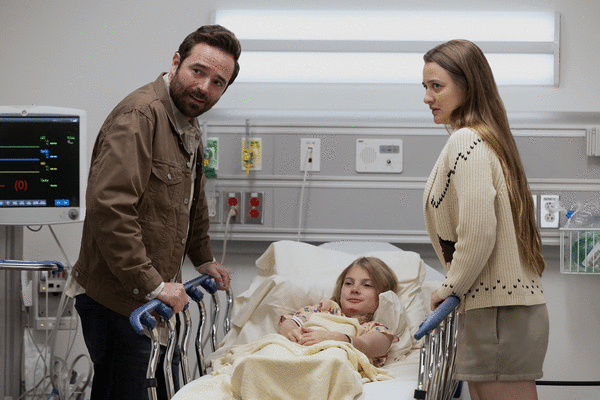
PITTSBURGH — When he didn't notice any "yinzer" accents in "The Pitt," Tom Sarabok took matters into his own hands.
The 27-year-old comedian, who grew up in Richland and moved to New York City at the age of 23, recorded a fan video of himself demonstrating what a nurse in the show might sound like with the regional dialect. The post, backed by the popularity of the HBO Max medical drama, has since garnered over 335,000 views on Instagram.
Though Sarabok believes "The Pitt" as a whole is a positive representation of emergency medical personnel in Pittsburgh (his father works locally as a nurse), he was slightly disappointed in the lack of Pittsburghese accents among the show's cast.
"It makes sense if it's a teaching hospital. There's people that go to Pitt that are from all over so they're not necessarily going to have the accent or a doctor might not have the accent," he said. "But the idea that nurses or people that are from the area, even patients, wouldn't have the accent seems like a detail that isn't accurate to the city."
"The Pitt" does a lot of things to ground itself in Pittsburgh. Its emergency room is based on that of Allegheny General Hospital on the North Side. There are a variety of local references, including ones to Pamela's Diner and Wholey's Market in the Strip District.
But Pittsburghers — including linguistics experts from Carnegie Mellon University and the University of Pittsburgh — have yet to notice a character in the show that uses the local dialect. They theorize that the difficulty in replicating it for people outside of Western Pennsylvania might stop "The Pitt" from including the accent, which likely wouldn't be recognized by the vast majority of its national audience.
"People who recognize the Pittsburgh accent and get warm and fuzzy feelings about it are mostly people in Pittsburgh or people from Pittsburgh," said Barbara Johnstone, professor emeritus of English and linguistics at Carnegie Mellon University. "That's a pretty small segment of the demographic that I think the show is trying to reach."
Johnstone, who has been keeping up with Season 2 of "The Pitt," said she enjoys watching the show for its variety of local references. The CMU professor has lived in the region for almost 40 years.
She was raised in State College, so she's been familiar with the ins and outs of yinzer accents since she was young.
For example, the vowel in words like "cot" and "caught" is pronounced the same way. Vowel sounds in words like "pout" can sound somewhat similar to vowel sounds in words like "pat."
Vowel sounds in words like "fire" can sound like the vowel sound in "far" and words like "seal" can sound the same as words like "sill."
Some sounds are pronounced with the tongue further down in the mouth, such as "stuff," "coat" and "home."
"That's really hard for people to catch on to, so what outsiders would have to do is listen to a lot of Pittsburghers and just learn by memory to duplicate it," Johnstone said.
Training actors not from the Pittsburgh region would likely cost production companies such as HBO Max time and energy as they attempt to hire a language coach, said Scott Kiesling, a linguistics professor at the University of Pittsburgh.
HBO Max did not respond to a request for comment on whether it has taken steps to replicate yinzer accents in "The Pitt" prior to publication.
Though the dialect is currently absent from the show, there are other forms of media that do make the attempt. Namely, a web series called "Greg & Donny" that Kiesling recommends to anyone looking for an example of classic Pittsburghese.
The series consists of four people: Matt Yeager, who plays Donny; Jeff Skowron, who plays Greg; Tamera Gindlesperger-Fisher, who plays Missy; and Kim Cea, who plays Gina. All four use thick Pittsburgh accents in the online skits.
Yeager and Skowron had the idea to start "Greg & Donny" in the mid-2000s after successfully launching a different web series. The two had always enjoyed talking with yinzer accents — even jokingly — and are able to replicate it well because of their Johnstown upbringings.
"My family definitely had [the yinzer accent] and I listened back on recordings I made when I was little and I definitely had it," Skowron said. "I think mine just sort of faded away as I started to move around."
Skowron has taken on roles outside of "Greg & Donny" that have required Pittsburgh accents. Though that way of speaking is essentially second nature for him, it's not for other actors.
"Sometimes they call me and I'll read their lines for them so they can get it down phonetically, but it's very hard for people," Skowron said. "I notice when people who are not from the area try to do it, they tend to slip into southern or even British sometimes. It's very strange."
Curt Wootton, co-creator and star of the online series "Pittsburgh Dad," grew up in Greensburg. Both of his parents were native Pittsburghers and had thick yinzer accents.
Despite his instructors in acting school trying to remove Wootton's ingrained Pittsburgh accent, the situation came full circle when he started performing for "Pittsburgh Dad."
Before moving to Pleasant Hills, Wootton pursued his entertainment career in Los Angeles. While there, he remembers helping an actress who wanted to replicate the accent for one of her sketches.
"I tried to sit her down and go through it phonetically," he said. "She could do Cockney and Irish, but she couldn't quite pick up the yinzer dialect."
Despite its difficulty, Wootton does remember the dialect showing up in films he watched growing up, namely George Romero's "Dawn of the Dead" (1978), when an announcement comes over the PA system at a shopping mall.
"She has one of the greatest yinzer dialects you've ever heard," Wootton said.
Other films, such as "Adventure Land" (2009) and "Striking Distance" (1993) were filmed in Pittsburgh, but didn't focus on recreating local speech phonetically.
"It's unfortunate because it could have been put in the public eye a lot sooner. But I think nowadays with stuff like our show and a lot of the yinzer pride that's on social media, it's getting out there a little bit more," Wootton said. "I imagine the really good performers will be able to pick it up and use it to their advantage."
Though authentic dialects — especially those isolated to smaller regions — are not always a priority for television shows and films, Wootton hopes the Pittsburgh accent becomes more prominent in media as the city continues to show up in large-scale productions.
"It'd be great to finally get the accent out there on the board for everybody to enjoy," he said.
© 2026 the Pittsburgh Post-Gazette. Visit www.post-gazette.com. Distributed by Tribune Content Agency, LLC.


Comments