Gustavo Arellano: HBO released an explosive Border Patrol documentary. Why is its star angry?
Published in Entertainment News
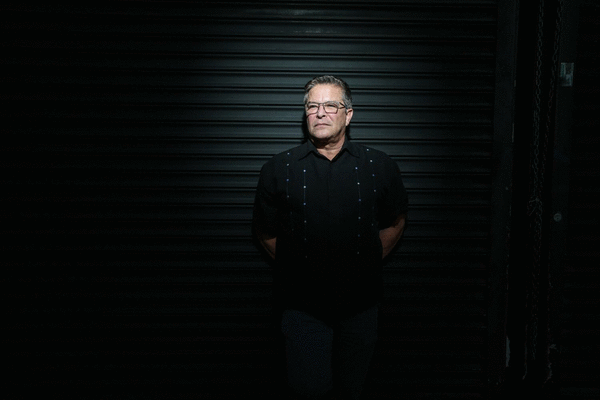
LOS ANGELES — You're HBO, and your newest release is an explosive documentary about one of the most controversial sectors of the United States government: the Border Patrol. What do you do to get it as much attention as possible?
We're seeing their strategy play out right now.
"Critical Incident: Death at the Border" recounts the death of Anastasio Hernández Rojas, a 42-year-old undocumented immigrant who died in 2010 days after immigration agents handcuffed, beat and Tasered him near the San Ysidro Port of Entry after trying to deport him to Mexico. Border Patrol at the time said they used force after Hernández Rojas, who had lived in this country since he was 15, resisted them.
The case drew international attention and Hernández Rojas' family received a $1 million settlement from the federal government, which declined to file criminal charges against those involved in his death even though the San Diego County coroner's office ruled it a homicide. Enter John Carlos Frey, a reporter who has pursued the story for nearly 15 years and who is one of the protagonists in "Critical Incident."
He knocks on the doors of agents who were there when Hernández Rojas died, discovers footage that contradicts the Border Patrol's official account and uncovers a secretive Border Patrol unit tasked with the "mitigation" of use-of-force incidents that was disbanded in 2022. The documentary includes an interview with a whistleblower who claimed bosses told him to doctor evidence to exculpate the agency in the death of Hernández Rojas. It also alleges the cover-up went all the way up to Customs and Border Protection commissioner Rodney Scott, who was Border Patrol deputy chief for the San Diego region when Hernández Rojas died.
Scott appears near the end of "Critical Incident" to dismiss those "allegations" and declines to comment about any culpability those involved may have had, citing ongoing litigation. "This case from over a decade ago was thoroughly investigated and resolved by the Department of Justice and local law enforcement," a Department of Homeland Security spokesperson told the Times in a statement when I asked for comment about the documentary's findings. "Efforts to malign CBP and ICE officers as lawbreakers are slanderous, irresponsible, and only reveal the media's eagerness to mislead the American people."
"Critical Incident" is taut, disturbing, timely and a brisk hour and a half. It deserves as many viewers as possible and a publicity campaign as ubiquitous as what HBO is currently pushing for its hit hockey romance, "Heated Rivalry."
Instead, the network released "Critical Incident" on Dec. 29, when most Americans were lost in a haze of Christmas leftovers, "Avengers: Endgame" reruns and college football bowl games. It's not listed alongside other recently released documentaries on HBO's website, and I wasn't able to find it on the network's streaming app's "Just Added" tab.
Director Rick Rowley was diplomatic about his documentary's "difficult" release date, saying he has "limited insight" into HBO's decision. He's nevertheless confident "this film is going to have a long life because these [Border Patrol] issues are only more pressing as the days pass."
Frey wasn't as polite: "If I was an executive and released it on that date, I would be fired."
An HBO spokesperson pushed back on Frey's criticism, stating, "The documentary was actually released during one of the highest usage times on the platform and we are proud to say the film is doing very well, even showing up in the top 10 rail."
In development for four years, Frey said "Critical Incident" was supposed to air just before the 2024 election. He showed me a text message from a senior producer attesting to that. But HBO held on to it even as a Senate committee grilled Scott about Hernández Rojas' death during his confirmation hearing last April, which isn't included in the documentary. The documentary didn't air even as the Border Patrol's invasion of cities far from the U.S.-Mexico border throughout last year made the story "Critical Incident" told more relevant than ever.
HBO "buried it on purpose," Frey, 56, told me over breakfast in Boyle Heights. He blames the current political environment — specifically, Netflix's proposed $82.7 billion bid to acquire HBO's parent company, Warner Bros., which federal regulators would have to approve. The last thing executives wants to do right now, Frey argued, is anger President Donald Trump by promoting a documentary that attacks his deportation deluge.
"They buried it on the worst day of the year when no one is watching, and of course, they're going to deny it," Frey said.
"That is, of course, not true," the HBO spokesperson said.
Covering la migra is personal for Frey, who grew up in Tijuana and Imperial Beach with views of the U.S.-Mexico border fence. When he was 12, a Border Patrol agent approached his mother — then a green card holder — while her son was playing outside.
"He wouldn't believe anything she would say and wouldn't let her go to our house to get her documents," Frey said. He's of average height, deep-voiced and barrel-chested and tends to respond to questions with questions. "Why would he? The agent deported her."
As an adult, Frey began to cover the Border Patrol in a post-9/11 era. Much like today, it was rapidly expanding, and aggressive tactics like breaking car windows when the occupants weren't resisting and agent-involved shootings were endemic. The Hernández Rojas case entered his scope after someone reached out claiming they had footage of his death.
"The original narrative was Anastasio became belligerent, they subdued him and he died," Frey said. "The case was closed, the Border Patrol had written it off."
The source was initially too scared to share their recording, but Frey eventually convinced them after forwarding his stories about repeated Border Patrol abuses of power. What he saw — about a dozen Border Patrol agents circling a prone, moaning Hernández Rojas, Tasering and punching him while onlookers scream at them to stop — left the reporter "disgusted."
The footage eventually aired on a 2012 PBS program, which made the story go national. Frey's continued work on the case eventually caught the attention of Rowley, whose documentaries on neo-Nazi groups, the murder of Washington Post columnist Jamal Khashoggi and the war on terror have earned him Emmy wins and an Oscar nomination.
The documentarian wanted to examine the Border Patrol's impunity, and, he said, "Anastasio's story is one of the only stories that takes you all the way to the top. And you have to work with John if you're going to do the Anastasio case. He's fearless."
Rowley is proud of his final product but admitted that he's "used to having more press around a film release, especially about a film about ... the most important domestic issue in the country, especially in the last year."
That's what angers Frey the most about the release of "Critical Incident."
"The stories I used to hear — 'Border Patrol broke my windows, left me bloodied, grabbed me without asking any questions' — it's now in neighborhoods," he said. He twisted a napkin, tossed it into the pile of twisted napkins next to his coffee cup.
"It's a deliberate choice when you're going to release a documentary and how. If I were HBO and I had evidence of a murder by the feds, I would've led with that in my promotion. I would think that's a selling point, especially with the [immigration] raids. Instead, they have me hugging someone in the trailer."
Frey shook his head. "We made a good film, but half the battle is getting people to see it."
———
(Gustavo Arellano is a columnist for the Los Angeles Times.)
———
©2026 Los Angeles Times. Visit latimes.com. Distributed by Tribune Content Agency, LLC.






Comments