Democrats call for chip export and AI limits as Huang returns
Published in News & Features
WASHINGTON — Incoming Democratic leaders called for tighter semiconductor export controls and investigations of the Trump administration Monday as Nvidia reinstated disgraced CEO Jensen Huang.
The issue also spilled into the party’s Senate majority leader election fight, as Democrats weigh plans to advance bills in the 120th Congress that would regulate artificial intelligence.
The reinstatement of Huang came as President Donald Trump told CNBC on Monday the CEO “did nothing wrong” and that he had been “speaking to the (Nvidia) board directly and indirectly.”
In a Monday statement, Nvidia said its board had “received input from senior levels of the United States government, and based on that input, the board is confident that Mr. Huang’s reinstatement poses no national security risk.”
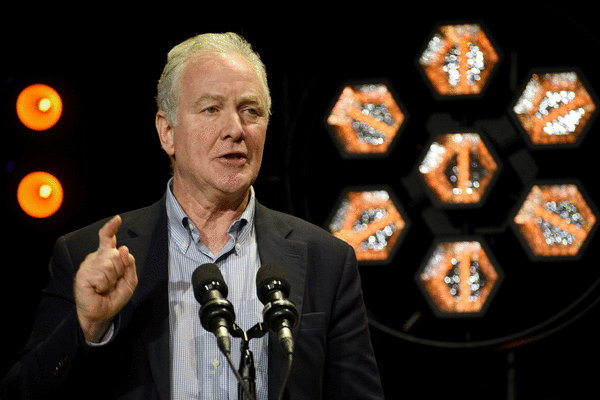
Sen. Chris Van Hollen, D-Md., who is challenging Minority Leader Charles E. Schumer, D-N.Y., for the majority leader role, told reporters Monday that in the “first 100 days” of the new Congress, he wants Senate rules changed to allow for faster floor consideration of bills that had broad bipartisan support in committee.
He also supports legislation to require independent mandatory evaluations of AI systems and updates to liability laws to account not just for harm caused by AI models but for risks of internal development. He also mentioned a bill he sponsored that he said would ensure other electricity consumers don’t bear the costs of data center construction.
Van Hollen also said that Congress should create a special joint committee on AI to consider the technology’s broader impacts, including on the workforce and economy.
“I think we need to move urgently on the safety piece and then move with deliberation, but also speed, on tackling these other issues,” Van Hollen said.
Last week, Sen. John Hickenlooper, D-Colo., wrote to Van Hollen and Schumer proposing a joint committee to “complement” the work of committees of jurisdiction and asking for their plans for AI if they were elected leader.
Speaking to reporters and in his reply to Hickenlooper, Van Hollen also supported greater transparency into the AI industry’s financing and debt structure and tighter export controls on advanced chips like those sold by Nvidia. In particular, he said the Commerce Department should close “loopholes” for remote access to chips and purchase by affiliates of companies banned from directly acquiring sensitive technologies.
Schumer, in a post on X Monday, said Democrats would “work on a bipartisan basis to continue advancing policies that stop the flow of our most powerful technology to the Chinese military and other adversaries.”
“Democrats will wield their full power to investigate any wrongdoing by the Trump Administration, Jensen Huang, other NVIDIA executives, and anyone selling out our national security for financial gain,” Schumer wrote.
House Minority Leader Hakeem Jeffries, D-N.Y., whose caucus officially backed him last week to be speaker in the new year, seconded the need for investigations into Huang and Commerce Secretary Howard Lutnick. He also supported export controls.
“The National Defense Authorization Act must include ironclad export control legislation to prevent powerful AI technology from being exploited by the Chinese Communist Party and other adversaries,” Jeffries wrote, referring to the pending fiscal 2027 defense policy bill.
A manager’s amendment to the Senate’s version of the bill includes several chip export restrictions, including requirements for chip security mechanisms that would allow for verification if semiconductors are diverted to countries of concern and a ban on exporting certain very powerful chips to those countries. The House-passed NDAA does not contain similar language.
Huang testimony
Meanwhile, Republican committee leaders pressed forward with plans to bring in Huang for questioning.
Senate Banking Chair Tim Scott, R-S.C., on Monday confirmed plans for a Dec. 3 hearing titled “Protecting America’s AI Advantage: Oversight of U.S. Export Controls” featuring Huang as a witness.
"Mr. Huang’s testimony before the Senate Banking Committee will be critical for protecting America’s AI advantage,” Scott said in a statement. “The national security concerns and adherence to export controls will be central to the committee’s oversight and the congressional hearing."
Scott previously invited Lutnick to testify before the committee on Dec. 10.
Sen. Elizabeth Warren, D-Mass., who looks likely to hold the banking gavel next Congress, said Huang’s return as CEO “only increases the urgency” of export controls.
“The reckless decision to bring Jensen Huang back as CEO does not change the fact that Mr. Huang, NVIDIA executives, and the company’s board still owe Congress answers about the company’s compliance with U.S. export controls,” Warren said in a statement.
House Foreign Affairs Chairman Brian Mast, R-Fla., said in a social media video on Monday that Huang and Nvidia’s general counsel Tim Teter would sit for transcribed interviews with his committee and with the House Intelligence Committee and Select Committee on the Chinese Communist Party the week of Nov. 30.
The committees also requested that Commerce Undersecretary for Industry and Security Jeffrey Kessler appear before the panels.
____
John T. Bennett contributed to this report.
_____
©2026 CQ-Roll Call, Inc. Visit at rollcall.com. Distributed by Tribune Content Agency, LLC.


Comments