Hungary's incoming leader moves to shake up Orban-built system
Published in News & Features
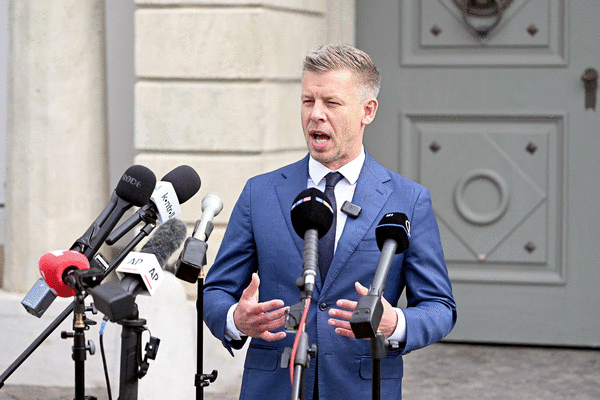
Hungary’s incoming leader Peter Magyar moved fast to assert dominance over the state institutions that outgoing Prime Minister Viktor Orban crafted over his 16 years in power, directing salvos against state media and the president appointed by his predecessor.
In a tense radio interview on Wednesday morning — his first in more than a year-and-a-half — Magyar castigated the interviewer for representing an organization that, he said, had spread fear and despair in the population, telling him that the news operation would be shuttered and relaunched as a true public service broadcaster.
Hours later, he appeared at the office of President Tamas Sulyok in Buda Castle to discuss the timetable for the transition he had to facilitate, while also demanding that the head of state quit once Magyar’s government had been formed.
Sulyok, he said, had shown himself morally unfit to be president by cooperating with Orban’s power grab and not speaking up against corruption and other scandals.
After the meeting, Magyar told reporters that the president had agreed to an accelerated transition schedule with a government likely to be formed on May 6-7, earlier than May 12, which is the latest possible date under the constitution. Sulyok said he would “consider” the demand to resign, according to Magyar.
In the interview, Hungary’s next leader also said he planned to reclaim the shares in two of the country’s biggest companies — oil refiner Mol Nyrt. and drug maker Gedeon Richter Nyrt. — that Orban handed to an academic foundation set up to propagate his “illiberal democracy” ideology.
The display of authority was a dizzying shift after 16 years during which opposition voices were largely shut out of state media outlets. A succession of Orban-appointed presidents acted largely as facilitators of his agenda - leading opponents to call them “signature machines.”
Magyar’s Tisza party won a landslide victory in Sunday’s elections after a period that saw the nationalist Orban expand his influence over all walks of life in a fashion unprecedented in the European Union. His dominance of the airwaves, courts and other state institutions was crucial in keeping millions of voters onside or quiescent through bouts of recession, collapsing social services and allegations of rampant corruption.
In back-to-back half-hour interviews on state radio and television, Magyar compared coverage to propaganda in North Korea and Nazi-era Germany for the intensity of the misinformation. He said journalists there had been complicit in sustaining an illiberal system based on cronyism, impunity and on inciting hatred.
“You’ve caused incredible harm to Hungarian people, in their soul, in instilling fear in children, in grandparents and elders,” Magyar said, adding that his government’s steps won’t be driven by a need to take revenge. “It’s not about me. It’s about every Hungarian person’s right to public media that broadcasts the truth.”
Hearing Magyar in his own words on state media was jarring on several levels.
Over the past year, the former ruling party insider turned critic had been cast in a negative light 96% of the time on the nightly TV news on M1 state TV channel, according to a Republikon Institute study published in February. Orban was mentioned in a positive context 95% of the time. In a statement to Bloomberg last week, the state media regulator had cited “procedural rules” for tying its hands in ensuring fair political coverage.
But it was also the tone of the interviews on Wednesday. Far from ceding the floor to a leader who had just been elected with a record turnout, the journalists were combative and interrupted Magyar, in contrast to often fawning weekly interviews with Orban.
The incoming leader hit back at the reporters for allegedly trying to perpetuate politically biased news that voters had rebuked in Sunday’s election. In a social media post following the interviews, he called it the “last throes of a factory of lies.”
Magyar had vowed during the campaign not only to oust Orban but to dismantle his self-styled illiberal system, which had targeted independent journalists and civil society in an increasingly authoritarian system.
Key to sustaining it was the the pro-Orban media juggernaut that counted hundreds of outlets from news websites, tabloids, regional newspapers and social-media influencers that benefited disproportionately from state advertisements.
Magyar’s planned steps mirror what happened in Poland in 2023. Returning Prime Minister Donald Tusk took the state media’s news channel off air after the previous nationalist administration in Warsaw had reduced it into its mouthpiece. Magyar has said his first trip abroad will be to Warsaw to meet Tusk, a center-right ally who had become one of the most scathing critics in Europe of the pro-Kremlin Orban.
Magyar’s ability to restore media freedoms will be key for Hungary’s access to more than $20 billion in frozen E.U. funds, which had been suspended over a range of concerns including corruption, rule of law and also the influence of politics over newsrooms.
©2026 Bloomberg L.P. Visit bloomberg.com. Distributed by Tribune Content Agency, LLC.

Comments