US outlines phased strategy for Venezuela's stabilization after Maduro capture
Published in News & Features
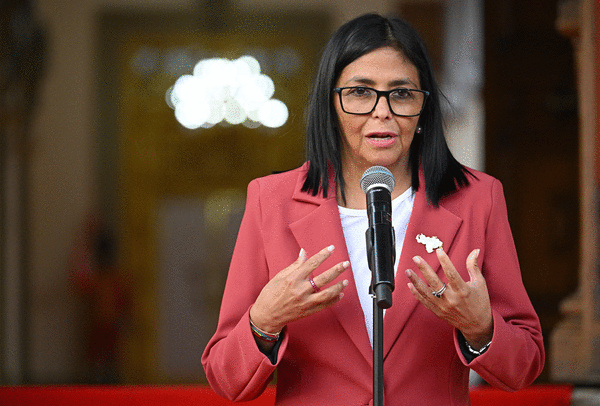
The Trump administration has been working through a phased strategy to stabilize Venezuela following the capture of Nicolás Maduro earlier this year, prioritizing security and economic recovery under interim leader Delcy Rodríguez as Washington gradually deepens engagement with Caracas.
The approach, described in recent remarks by a senior U.S. defense official at a Miami forum, envisions a sequence of stabilization, recovery and eventual political transition, with improvements in security conditions seen as the foundation for broader economic and diplomatic steps.
“You have stabilization, you have recovery, and then you have transition. Stabilization and recovery are kind of concurrent phases… but obviously, the bedrock of stabilization is security,” Joseph Humire, assistant secretary of defense for homeland defense and Americas security affairs, said during the event organized by the Heritage Foundation, which posted the video of his remarks on Monday.
In his comments, Humire added that U.S. officials were engaging Venezuelan authorities “every day… at different levels” as relations normalize. His comments suggested that while democratic restoration remains the end goal, officials view it as a later stage that could follow a potentially lengthy stabilization period.
By emphasizing security and economic recovery as prerequisites — and placing the transition phase outside his department’s immediate focus — the remarks indicated that Washington expects political change to emerge gradually, shaped by conditions on the ground rather than a fixed timeline.
The broader policy has taken shape since the Jan. 3 capture of Maduro in a U.S. raid in Caracas, an operation that reshaped Venezuela’s political landscape and opened the door to a U.S.-backed stabilization effort.
In the months since, interim authority has been exercised by Rodríguez, Maduro’s vice president and a longtime Chavista figure, whose government the Trump administration has acknowledged as its primary counterpart during the transition. President Donald Trump has confirmed that recognition publicly, saying Washington is “dealing with them” and praising Rodríguez’s performance.
“Delcy has done a very, very good, excellent job. And the relationship is solid,” Trump said in February, adding that the White House is supervising a process aimed at stabilization and economic recovery.
The stabilization effort has been closely tied to the revival of Venezuela’s oil sector, which U.S. officials view as central to restoring economic stability and reducing migration pressures. Trump has highlighted the reopening of crude production under a framework negotiated between Washington and Caracas.
Once producing more than three million barrels per day, Venezuela’s oil output collapsed in recent years amid mismanagement, corruption and sanctions. U.S. officials now say increasing production — while maintaining oversight of foreign participation — is key to stabilizing the economy and countering geopolitical rivals.
In his remarks, Humire said improvements in security conditions were expected to unlock broader economic engagement, with multiple U.S. agencies preparing to support investment.
“Over time, what we’re expecting to see is the security situation in Venezuela increase, stabilization begin to take hold,” he said. The administration, he added, is “very much looking to bring investments into the country to make Venezuela become a semblance of what used to be one of the richest countries in all of Latin America.”
He framed the effort as gradual, pointing to Venezuela’s past prosperity as a long-term benchmark. “People remember how Venezuela used to be in the 1980s, 1970s,” he said.
The administration has already increased high-level engagement. U.S. Energy Secretary Chris Wright recently traveled to Caracas for meetings with Rodríguez and senior officials, while the Treasury Department approved new licenses allowing non-Venezuelan companies to resume operations under compliance conditions. The measures mark a shift from the “maximum pressure” approach toward targeted sanctions relief tied to oversight mechanisms.
Humire also indicated that his office is focused primarily on stabilization, with decisions about a political transition left to senior leadership, including Trump and Secretary of State Marco Rubio.
He cautioned that the process would be gradual and imperfect, but argued that incremental improvements in security, governance and economic activity would signal progress.
“It’s not going to be a perfect situation, but it’s going to be better.”
_____
©2026 Miami Herald. Visit miamiherald.com. Distributed by Tribune Content Agency, LLC.





Comments