Anchorage election officials push back on 'misleading' claims about its mobile voting system
Published in News & Features
ANCHORAGE, Alaska — A company that’s been touting Anchorage’s mobile voting use has been told to stop.
The Municipality of Anchorage in March sent a cease-and-desist letter to the Mobile Voting Project and its founder, Bradley Tusk, asserting the company has misrepresented the city’s mobile voting.
As the municipality prepares for its April 7 election, it has had to contend with what its attorneys have called “false and misleading statements about the Municipality’s voting technology that risk undermining voter confidence in the integrity of our elections,” according to the cease-and-desist letter dated March 11.
The New York Times on Nov. 13 published an article titled “Will People Trust Voting by Phone? Alaska Is Going to Find Out,” referring to Anchorage’s use of mobile voting as an “experiment with internet voting in local elections, betting that its ease and security will win over voters even in an era of election conspiracy theories.” The article prominently featured venture capitalist Tusk and the Mobile Voting Project.
Municipal Clerk Jamie Heinz released a swift response to the article that evening, saying it was “an egregious misrepresentation of MOA Elections.” Heinz said the article made it seem like voting options had changed and that the municipality mainly uses mobile voting.
Electronic voting has been incorporated in municipal elections since 2018, allowing for voters to cast their ballots via email or fax. During the 2025 municipal election, the city allowed voters to cast their ballot through a “secure document portal.” Akin to software like DocuSign, this lets registered voters cast their selections online with an electronic signature.
Only a fraction of Anchorage voters opt for mobile voting, Heinz said. Last year, 136 registered voters used the secure document portal to vote, including those who were abroad and did not have access to a printer or a permanent address. For the upcoming municipal election, 182 have so far used the portal.
The municipality uses OmniBallot, a software portal through the election vendor Democracy Live, for this type of voting. Democracy Live, according to its website, has been used in 36 states and in more than 7,000 elections.
When The New York Times initially reached out to the municipality for inclusion in a story on voting, Heinz said staff believed they were giving anecdotes alongside the roughly 2,500 other jurisdictions that offer similar electronic voting options.
“We were quite shocked to learn that we were the only ones being portrayed to be using this method,” Heinz said.
Even after the conversation around the article had “died on our side of the country,” people were still talking about it on the East Coast, Heinz said.
Since the publication of that story, Heinz said she has received phone calls from a municipality in Vermont, a legislator’s aide in Maryland and international media outlets.
Heinz linked the inquiries she got to the article and Tusk, who had posted online about Anchorage’s mobile voting use in conjunction with his Mobile Voting Project software.
In a now-amended webpage cited by the municipality in its cease-and-desist letter, the Mobile Voting Project website before mid-March claimed “Anchorage will be the first city to offer mobile voting in its municipal elections.”
To avoid another stir in Anchorage, the municipality decided to directly ask Tusk to stop, she said.
“Anything relating to false information around elections is problematic, in my opinion,” Heinz said.
Assembly Chair Christopher Constant said the article made it seem like Anchorage was an “activist leading the cause” to move from a paper ballot to voting by phone.
“We will defend our elections against any perception of cavalier or super-progressive policy,” Constant said.
A New York Times spokesperson in November said the article was “accurate and based on interviews with Anchorage government and election officials, as well as remote voting experts.”
“Our coverage fairly reflects the realities of this current digital electoral transformation, which has taken place in several parts of Alaska and other regions seeking to overcome logistical challenges and improve voter access,” spokesperson Danielle Rhoades Ha said in a November email.
There did appear to be a brewing partnership between the Mobile Voting Project and Democracy Live late last year that would have connected Anchorage to the service.
The day after The New York Times article published in late 2025, the Mobile Voting Project announced VoteSecure, an open-source voting software, and said Democracy Live would use it. But that didn’t happen, according to both the Mobile Voting Project and Democracy Live.
“Democracy Live is working to implement our technology, VoteSecure, but as I mentioned in the previous statement, it is not yet doing so. So because it is not available yet for Anchorage, we are not promoting it as such,” a Mobile Voting Project spokesperson said. “Simple as that.”
Democracy Live CEO Bryan Finney said the option is still on the table.
“We respect and appreciate MVP’s strong advocacy for improving voting technology in the U.S. While we have not used their technology yet, we remain open to using any tools which can be improve the security and integrity of elections,” Finney wrote in an email Friday.
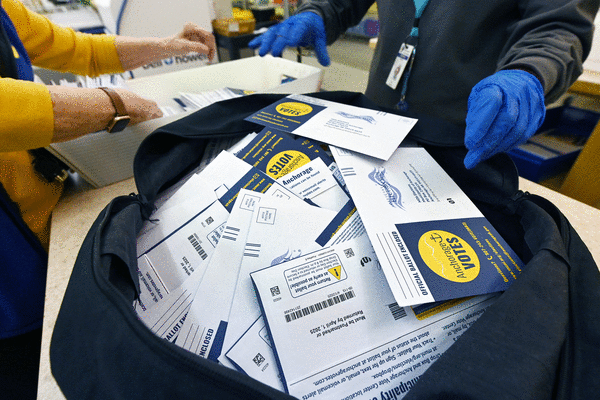
Ballots are due April 7 in the Anchorage municipal election, where voters will decide on six Anchorage Assembly seats, two school board seats and a host of bonds. Physical ballots can be delivered to one of 18 secure drop boxes or returned to an Anchorage Vote Center, where in-person voting and other voter services are offered. Mailed ballots must be postmarked by April 7 to be counted.
©2026 Anchorage Daily News. Visit at adn.com. Distributed by Tribune Content Agency, LLC.






Comments