Maduro asks federal judge to toss case, claiming US sanctions deny fair trial
Published in News & Features
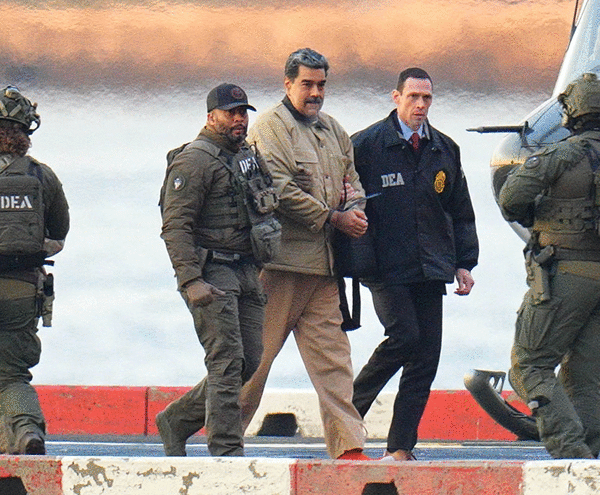
Lawyers for former Venezuelan strongman Nicolás Maduro and his wife, Cilia Flores, are asking a U.S. federal court to dismiss the criminal case against them, arguing that Washington has violated their constitutional rights by blocking access to funds needed to mount their defense.
In a filing submitted in the U.S. District Court for the Southern District of New York, defense attorneys contend that sanctions enforced by the Treasury Department’s Office of Foreign Assets Control are preventing the couple from using Venezuelan government funds to pay for their legal representation.
The restrictions, they argue, effectively deny Maduro and Flores their Sixth Amendment right to counsel of their choice and their Fifth Amendment right to due process, as neither has the personal resources to finance their defense.
“The only remedy is dismissal,” their attorneys wrote, arguing that forcing the defendants to rely on court-appointed counsel cannot cure what they describe as a constitutional violation.
The filing marks a pivotal moment in a case that U.S. prosecutors have framed as one of the most far-reaching efforts ever to hold a former head of state accountable for alleged involvement in global drug trafficking.
Years in the making
At the center of the prosecution is a sweeping federal indictment that paints a stark picture of Venezuela’s upper echelons of power, alleging that for more than two decades the country’s leadership turned the machinery of the state into a vehicle for narcotics trafficking.
“For over 25 years,” prosecutors wrote, “leaders of Venezuela have abused their positions of public trust ... to export tons of cocaine into the United States.”
According to the indictment, Maduro and Flores were part of a tight inner circle of political and military figures operating what U.S. officials have long referred to as the Cartel de los Soles — a network allegedly composed of senior officials who used their positions to facilitate the movement of cocaine through Venezuelan territory.
The charges accuse Maduro, Flores and others of participating in a decadeslong conspiracy involving drug trafficking and narcoterrorism, with cocaine shipments moving from Colombia through Venezuela and onward to the United States via Central America and the Caribbean.
“The profits of this illegal activity flow to corrupt civilian, military and intelligence officials,” prosecutors said, describing a patronage system in which power and illicit wealth reinforced one another.
Transnational network
U.S. authorities describe the Cartel de los Soles as a central hub within a broader transnational trafficking network linking some of the hemisphere’s most powerful criminal groups.
Among those named are Colombia’s FARC and ELN guerrillas, Mexico’s Sinaloa and Los Zetas cartels, and Venezuela’s own Tren de Aragua criminal gang.
According to prosecutors, cocaine produced in Colombia was funneled through Venezuelan territory under the protection of state officials, then shipped north through established routes toward U.S. markets.
“Venezuelan officials and their family members ... partnered with narcotics traffickers and narcoterrorist groups,” the indictment states, describing a system in which each organization controlled a segment of the pipeline — production, transportation, security or distribution — while Venezuelan authorities ensured safe passage.
The result, prosecutors argue, was a highly coordinated network with global reach, sustained over decades by the convergence of political power and criminal alliances.
Inner circle role
Within that system, prosecutors portray Maduro not as a peripheral figure but as a central architect.
Before becoming president, they say, he used his position as foreign minister to provide diplomatic cover for trafficking operations — including the alleged sale of diplomatic passports to traffickers and the facilitation of flights carrying illicit proceeds.
As president, the indictment claims, he allowed “cocaine-fueled corruption to flourish” for the benefit of his regime and inner circle.
Flores, a longtime political figure and former head of the National Assembly, is also charged in connection with the alleged conspiracy.
The document also highlights the role of Interior Minister Diosdado Cabello, describing him as a key power broker who exercised influence over military and intelligence structures involved in protecting drug shipments.
Together, prosecutors say, these figures sustained a system in which loyalty was rewarded with access to illicit profits, reinforcing a cycle that allowed the network to endure for years.
Sanctions vs. constitutional rights
Against that backdrop, Maduro’s defense is shifting the legal battle toward a constitutional question with potentially far-reaching implications.
At issue is Treasury’s decision earlier this year to revoke licenses that had allowed the defendants to receive payments from the Venezuelan government to cover legal expenses.
Their lawyers argue that under Venezuelan law, the state is obligated to pay those costs — creating a property right that U.S. authorities are now unlawfully blocking.
They also stress that the funds in question are “untainted” — not derived from alleged criminal activity — placing them within protections recognized by the U.S. Supreme Court.
Citing prior rulings, including Luis v. United States and United States v. Stein, the defense argues that the government cannot interfere with access to legitimate resources needed to hire legal counsel.
The government, they say, does not dispute that Maduro and Flores lack personal funds, nor that Treasury has allowed similar third-party payments in other cases.
Instead, prosecutors have pointed to sanctions policy and national security concerns — arguments the defense calls both insufficient and inconsistent.
“The mere invocation of national security ... is not a talisman that overrides a defendant’s constitutional rights,” the filing states.
Questions over consistency
The defense also raises questions about the government’s handling of the licensing process.
According to the attorneys, Treasury initially issued licenses allowing payment of legal fees, only to later revoke them. At times, officials described the original approvals as administrative errors; at others, they cited broader policy considerations following consultations with the State Department.
The shifting explanations, the defense argues, suggest the decision may have been arbitrary.
They also note that Treasury has continued to authorize other transactions involving Venezuelan funds — including commercial and legal activities — even as it blocks payments in this case.
That inconsistency, they argue, undermines the government’s position that national security concerns justify the restrictions.
_____
©2026 Miami Herald. Visit miamiherald.com. Distributed by Tribune Content Agency, LLC.




Comments