Judge weighs removing Santa Clara DA from Stanford felony vandalism retrial
Published in News & Features
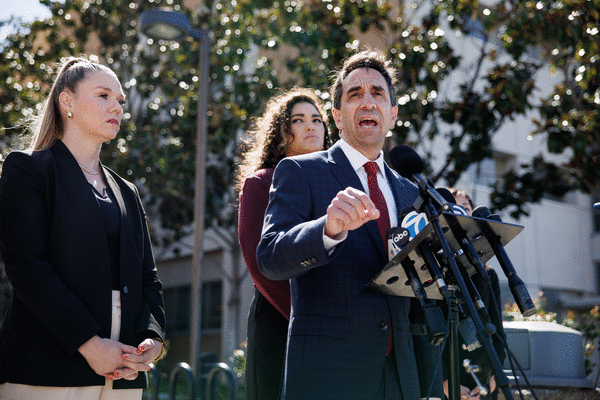
SAN JOSE, Calif. — A Santa Clara County judge is weighing whether to remove District Attorney Jeff Rosen and his office from retrying a felony vandalism case against five pro-Palestinian activists — a ruling that could upend one of the most serious prosecutions in the country tied to the wave of campus protests in 2024.
Judge Kelley Paul said Wednesday she would rule by March 26 on the defense’s request for additional records — and potentially the recusal itself — and would not entertain further arguments before then.
Deputy Public Defender Avi Singh, who represents defendant German Gonzalez, filed the motion Feb. 25, arguing Rosen used the high-profile prosecution to solicit campaign donations that Singh called “monetizing criminal prosecution.” Singh said Rosen highlighted the case on his campaign website alongside donation buttons and on a page titled “DA Rosen Fighting Anti-Semitism.”
“Our claim is actually quite focused. It’s about raising money by trading off a prosecution of a defendant essentially,” Singh said during Wednesday’s hearing. “If you go ask people for money and say it’s because I’m fighting antisemitism by prosecuting these defendants, it doesn’t matter whether anybody gave you money.”
The defense also asked the court to require prosecutors to turn over additional records, including details about a fundraising appeal sent to more than 600 Los Angeles County donors that referenced the case and information about when Rosen’s campaign website was created. Defense attorneys say they want to determine whether Rosen’s fundraising influenced specific decisions — including a motion to bar use of the word “genocide” at trial and the decision to immediately announce he would retry the case after the mistrial.
Though Singh filed the motion on behalf of Gonzalez, all defendants — including those who accepted plea deals or entered diversion programs — joined the petition to remove Rosen, they told the court Wednesday.
The five who went to trial are Gonzalez, Maya Burke, Taylor McCann, Hunter Taylor Black and Amy Zhai, known as the “Stanford 5.” The remaining defendants either accepted plea deals or entered diversion programs that could allow charges to be dismissed if they complete certain requirements.
If convicted at retrial, the five face up to three years in prison and potential restitution.
The prosecution, however, says the defense is seeking records it does not have.
At the March 26 hearing, Paul said she will first rule on the defense’s request to compel additional records. If that request is denied, the court will move to the recusal motion. If it is granted — giving the defense time to obtain further documents — the recusal ruling will be delayed.
Deputy District Attorney Rob Baker argued during Wednesday’s hearing that the office does not have the records the defense is seeking — including the donor list, fundraising speech notes or a financial breakdown from a December fundraiser.
Baker said campaign donation records are publicly available and that the defense had weeks to obtain them through proper channels. He also argued the DA’s office and Rosen’s campaign are legally separate entities, noting the office had already turned over emails between a senior prosecutor and the campaign manager.
A representative from the state Attorney General’s office also opposed the motion, arguing that state law does not guarantee access to additional evidence in efforts to remove a prosecutor, and that the defense had not met the legal threshold to justify it or delay the trial.
The case stems from a June 2024 demonstration in which protesters briefly occupied Stanford University’s executive offices, calling on the school to divest from companies linked to Israel over the war in Gaza. University officials accused demonstrators of causing at least $300,000 in damage.
A mistrial was declared Feb. 13 after jurors split 8-4 in favor of guilt on the conspiracy charge and 9-3 on the vandalism charge, falling short of the unanimous verdict required for conviction.
The prosecution is among the most serious criminal cases brought nationwide in connection with the wave of pro-Palestinian campus protests that swept the country in 2024. Similar cases at Columbia University, the University of Michigan and UCLA were either dismissed or never pursued criminally.
Stanford has become a flashpoint for pro-Palestinian expression and accusations of antisemitism on campus. Separate subcommittees in 2024 found a basis for alleged antisemitism and anti-Israel bias, as well as documented cases of Islamophobia and discrimination against Muslim, Arab and Palestinian students.
Outside the campus, the case has underscored how deeply divided views over the war in Gaza have complicated court proceedings, with attorneys clashing over whether political views should influence jury selection, defense arguments or witness testimony.
If the motion to recuse the DA is granted, it would be one of the rare instances in Santa Clara County in which an entire district attorney’s office is removed from a case. The attorney general would then decide whether to take over the prosecution or dismiss the charges.
There’s been a precedent for that in Santa Clara County.A similar situation arose from a 2020 pay-to-play scandal involving concealed-carry weapons permits under former Sheriff Laurie Smith. A judge initially rejected the removal motion, but a state appeals court later overturned that decision. The attorney general’s office took over the case and ultimately dismissed the charges.
©2026 MediaNews Group, Inc. Visit at mercurynews.com. Distributed by Tribune Content Agency, LLC.





Comments