State lawmakers push to expand laws allowing guns on college campuses
Published in News & Features
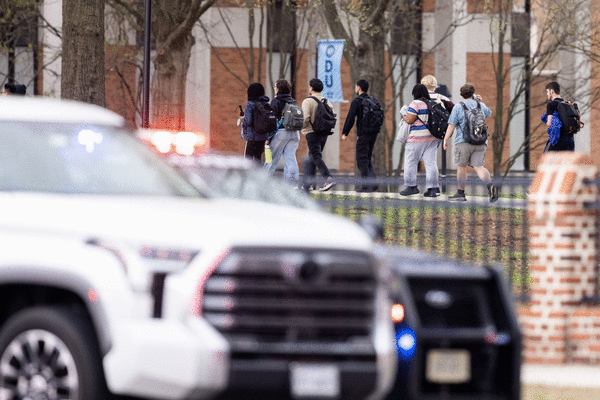
In at least six statehouses this year, lawmakers are revisiting a long-running debate over whether guns should be allowed on college campuses.
Republican lawmakers in Florida, Louisiana, New Hampshire, South Dakota, Utah and Wyoming have introduced bills that would allow students, staff or visitors with concealed carry permits — and in some cases, without permits — to bring firearms onto public college campuses.
Supporters say the proposals would allow people to defend themselves during emergencies. Opponents argue they could make campuses less safe and increase the risk of accidental or impulsive violence.
The push comes amid another year of intense debate over gun policy in state legislatures, where lawmakers are advancing sharply different measures.
And it comes as college campuses continue to grapple with the threat of gun violence.
On March 12, a gunman opened fire inside a classroom at Old Dominion University in Norfolk, Virginia, killing one person and injuring two others before ROTC students fought back. One of the students stabbed the gunman, killing him, according to law enforcement officials.
Virginia law currently prohibits firearms on public college and university campuses. The FBI is investigating the attack as a possible act of terrorism.
The Old Dominion University attack was the most recent of 17 deadly shootings on college campuses nationwide since 1966, according to Stateline research.
More than half of the states prohibit firearms on public colleges and universities. In some states, individual institutions may decide whether to allow guns on campus.
At least 14 states currently allow firearms on public college campuses, though some restrict them to people who have a valid carry license.
Campus carry proposals are part of a broader push by gun rights advocates to dismantle gun-free zones or other designated “sensitive places,” such as schools, hospitals, places of worship or government buildings. Advocates also are pushing for laws that allow people to carry guns without having to first get permits, which advocates call “constitutional carry.”
“It’s definitely in conjunction with the political fight to expand constitutional carry,” said Chris Stone, the director of state and local affairs for Gun Owners of America, one of the country’s largest gun advocacy groups.
Supporters often argue that gun-free zones may attract crime and make schools or other locations more likely targets for mass shootings. They also contend that disarming individuals limits their ability to defend themselves.
Some gun rights advocates cite research by economist John Lott, who leads the Crime Prevention Research Center, suggesting that about 82% of mass shootings occurred in gun-free zones between 1998 and 2025.
“All you do by creating a gun-free zone is creating a magnet — just read the diaries and manifestos. All you do is create a magnet for those who want to go and kill people,” Lott, who also served as a senior adviser for research and statistics at the U.S. Department of Justice during the first Trump administration, told Stateline.
But some experts say the data on whether gun-free zones increase violent crime is inconclusive.
A 2024 study published in the peer-reviewed journal The Lancet Regional Health found that active shootings were 62.5% less likely to occur in gun-free establishments than in places that allow firearms, based on an analysis of 150 U.S. active-shooting locations and 150 similar control sites from 2014-2020.
Some Second Amendment experts say states retain wide flexibility to regulate guns on college campuses, yet the biggest unresolved legal questions involve the “where” of campus gun bans — how far gun-free school zones can stretch beyond classrooms into areas such as student housing, parking lots and other university‑owned property.
“It’s clear that there is a power to prohibit guns on school grounds, and the real question is just how broad that power is,” said Joseph Blocher, a law professor at Duke University. Blocher is the co-founder and faculty director of Duke’s Center for Firearms Law.
Proposed measures
The campus carry proposals considered this year vary widely.
In Wyoming, lawmakers debated a measure that would have allowed anyone eligible under the state’s permitless, or “constitutional carry,” law to carry concealed firearms on college campuses. The proposal did not pass; under current law, only people with a state-issued concealed carry permit may carry on campuses.
Lawmakers approved a separate measure, however, which was signed into law earlier this month by Republican Gov. Mark Gordon. The new law, which takes effect in July, lowers the minimum age for a concealed carry permit from 21 to 18 and removes the requirement that applicants under 21 obtain a discretionary recommendation from their local sheriff.
“When the good guys are armed, the bad guys don’t like showing up,” said Wyoming state Rep. Jeremy Haroldson, a Republican, who sponsored both measures.
In Louisiana, lawmakers are considering a proposal that would allow anyone 18 or older who is legally permitted to possess a firearm to carry one on campuses, including inside buildings. The measure would apply to students, faculty, staff, contractors and visitors. Since July 2024, the state has allowed anyone 18 or older to carry a concealed firearm without a permit in other locations.
“We can trust people with their rights and the ability to be responsible with them more than I think some people give them credit for,” said Republican state Rep. Danny McCormick, the bill’s sponsor. “I see it making campuses more safe.”
The bill includes restrictions, such as prohibiting firearms in locations already restricted under federal law, during disciplinary or administrative hearings, in medical or mental health facilities and at events with security screenings. It would also prevent the state’s higher education governing boards or individual institutions from imposing stricter rules than state law.
In New Hampshire, lawmakers are weighing legislation that would prohibit public colleges and universities from banning or regulating the possession or carrying of firearms and nonlethal weapons. The measure passed the House earlier this year and is now under consideration in the Senate.
In South Dakota, the House Education Committee rejected a proposal that would have removed the requirement that individuals hold an enhanced concealed carry permit to carry on public university and technical college campuses governed by the South Dakota Board of Regents. Under current law, only people with enhanced permits may carry on those campuses.
In Utah, following the assassination of conservative activist Charlie Kirk at Utah Valley University last September, lawmakers passed a bill that would ban open carry while allowing eligible people to carry concealed without a permit.
The measure now awaits action from Republican Gov. Spencer Cox and would take effect May 6 if signed.
Arming faculty and staff
Meanwhile, less than a year after a gunman opened fire on the campus of Florida State University, killing two people and injuring six others, state lawmakers approved legislation that would allow professors and other employees designated by university presidents to carry firearms on public college and university campuses. Both chambers of the legislature passed the bill, and it will soon make it to GOP Gov. Ron DeSantis for consideration.
The measure would expand the state’s voluntary School Guardian Program — created for K-12 schools after the 2018 shooting at Marjory Stoneman Douglas High School in Parkland, Florida — to higher education. Faculty and staff who volunteer and complete specialized training could be authorized to carry guns to respond to potential active shooter situations.
The program would provide 144 hours of training, compared with the 770 hours required for Florida law enforcement officers.
Some opponents say the required training falls short of law enforcement standards and that key policies — including use-of-force thresholds, weapon types and storage, and coordination with police — remain unclear. Critics also have raised concerns about liability, compensation for guardians, and how effective handguns would be on open campuses.
“If I could just ask one thing of lawmakers, it would be, ‘Let’s take a pause on this. Let’s readdress what’s in this bill,’” said Tom Hixon, who sits on the Everytown Veteran Advisory Council and previously served as a Marine. Everytown for Gun Safety advocates for stricter gun laws.
Tom’s father, Chris Hixon, an athletic director and a Navy veteran, was killed while trying to stop the Parkland shooter. Florida’s K-12 guardian program was renamed in his honor, alongside security guard Aaron Feis and teacher Scott Beigel.
“If we are dead set on passing this, let’s make sure that we’re passing it with all the proper inclusions, safeguards, accountability, training, safety,” Hixon said.
The bill also would require colleges and universities to conduct threat assessments, establish threat-management teams, and provide training for faculty to identify behavioral warning signs.
“We wouldn’t ask doctors to arm themselves in the event of a shooting at a hospital. We wouldn’t ask fast-food employees to arm themselves in situations where a shooter might come through the drive-thru. But we’re expecting our professors to be prepared to do something like that,” said Andres Cubillos, a graduate student at Florida State University and volunteer with Students Demand Action, a gun control advocacy group.
Campus carry movement
The modern push for campus carry laws began more than two decades ago. Utah became the first state to allow concealed firearms on public college campuses statewide in 2004.
Momentum grew in the following decade, particularly after high-profile school shootings and the expansion of permitless and concealed carry laws across the country.
“Those movements are all very intricately linked to one another in the process of restoring the Second Amendment,” said Stone, of Gun Owners of America.
At least 29 states have expanded access to firearms by adopting permitless carry laws.
“It’s absolutely true that rules about where guns can be carried intersect with rules about who gets to carry them,” said Blocher, the Duke University law professor. “It is also the case that the states that are deregulating in one area tend to deregulate in the other as well.”
Legal debates
The U.S. Supreme Court has long suggested that governments can bar guns in certain locations — including schools and government buildings — but it has offered little guidance on how far those gun-free zones can stretch across today’s sprawling college campuses.
“It’s fair to say that states and universities still have broad authority to make decisions about guns on campus, to regulate them or to deregulate them,” Blocher said.
The Supreme Court’s 2022 decision in New York State Rifle & Pistol Association v. Bruen said that modern gun laws must align with the country’s historical tradition of firearm regulation.
Bruen also limited the extent to which states can restrict who may carry guns in public, which has shifted some legal debates to focus on where guns can be carried.
Courts generally accept that schools fall within the category of “sensitive places,” Blocher said, but the doctrine is still underdeveloped: Judges have said far less about how to treat off-campus housing, remote research sites or other university properties.
“It is the category that we kind of have the least guidance on — what locations are OK to restrict guns in, and why,” he said.
____
Stateline reporter Amanda Watford can be reached at ahernandez@stateline.org.
____
©2026 States Newsroom. Visit at stateline.org. Distributed by Tribune Content Agency, LLC.






Comments