New Iranian leader Khamenei vows 'never-ending' revenge in first public statement
Published in News & Features
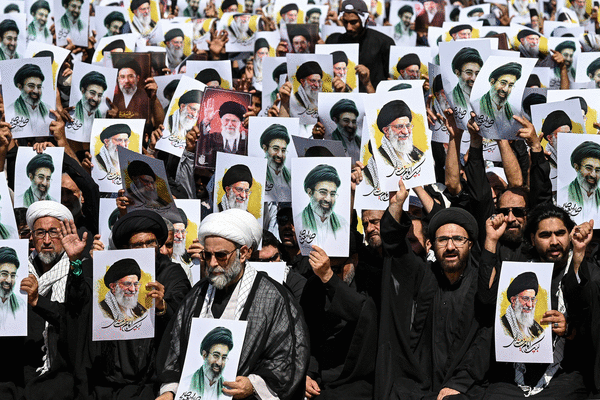
WASHINGTON — Iran’s new supreme leader, Mojtaba Khamenei, vowed retaliation Thursday against the United States and Israel and signaled that Tehran will continue to choke off the world’s most crucial oil route, as the war strained global energy markets and deepened the humanitarian crisis across the region.
In his first public remarks since U.S.–Israeli strikes killed his father, Supreme Leader Ayatollah Ali Khamenei, Mojtaba Khamenei swore revenge. The new leader, notably, did not appear in person for the televised statement. Instead, his written words were read aloud on state media.
“We will never retreat, and vow to avenge the blood of our martyrs,” he said. “Our revenge will be never ending, not only for the late supreme leader, but also for the blood of all of our martyrs. … Those who killed our children will pay the price.”
Khamenei offered condolences to families who lost children in a strike on a girls’ school in Minab that killed at least 175 people, many of them children, according to Iranian officials. He also warned that the war could go on indefinitely, “(depending) on the interests of the parties.”
The Associated Press, citing two sources, reported that outdated intelligence probably led to the deadly U.S. missile strike on the elementary school. U.S. Central Command relied on target coordinates for the strike using outdated data provided by the Defense Intelligence Agency, according to a person familiar with the preliminary finding.
Khamenei indicated that Tehran would maintain its blockade in the Strait of Hormuz, a key choke point through which 20% of the world’s oil supply is shipped. He also said that he believes in friendship with his country’s neighbors, but that attacks on U.S. military installations in the region will continue. He described maintaining pressure on the waterway as a necessary part of Iran’s war strategy.
War threatens energy supply disaster
His remarks came as attacks continued to disrupt shipping and energy infrastructure across the Persian Gulf. The war sent the price of oil up 10% Thursday as Iranian forces intensified strikes on vessels attempting to pass through the Strait of Hormuz, leaving hundreds of ships stranded at its entrances.
“They will pay the price. We will destroy their facilities,” Khamenei said. “It is necessary to continue our defensive activity, including continuing to close the Strait of Hormuz.”
Iranian strikes Thursday in the Persian Gulf destroyed a U.S.-owned tanker flying a Marshall Islands flag. The Islamic Revolutionary Guard Corps claimed responsibility for the attacks, which killed at least one crew member and set two vessels ablaze, according to the Associated Press.
Early Thursday morning, a container ship was reported to have been struck by an “unknown projectile” near Dubai, causing a small fire, the United Kingdom Maritime Trade Operations reported.
“The war in the Middle East is creating the largest supply disruption in the history of the global oil market,” according to an International Energy Agency report released Thursday.
On Wednesday, the 32 member countries of the IEA unanimously agreed to release 400 million barrels of oil from emergency reserves to address the disruptions. The United States will contribute 172 million barrels toward that release over 120 days.
The latest incidents follow drone strikes and explosions targeting fuel storage facilities across the gulf, including at energy sites in Bahrain and at the port of Salalah in Oman, an important hub for tankers seeking to bypass Hormuz. It’s a relatively thrifty way to sow global chaos without using a lot of resources, according to Benjamin Radd, a UCLA expert on U.S. foreign relations with Iran.
“They cannot match the United States and Israel on the ballistic, kinetic warfare front,” he said. “But Iran has now seen the disproportionate effect that their maritime escalation has on the global economy and energy markets. Look at how much damage they can inflict by doing relatively little.”
Despite the intensity of the fighting, the Trump administration has not clearly defined the end goal of the campaign or how long it could last. Defense Secretary Pete Hegseth has said the conflict could last seven more weeks, but President Trump was confident of a quicker resolution. “It’s just a question of when, when do we stop?” he said Wednesday during a trip to Hebron, Ky.
“The United States is the largest Oil Producer in the World, by far,” Trump wrote on his social media website. “So when oil prices go up, we make a lot of money. BUT, of far greater interest and importance to me, as President, is stoping an evil Empire, Iran.”
Gov. Gavin Newsom had a different spin for Californians as they saw prices at the pump tick to an average of more than $5.20 per gallon: “Your gas prices are going up — but Trump is making lots of money. So it’s ok.”
Humanitarian toll grows in Iran and Lebanon
The war, about to enter its third week, shows little sign of slowing, and the human toll continues to mount.
U.S. and Israeli forces have targeted missile sites, nuclear facilities and military bases across Iran in a campaign that has killed 1,348 Iranian civilians as of Thursday, according to Iran’s representative to the United Nations, Amir Saeid Iravani. The U.N. refugee agency estimated about 3.2 million people have been displaced in the country.
Seven U.S. service members have been killed and 140 injured in Iranian counterattacks, according to the Pentagon.
In a Capitol Hill briefing Wednesday, defense officials told lawmakers that the first six days of war had cost more than $11.3 billion, or about $1.9 billion per day. These estimates excluded the steep toll of asset damage, and the cost of resupplying, according to analysts.
Meanwhile, the Israeli military intensified its air campaign in Lebanon against the Iran-backed militant group Hezbollah, launching a series of attacks across the country, including in Beirut, the capital.
Shortly after 1 a.m. Thursday, Israeli warplanes struck a seafront area near Beirut’s public beach, killing eight people and wounding 31, Lebanese authorities said. Later in the day, the Israeli military issued multiple evacuation orders for buildings less than a mile from the government’s seat of power in downtown Beirut.
Even as those attacks sowed panic, Israel pressed on with waves of strikes across southern Lebanon and the southern suburbs of the capital. Lebanese authorities say more than 687 people have been killed so far, including 98 children and 52 women.
Khamenei reiterated Tehran’s posture that it would continue to carry out a war of attrition amid the rising humanitarian and economic tolls. He cast the war as an enduring struggle against Iran’s adversaries, saying the country would “continue the path of resistance and the path that will lead us to defeat the enemy.”
_____
©2026 Los Angeles Times. Visit at latimes.com. Distributed by Tribune Content Agency, LLC.






Comments