Congress' updated NASA directive seeks to extend space station life to 2032
Published in News & Features
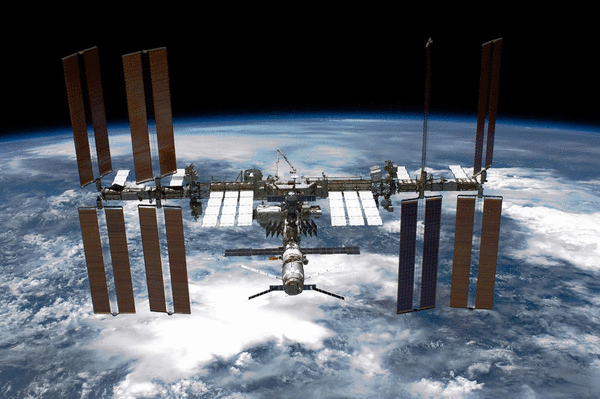
A revamped version of a congressional NASA authorization act moving through the U.S. Senate would add two more years of life to the International Space Station among a slew of new directives for the nation’s space agency.
The NASA Authorization Act of 2026 passed the Senate Commerce, Science & Transportation committee with bipartisan support Wednesday, setting up a full vote in the chamber.
Spearheaded by chairman Sen. Ted Cruz, R-Texas, the 200-plus page document spells out what Congress expects NASA to do with itself in the coming years and builds on previous NASA authorization bills. A final version would need to also be passed by the U.S. House and signed by the president.
Among the major shifts in the bill is extending the life of the space station from 2030 to 2032, giving the agency time to ensure a commercial replacement is in place before the current plan to deborbit the station and have it burn up in Earth’s atmosphere.
“It is the intent of Congress to ensure an orderly transition from the ISS to commercial low-Earth-orbit destinations without a gap in continuous United States human presence in low-Earth orbit.”
A crew has remained on board since November 2020 when Expedition 1 began.
The law’s text calls out NASA for waffling in its support of potential replacements.
“The successful development of commercial destinations capable of maintaining continuous human presence in low-Earth orbit depends upon timely, stable, and transparent Federal acquisition strategies, clearly defined operational requirements, and predictable transition timelines,” the text reads.
It said the agency has made programmatic direction shifts and delayed final contract decisions that have caused confusion among commercial providers.
“NASA has repeatedly delayed the release of a request for proposals for sustained commercial low-Earth-orbit services, and such delays, coupled with shifting requirements and inconsistent programmatic direction, have introduced substantial uncertainty into the development planning, financing, workforce scaling, and infrastructure investment decisions of commercial providers,” the act text states.
That has meant companies like Axiom Space, Blue Origin, Voyager Space and Vast, all of which who have space station plans in various stages, have been unable to scale development and private investment at a pace to meet the 2030 deorbit deadline.
The act further directs the extension of the International Space Station’s life to allow for at least one full year of operating alongside at least one other fully operational commercial station. And during that yearlong transition, full crews will be in space at the same time for at least 180 days.
The ISS crew complement for now ranges from three to seven, usually made up of three crew flown up by partner Russia, and four flown since 2020 by SpaceX as part of NASA’s Commercial Crew Program. That’s the program that Boeing’s Starliner is part of as well.
The act posits posits that uninterrupted U.S. human presence in space “is a matter of national interest, scientific continuity, workforce stability, international leadership, industrial base preservation, and strategic competition.”
It also directs NASA to maintain the same average number of commercial crew as well as frequency of cargo flights to the station as part of the act. “including exploring opportunities for private cargo missions to build commercial operational experience.”
For now, NASA has had four private astronaut missions, all through Axiom Space since 2021, flying on SpaceX Crew Dragon and visiting the station, but no private cargo missions. Axiom Space has one more mission planned for early 2027 while newcomer Vast has been awarded its first visit with crew later that year.
The act also enshrines NASA’s role in developing a future low-Earth-orbit economy “to ensure the evolution of an ecosystem with private sector development of new technologies, hardware, processes, capabilities, and other commercial low-Earth orbit service offerings.”
The NASA authorization act also covers a wide range of other new or updated directives.
While peppering in the threat of moon plans from China, the act states, “Establishing a lunar base ensures that the United States can explore from the ultimate high ground of the Moon, providing strategic advantages for science, technology, international cooperation, and national interests, while ensuring peace and freedom of exploration beyond Earth.” It calls for a “Lunar Surface Moon Base.”
Relatedly, the act only mentions once Gateway, the previously planned lunar space station, telling the administrator to update Congress on its status within 60 days of the act becoming law.
It also officially cancels the Exploration Upper Stage that was planned for future missions of Artemis program, something NASA Administrator Jared Isaacman already announced NASA was ending in favor of standardizing the Space Launch System rocket and increase how often it can launch.
Other directives include:
–For Artemis, allowing the administrator to “repurpose, reprogram, reconfigure, or reassign existing programs, platforms, modules, or hardware originally developed for other programs.”
–Directing NASA to obtain the capability to develop spacesuits since it’s relying solely on one provider, Axiom Space, for the new suits planned on lunar missions. A second provider, Collins Aerospace, dropped out in 2024.
–Increasing from one to at least two the number of contracts to be awarded for new lunar rovers. Three companies, Lunar Outpost, Venturi Astrolab and Intuitive Machines, have been awaiting the contract announcement.
–Telling NASA to use the taxpayer-funded infrastructure at the Kennedy Space Center, including the Exploration Ground System, to be “used to the extent practicable in support of space exploration missions and activities.”
----------
©2026 Orlando Sentinel. Visit at orlandosentinel.com. Distributed by Tribune Content Agency, LLC.






Comments