Trump's revised tariff path avoids strong resistance in Congress
Published in News & Features
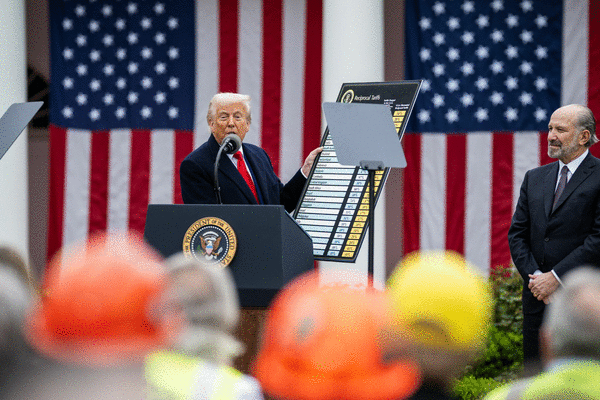
President Donald Trump said he doesn’t need to go to Congress to restore his sweeping global tariffs after the Supreme Court decision Friday that struck them down.
Asked if he would go to Congress on the matter, Trump told reporters at the White House “I don’t need to” because the authorities he is seeking are already approved. Trump said if he did ask Congress for additional tariff authority, he believed he would probably get it.
The White House has said it will quickly replace the levies using other legal tools. Trump said he would impose a 10% global tariff under Section 122 authority, and will launch several investigations that could justify other tariff implementations.
The president’s new approach avoids a legislative fight to restore his sweeping global tariffs, where he would have faced daunting odds.
The slim Republican majority in both chambers and heightened anxiety around the economic impact of the duties would make enshrining the tariffs into law challenging. And both the House and Senate have opposed parts of Trump’s tariff agenda in recent months.
Trump’s revised tariff plan relies on invoking other authority to impose duties on imports deemed a threat to specific U.S. industries or national security. Several of the options require lengthy investigations beforehand or limit the amount and duration of any penalties.
House Speaker Mike Johnson said in a social media post that the White House and congressional leaders “will determine the best path forward in the coming weeks.”
Even though tariffs are a centerpiece in the president’s economic agenda, the Republican-controlled Congress likely cannot pass trade legislation without Democratic support.
Republicans hold slender congressional majorities and some GOP lawmakers have opposed import taxes. The House passed legislation earlier this month aimed at ending Trump’s tariffs on Canada, and the Senate disapproved of several Trump tariff decisions in symbolic floor votes.
Even some Republican lawmakers publicly celebrated the president’s court loss on tariffs. “Broad-based tariffs are bad economics,” Republican Representative Don Bacon of Nebraska said in a social media post.
Democrats have shown no inclination to help the president advance his trade agenda. Many applauded the court’s decision on Friday, attacking the Trump tariffs for contributing to rising prices. Lawmakers are already campaigning in the midterm elections on the high cost of living, pointing to the president’s economic policies as key contributors.
“It is a hard path for the administration to go to Congress because even within the Republican caucus there are a variety of views on tariffs,” Greta Peisch, who served as general counsel for the U.S. Trade Representative during the Biden administration, said in an interview before the court ruling was announced. “It can just really get bogged down in the details and make it difficult to get anything across the finish line.”
The decision could present an opportunity for the House and Senate to reassert themselves after largely staying on the sidelines during the first year of the second Trump administration, which has conducted much of its agenda through executive orders.
Now Republicans as well as Democrats might attempt to place restrictions on the president’s tariff authority, even as some Republican lawmakers seek to lock in market access gains that he negotiated.
“I think it’s almost inevitable that Congress will get engaged, but it takes a long time to get that momentum going,” said Everett Eissenstat, who served as a senior international economics adviser in Trump’s first term, also interviewed before the court ruling.
GOP proposals
At the same time, some Republican leaders see an opening to enshrine into law individual trade agreements the administration negotiated with foreign countries, though even that remains a long shot with an outcome that might not be known for months or even years.
House Budget Committee Chair Jodey Arrington, a Texas Republican, said in a January interview that he supported codifying some of Trump’s newly negotiated trade deals by incorporating them into a near-term spending package.
“We could give the heft of Congress behind those deals, which would give the market more certainty and producers and our trading partners more certainty, which would give us more economic velocity and growth going into November,” Arrington said, referring to the midterm elections.
Representative Adrian Smith, a Nebraska Republican who leads a subcommittee on trade policy, also said he would like to codify the new trade deals.
“We could ultimately do that,” Smith said in December, even as he added that he is “not a fan of tariffs.”
Both Eissenstat and Peisch cautioned that codifying a deal that increases tariffs on trading partners, rather than securing a free trade agreement, has little precedent in Congress and would be a challenge to get through. Republicans could lose a few votes in either chamber.
Still, Smith expressed optimism.
The U.S.-Mexico-Canada Agreement governing trade in North America, he said, was “a Trump priority” during the speakership of Nancy Pelosi, a Democrat. “I remind folks that if that can be done, just about anything should be able to,” he added.
_____
With assistance from Derek Wallbank.
_____
©2026 Bloomberg News. Visit at bloomberg.com. Distributed by Tribune Content Agency, LLC.




Comments