Philadelphia's Moore College will consider opening undergraduate programs to men
Published in News & Features

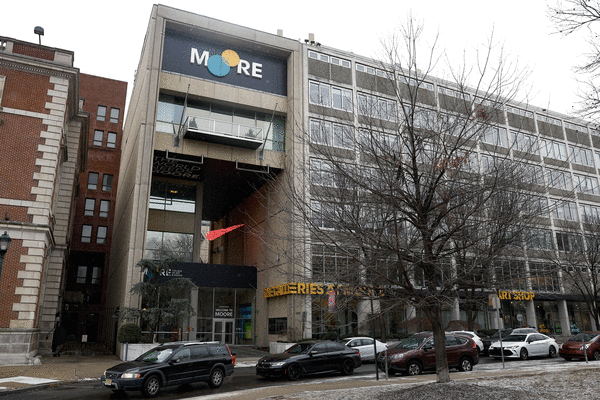


PHILADELPHIA — Moore College of Art & Design will consider opening its undergraduate programs to men for the first time in its 177-year history.
The Philadelphia school, which touts its role as “the first and only historically visual arts college for women in the nation,” cited the need to make arts programs more accessible in the region and the expected national decline in the available pool of high school graduates.
The college, which enrolls about 500 students, will study and discuss with its community the prospect of admitting men over the next four months and make a decision by June, the school announced in emails to alumni, faculty, and students Monday. If the school decides to admit all genders, the first class admitted would be for 2027.
“We will explore all of this together in an inclusive way for students, faculty, staff, and alumni,” wrote Moore President Cathy Young and Frances Graham and Art Block, chairs of the school’s board of trustees and board of managers, respectively. “Your voices are essential. No decision has been made at this time. The boards want your feedback.”
If Moore goes co-ed, Bryn Mawr College would be the only remaining women’s school in the Philadelphia region. (In Allentown, Cedar Crest College remains primarily a women’s college.)
Several other colleges in the region that were formerly for women have gone co-ed over the last decades, including Rosemont on Philadelphia’s Main Line in 2008, Immaculata University in Chester County in 2005 and Chestnut Hill College in Philadelphia in 2003.
Nationally, the number of women’s colleges has been declining from a high of over 200 to just 31 as of 2022, according to a 2025 report by the Pew Research Center.
It wouldn’t be the first change in Moore’s admissions policy in recent years.
In 2015, Moore began admitting “all qualified students who live as women and who consistently identify as women at the time of application.”
Then in 2020, Moore also began accepting nonbinary and gender-nonconforming students. Since then, the number of those students has been growing. They made up 6% of the first freshman class under the new policy in 2021. By fall 2022, they accounted for 21%, and by fall 2023, 26%. Last fall, that grew to one-third of the freshman class.
Moore’s graduate programs and most of its continuing education programs already include men.
Moore officials said they are making the decision from a position of financial and academic “strength.” The school has had operating surpluses for the last 24 consecutive years, a school spokesperson said. Many small schools have faced financial strain in recent years, but Moore fared among the top small private colleges in the Philadelphia region for financial health in a 2024 Inquirer review.
Moore’s net tuition climbed from $10.8 million to $12.7 million in FY24 and to $16.5 million in FY25, financial records show. The school also saw a big gain in private gifts and grants last year to $2.2 million, up from $885,383 the year before.
This year’s enrollment is the school’s second highest behind fall 2024, when the college accepted 112 students from the University of the Arts, which abruptly closed in June 2024. The school also took 12 students that year from the Delaware College of Art and Design, which closed that year, too.
Moore opened a new residence hall in Rittenhouse Square last fall, which is just a seven-minute walk from campus and will allow the school to guarantee students housing for all four years.
In announcing the possibility of accepting all genders, Moore officials noted UArts’ closure and the end of degree-granting programs at the Pennsylvania Academy of Fine Arts.
“There is a void in Philadelphia’s higher ed creative landscape, and that begs the question: Shouldn’t all creatives, regardless of gender, have access to Moore…” they wrote. “The answer doesn’t have to be “yes,” but it is our responsibility to explore it.”
College surveys of applicants have shown that the school’s status as a women’s college isn’t a big draw. Only 6% cited it as important to their decision out of 885 survey respondents over the last dozen years, the school said. Meanwhile, a quarter said it was one of the important reasons they didn’t choose Moore.
Moore officials also cited the expected drop in the high school graduate population beginning this year because of declining birth rates. A decline of 10% is expected by 2037, they noted.
“There are simply fewer students,” they wrote. “No responsible institution can ignore factors like these. And we won’t.”
They said they will discuss ways “to preserve and activate in new ways “ Moore’s history and legacy as part of the exploration.
Between February and April, Moore plans to host about 20 sessions for faculty, staff, and alumni to share their thoughts, as well as providing an opportunity for online comments.
_____
Staff writer Harold Brubaker contributed to this report.
_____
©2026 The Philadelphia Inquirer. Visit inquirer.com. Distributed by Tribune Content Agency, LLC.






Comments