Attendance drops at Minnesota schools as federal immigration enforcement intensifies anxieties
Published in News & Features
MINNEAPOLIS — Student attendance has dropped sharply in several Twin Cities school districts as families keep children home amid heightened fear over increasing federal immigration enforcement.
With 3,000 federal agents reportedly headed to Minnesota in what the U.S. Department of Homeland Security calls the largest immigration enforcement operation in history, local schools are facing a growing number of reports, many unconfirmed, of agents near school buildings and bus stops.
While schools haven’t confirmed any agents entering schools, the federal activity is stoking fear and uncertainty, especially after federal agents and protesters clashed at Roosevelt High School in Minneapolis last week.
Minneapolis closed schools for two days over safety concerns while Fridley closed schools on Jan. 9 and Columbia Heights shifted to online learning that day. Now, more schools are offering remote learning, with Fridley, St. Paul and Robbinsdale on Thursday joining Minneapolis in giving students the option of e-learning hours after a Robbinsdale student’s parent was detained at their school bus stop.
St. Paul, the state’s second-largest district, is calling off classes Jan. 19-Jan. 21 to prepare for the debut of the temporary virtual learning option on Jan. 22.
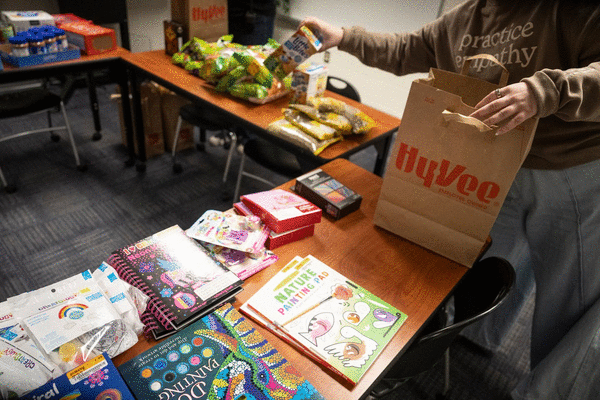
Across the Twin Cities, school leaders are expanding safety measures, including reminding bus drivers of what to do if ICE agents show up, and increasing communication with families. Staff and parent groups are also rallying to show support for families, and offering transportation and grocery deliveries to students and staff too scared to come to school or drive themselves.
“This is terrorizing our school community,” Fridley Public Schools Superintendent Brenda Lewis said. “No one feels safer with this presence, and the damage to our most vulnerable students will take years to undo.”
Many school districts began developing guidance and communication plans related to immigration enforcement more than a year ago, after federal policy changes in early 2025 lifted prior guidance limiting enforcement in sensitive locations, including schools. Federal officials have since said immigration agents do not target schools or children.
School leaders say those protocols have taken on new urgency as enforcement activities have intensified. At least two educators have been detained in the last week, one outside of Roosevelt after the Jan. 7 incident and one outside a school in Intermediate School District 917 on Jan. 12 in Inver Grove Heights.
Bystander video of that incident showed a federal agent alleging the educator had rammed into his car, but witnesses said federal agents rammed into the educator’s vehicle as they were trying to turn into the school’s parking lot. DHS Assistant Secretary Tricia McLaughlin said the educator, who is a U.S. citizen, “moved her vehicle dangerously getting close” to officers, “tried to cut their vehicle off and collided with law enforcement’s vehicle.” She added that the woman refused commands to get out of her vehicle and officers used “minimum amount of force necessary” to arrest her for obstruction.
Then on Jan. 14, a parent of a Brooklyn Center elementary student was detained by federal agents at a school bus stop as they waited for the bus, according to an email sent to families from Northport Elementary Principal Bridget Dooley. All students boarded the bus and the district said school psychologists, social workers and other support staff were available to provide counseling and support.
In St. Louis Park, dozens of parents protested Jan. 14 the increased presence of federal agents near Aquila Elementary School. Mayor Nadia Mohamed and Rep. Larry Kraft, DFL-St. Louis Park, both called the agents’ presence “terrorizing” for students and community members.
Kraft said agents have been staging near the school, and teachers closed window blinds to prevent students from seeing “what was happening across the street,” he said. “This feels like we’re being occupied. ... I don’t care what you think of immigration policy, this is not OK.”
Parent Marcus Penny said agents “kicked down the doors” of an apartment building across the street and agents’ presence seems to increase in the area around student drop-off and pick-up times.
“Students saw them and they are afraid,” Penny said. “And they should be — these are strange, masked men showing up in their streets, pulling out their guns.”
Kraft said more than 1,000 community members have joined a rapid response group in St. Louis Park. Many of them have helped escort children to and from school. Students of color make up more than half of the elementary school’s students.
Justin Pierre, an Aquila parent and member of the band Motion City Soundtrack, helped walk a couple of students home today. They told him they were afraid to be outside. “Putting people over politics is really important,” he said. “Kids are being affected.”
Many immigrant families are left with a difficult choice: Send kids to school and risk having the children return home to find their parents or other family members detained, or keep them at home where they might witness federal enforcement action.
In St. Paul, half of the district’s Spanish-speaking students and a quarter of its Somali students were absent last Friday — the most recent date for which figures were available. Minneapolis schools reported Jan. 13 that 5,500 students — nearly 20% in grades K-12 — had expressed interest in the online learning option.
“Parents across Minneapolis, and not just immigrant families, are afraid to send their kids to school and to go outside. This isn’t right,” said Jennifer Arnold, the mother of a second-grader who has helped organize more than 90 home food deliveries.
Bus drivers in both the Minneapolis and St. Paul school districts have been trained to keep students onboard if they or students feel it would be unsafe for them to be dropped off. Minneapolis drivers then continue through their routes and circle back to the stops to see if they now are safe.
“The real temperature at this time is just fear — a lot of fear,” said Donnie Belcher, a spokeswoman for Minneapolis Public Schools.
In Fridley, which is offering a temporary virtual learning option starting Jan. 20 for families who don’t feel safe sending children to school, Lewis said attendance plummeted last week, prompting her to call off classes Jan. 9.
Lewis said preliminary attendance data showed more than a third of students absent on some days this week. More than three-quarters of Fridley’s students are students of color, and the district employs about 100 international educators, many recruited in recent years to help address staffing shortages.
“I listen to the voicemails of families calling their students in,” Lewis said. “They tell us what they’re afraid of, and they ask us for help.”
While she emphasized that there have been no confirmed incidents of agents entering Fridley schools, she said staff and families frequently report seeing armed agents near apartment complexes, businesses and major roadways.
“This is no longer about protocol,” Lewis said. “It’s about mitigating harm so no one gets hurt.”
Lewis said Gov. Tim Walz and Education Commissioner Willie Jett visited a Fridley school on Jan. 12 “to just be listeners.” Fridley school leaders have also arranged transportation for educators scared of driving to and from school.
More than 100 educators in Fridley Public Schools are international recruits. They’re here legally, but Lewis said she fears they’ll be profiled. She’s working to make sure they all have documentation to present if they’re stopped and she and other staff have started checking in with international staff over the weekend.
Lewis said many teachers have arrived at school visibly shaken but continue to show up for students. “They’re still prioritizing our kids,” she said.
Across the Twin Cities, districts have stepped up outreach to families, including with multilingual messages, repeatedly reassuring families that schools remain safe.
School leaders from Minneapolis to Rochester have said absences tied to safety concerns will be excused and that families will not be penalized for keeping children home.
“It remains true that school is one of the safest places that students can be,” St. Paul Public Schools Superintendent Stacie Stanley said to the community in a note last week. On Monday,Stanley added in a YouTube message that agents cannot enter schools without a signed judicial warrant, and no federal agents have come into any of the district’s buildings.
The Robbinsdale school district sent a note to families explaining that staff are trained on how to respond if federal agents appear on or near school property and reiterated the district’s responsibility to protect student privacy and follow the law.
In southern Minnesota, Rochester Superintendent Kent Pekel said in a Jan. 9 message to families that the district was among the first in Minnesota to develop guidance for school leaders and staff outlining the steps they should take if ICE agents came to one of its schools. “Given recent events,” he added, “we worked with our legal counsel to update and strengthen those procedures.”
“ICE agents will not be allowed unrestricted access to our school buildings or grounds,” Pekel wrote.
In Fridley, the district added safety measures including increasing staff monitoring of school grounds, more security team members on site and “constitutional observers” present during arrival and dismissal. The district also shared resources to help families talk with children about immigration enforcement.
Richfield Public Schools leaders alerted families on Jan. 7 of reports of unidentified vehicles near school routes and following students or families, saying the reports were serious, though no link to immigration enforcement was confirmed. The message reminded families of their legal rights and encouraged them to report any suspicious activity or sightings of federal agents on school grounds to administrators.
School districts are coordinating with the Department of Education to expand access to meals, groceries and other basic needs for families who are afraid to leave their homes. Districts are clearly marking school vehicles used to deliver Chromebooks, Wi-Fi hotspots or food so families do not mistake school staff for federal agents.
“We’re doing everything we can to be helpers,” Lewis said. “Right now, that’s what our families need us to be.”
_____
©2026 The Minnesota Star Tribune. Visit startribune.com. Distributed by Tribune Content Agency, LLC






Comments