Gaza deal's second phase to begin with truce under strain
Published in News & Features
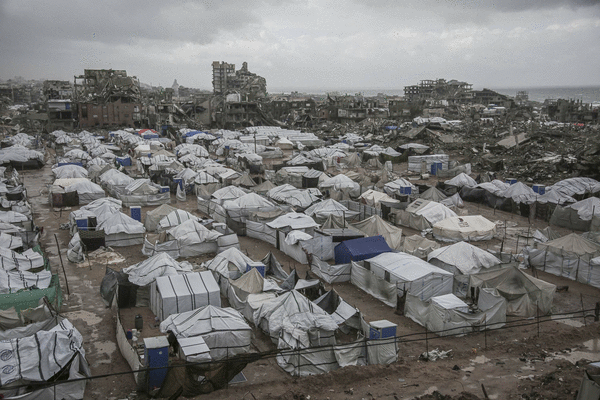
The U.S. announced the “launch” of the second phase of President Donald Trump’s 20-point peace plan in the Gaza Strip in an attempt to advance a fragile truce that has been challenged by Hamas militants refusing to disarm.
The second phase will see the war-torn enclave “moving from ceasefire to demilitarization, technocratic governance, and reconstruction,” U.S. Middle East envoy Steve Witkoff wrote in a post on X Wednesday that threatened Hamas with “serious consequences” if it doesn’t “comply fully” with its obligations.
In a joint statement, Qatar, Egypt and Turkey announced the formation of the Palestinian technocratic committee tasked with administering the Gaza Strip.
It will be headed by Ali Shaath, who has held several senior positions within the Palestinian Authority, the three ceasefire mediators said. They described the move as an “important development that will contribute to strengthening efforts aimed at consolidating stability and improving the humanitarian situation in the Gaza Strip.”
A key part of the second phase involves a team of technocrats being appointed to help run Gaza as part of U.S. efforts to rebuild after more than two years of conflict with Israel. Diplomats hope that administration can help restore day-to-day governance and public services under the broader oversight of a so-called Board of Peace chaired by Trump and other world leaders that has yet to be announced.
Invitations to the Board of Peace were distributed on Wednesday, with Trump selecting who he wanted to be on the panel, according to a U.S. official who briefed reporters on the condition of anonymity.
Yet with Hamas still in control of almost half of Gaza and refusing to disarm, the prospect of a durable peace is uncertain. And while more humanitarian aid has reached Gazans in recent months, it’s unclear how the U.S. could help spur reconstruction efforts. Witkoff’s post on X had few details about overcoming the challenges.
The shaky ceasefire has already seen numerous Hamas attacks and Israeli airstrikes, and the Iran-backed militant group has refused to give up its weapons despite U.S. and Israeli threats.
Hamas has also not yet returned the remains of the last hostage taken during the Oct. 7, 2023 attacks that triggered the conflict. Israel, which has demanded Hamas hand over all remaining hostages as required in the deal before phase two begins, has said Israeli policeman Ran Gvili was killed trying to fight off the 2023 Hamas invasion and that his body taken into Gaza.
Palestinian officials have been operating in good faith and have identified several sites where the remains might be located that will be searched, the U.S. official.
The announcement of the technocratic committee on Wednesday prompted a statement from Israeli Prime Minister Benjamin Netanyahu, who spoke to Gvili’s parents on Wednesday evening.
“The Prime Minister clarified that Ran’s return is a top priority and that the declaratory move regarding the establishment of a technocratic committee will not affect the efforts to return Ran for a Jewish burial,” his office said in a post on X, adding that “Hamas is required to meet the terms of the agreement to exert 100% effort for the return of the fallen hostages, down to the very last one, Ran Gvili, a hero of Israel.”
Mahmoud Abbas, whose Palestinian Authority runs the West Bank, said in a statement on Wednesday that he “welcomed the efforts made by President Donald Trump to complete the implementation of his peace plan” with the announcement of the Palestinian committee.
_____
©2026 Bloomberg L.P. Visit bloomberg.com. Distributed by Tribune Content Agency, LLC.






Comments