Tina Peters to ask Colorado Court of Appeals to overturn her convictions
Published in News & Features
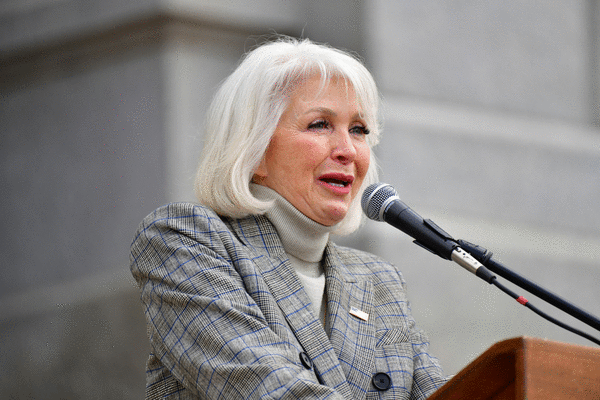
DENVER — Attorneys for discredited Colorado elections clerk Tina Peters will challenge her criminal convictions before the Colorado Court of Appeals on Wednesday, her latest attempt to escape a nine-year sentence after state officials dismissed a would-be pardon from President Donald Trump.
Mesa County jurors convicted Peters, 70, of four felony and three misdemeanor crimes in 2024 after she orchestrated a plot to sneak an unauthorized member of the public into a secure area to examine voting equipment amid unfounded claims of voting fraud in the 2020 presidential election.
Trump has called for Peters’ release and, in December, claimed to pardon her — a power he does not have over state-level criminal charges. Colorado officials have resisted the president’s efforts to free Peters, prompting Trump to mount what Attorney General Phil Weiser described as a “revenge campaign” against the state, including cancelling more than $700 million in federal funds earmarked for Colorado.
Gov. Jared Polis this week suggested in a TV interview that he was considering commuting Peters’ prison sentence, which he called harsh. Other state officials have urged Polis to reject clemency.
Against that backdrop, Peters’ attorneys argued in court filings that her case should be tossed because the presidential pardon should be applied to her state convictions.
“The U.S. Constitution provides that the president may pardon ‘Offences against the United States,'” Littleton attorney John Case wrote for Peters. “This case raises the question whether ‘Offences against the United States’ means only crimes defined by federal statutes, or if the president can also pardon state crimes that impinge on federal powers.”
Attorneys with the Colorado Attorney General’s Office dismissed that argument as “mistaken.”
“Throughout the entire history of this country, no president has purported to pardon state offenses nor claimed the power to do so,” the attorneys wrote in a court filing. “…In sum, the case law, the text of the pardon clause, the structure of the Constitution, and the historical evidence all point to the unmistakable conclusion that the president’s pardon power is limited to federal offenses.”
Peters also appealed her convictions on the grounds that the evidence against her was insufficient, she was immune to state prosecution, the district court judge violated her due process rights and the nine-year sentence violated her First, Eighth and Fourteenth Amendment rights.
State attorneys have countered that she was not entitled to immunity, that the district court judge made appropriate decisions about evidence and jury instructions during her trial, and that her prison sentence was reasonable and proper.
Peters was sentenced to serve three-and-a-half years on two counts of attempting to influence a public official and another three-and-a-half years on a third count of attempting to influence a public official. She received an additional 15 months for conspiracy to commit criminal impersonation and another six months for violation of duty and failure to comply with the requirements of the secretary of state, according to a filing from the attorney general’s office.
Peters will be eligible for parole in December 2028, according to the Colorado Department of Corrections.
-----------
©2026 MediaNews Group, Inc. Visit at denverpost.com. Distributed by Tribune Content Agency, LLC.





Comments