Florida's deportation campaign arrests more than 20,000. Some had clean records
Published in News & Features
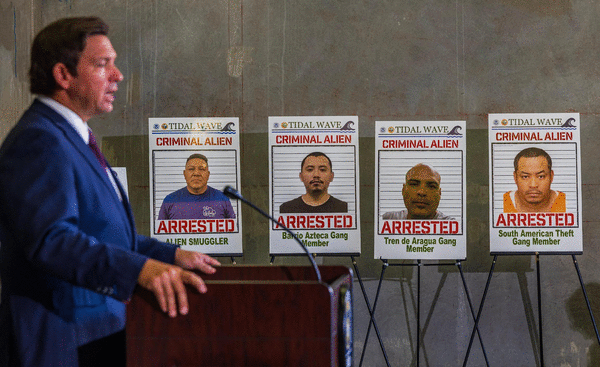
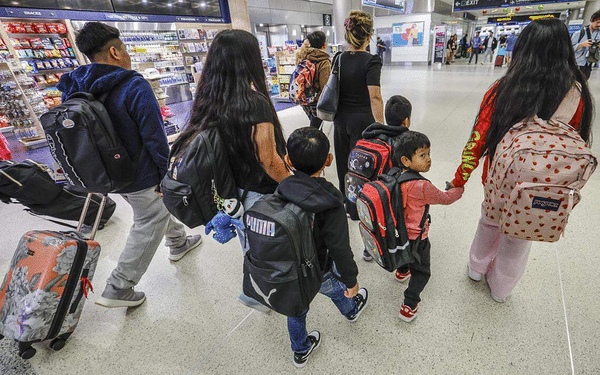

The officers are often masked, armed and do not identify themselves. At a Chili’s in the Key West airport, they arrested 11 people at a family reunion. On a canal near Fort Lauderdale, they picked up two men who’d gone fishing. In July, they detained a young man with a work permit and held him for three months. They stopped a construction worker in a small city near Orlando for jaywalking.
And, in a chilling video of a traffic stop on Dec. 3, five officers surrounded a Toyota Corolla and dragged a 33-year-old woman in scrubs from her car.
“I am a U.S. citizen!” she screamed to a reporter filming the spectacle. “Please help me!”
Under the pretense of removing violent criminals from the streets, President Donald Trump’s administration is waging a sweeping, relentless crackdown on immigrants — whether they are in the country legally or not. Florida, where nearly one in every four people are immigrants, has become one of the nation’s strongest anti-immigration enforcers — arresting more people than any other state except Texas.
A Miami Herald analysis of U.S. Immigration and Customs Enforcement data found that more than 20,000 immigrants have been arrested since Trump assumed office again on Jan. 20, 2025. The president found an eager partner in Florida Gov. Ron DeSantis, who boasted in November that his Florida Highway Patrol alone had “gotten close to 10,000 arrests of illegal aliens this year.”
Minimum number of people arrested on immigration related charges in Florida in 2025
While state officials tout the arrest of predators and other criminals, the Herald investigation found that officers are often taking whoever they can — including immigrants with work permits and pending asylum cases, spouses and parents of United States citizens, workers with no criminal records, and, as in the case of the woman in scrubs, U.S. citizens.
“I want to make something absolutely clear: This is not the America that I grew up in, and this is not the America that we represent,” wrote Dayana O., the behavioral therapist in the video, in a statement to the Herald. She asked that her full name not be used for fear of retaliation.
The Herald’s tally of 20,000 is an undercount. The data is only through mid-October and does not include U.S. Customs and Border Protection arrests in Florida, because the federal government doesn’t release those numbers by state. Nor could it account for thousands of state agency arrests, because a public-facing dashboard only began in August and is incomplete.
But the number is still almost three times higher than 2024’s — the equivalent of a small city nearly the size of Key West disappearing from the state.
Neither the DeSantis administration nor the U.S. Department of Homeland Security answered repeated requests for the number of people arrested in Florida in 2025 and data on the charges against them.
The administration has described undocumented immigrants as “an existential threat.” Officers “will stop at nothing to hunt you down,” reads one DHS post. For Christmas, the government rolled out a holiday stipend of $3,000 for voluntary departure and released a series of videos, including one of Santa in an ICE vest, on social media.
“This Christmas, our hearts grow as our illegal population shrinks,” is the caption for one DHS post on X, published with a video montage of holiday imagery set to an electronic version of “All I Want for Christmas” and the words: “Christmas after Mass Deportations.”
A post from the White House reads: “Avoid the Nightmare Before Christmas!”
In Florida, the Alligator Alcatraz and Krome detention centers are filled with complaints of inhumane conditions. Detainees are ping-ponged from one center to another, often across the country, and encouraged to sign deportation orders.
Six people died in federal immigration custody in Florida in 2025, the Herald found. At least 30 have died across the country. A record 65,000 immigrants nationwide were in detention centers, federal prisons or local jails as of late November, according to the latest Immigration and Customs Enforcement data.
Many people — including U.S. citizens — have been stopped and questioned. The federal government claims citizens are not being arrested, but in fact, more than 170 U.S. citizens have been detained across the country, an examination by ProPublica found.
Under DeSantis, Florida has allocated more than $298 million to immigration enforcement, opened two state-run detention facilities and signed more agreements for local and state agencies to act as federal immigration agents than anywhere else in the country. More than 5,900 officers from 119 Florida law-enforcement agencies are helping the feds, according to a report by the State Board of Immigration Enforcement.
When reached for comments with a list of nine questions, Department of Homeland Security Assistant Secretary for Public Affairs Tricia McLaughlin wrote: “The first ‘question’ reveals how ridiculous this story is going to be. Embarrassing.”
McLaughlin was objecting to this statement: “We have found that, under the pretense of removing violent criminals from the streets, the Trump Administration is waging a sweeping, relentless crackdown on immigrants — whether they are in the country legally or not.”
Instead of answering a reporter’s questions about how many immigrants had been detained in Florida, she sent the Herald an email that included 10 people with criminal records. She said that through local partnerships in Florida, “hundreds of rapists, murderers, gang members, pedophiles, and drug traffickers are off of Florida communities and are now out of our country.
“Floridians should take a moment this holiday season and give thanks to the men and women of ICE, as well as their state and local leaders, for playing a key role in arresting the worst of the worst from their communities,” McLaughlin wrote. Nearly a quarter of the 20,000 people detained — more than 4,800 — only had immigration violations, according to the federal data, which was obtained by the University of California-based Deportation Data Project and analyzed by the Herald. A third of those arrested in Florida by the Herald’s count had criminal convictions, and the rest pending criminal charges — which include non-violent crimes such as driving without a valid license.
Since January 2025, the government has claimed without evidence that those arrested nationwide, some of whom have been shuffled to the U.S. Navy base in Guantánamo Bay, Cuba, and a notorious prison in El Salvador, are the “worst of the worst.” But many of the immigrants caught in the crackdown and left for months in detention are working people who have built lives in the U.S. — or were trying to.
“Truthfully, I don’t know what Latinos are doing wrong,” said Gabriel Hernandez Alvarez: who is a 19-year-old from Honduras with a valid work permit and a pending asylum case but was arrested by the Florida Highway Patrol in July. He spent three months in detention.
“Yes, there are people who aren’t good,” he said, “but there are people who came to work, to move their families forward, and we don’t deserve what is happening.”
A ‘scalpel’ not a ‘sledgehammer’
Both the DHS and DeSantis mass-deportation campaigns are likely to intensify.
Congress passed a bill in July allocating more than $170 billion to immigration enforcement, including $45 billion for detention alone.
The Trump administration has also heavily restricted legal migration — implementing far-reaching travel bans, pausing asylum decisions and canceling naturalization ceremonies for some. He placed full or partial travel bans on nearly 40 countries and announced reviews of green-card holders from 19 countries.
In May, DeSantis sent a proposal to the White House outlining his plan to carry out Florida’s own crackdown — and establish detention centers to house 10,000 people. He, too, has urged restrictions on birthright citizenship. The governor declined to be interviewed for this report.
“Because Florida leads the nation in illegal immigration enforcement, we took proactive steps to increase transparency and highlight our success,” Molly Best, DeSantis’s press secretary, wrote in an emailed statement. “In August 2025, we built and launched a comprehensive enforcement dashboard that showcases the strong results of our illegal immigration-related arrests.”
But a Dec. 15 report submitted to the Florida Senate highlights the challenges in the state’s dashboard, which only shows data since August. Reporting is inconsistent and lagging. Some agencies are not reporting anything at all. Multiple departments told the Herald they had no immigration arrests despite the site showing otherwise.
Sheriff Grady Judd’s office in Polk County has arrested nearly 600 “aliens,” according to the dashboard. More than 200 of them were only taken for federal immigration violations — not for a local or state crime, according to data analyzed by the Herald. Meanwhile, the Miami-Dade Sheriff’s Office had only logged nine arrests in the dashboard since August.
Miami-Dade County’s population is more than three times higher than Polk’s. It also has more pending deportation cases than anywhere else in the country — more than 146,000 as of September, according to TRAC Reports, a non-profit based at Syracuse University.
Judd told the Herald in an interview that — while his office is just following the law — “everyday business people” are “getting called up as collateral.”
“I’m advocating that we need to figure out a system to legalize the good, hard-working, God-fearing, honest people that came across the border inappropriately, illegally, but they’re not violating any laws. They’re just working hard. They’re not taking any government money,” Judd said.
“I’m all for that, but irrespective of that, I’m not a legislator. I’m a rule-enforcer, and the rules say they’re here illegally, and that’s where the conflict is,” he added. “We need to use a scalpel on this issue, you know, not a sledgehammer.”
The number of people who have legal protections from deportation but are now subject to arrest is rapidly growing. About 14 million people live in the U.S. without authorization or with temporary or precarious protection, according to the Pew Research Center. Hundreds of thousands of people relied on humanitarian immigration programs, which were terminated in 2025, making those people suddenly “illegal” and subject to deportation.
The arrests are ripping apart communities, activists, lawyers and immigrants told the Herald.
“It seems like that’s been the purpose and the goal — to take immigrants and people of color off the streets and out of our communities,” Lupita Vazquez Reyes, a volunteer with Unidos Immokalee northeast of Naples, said. “Almost like purging them.”
‘These are working people’
On a sunny Thursday afternoon in August, a four-bedroom home in Palm Beach County was surrounded by about 27 sheriff’s deputies, 26 cop cars, a K9 unit and at least one Florida Highway Patrol troopers.
Inside, two elementary-school girls had been doing homework in bed. Outside, the officers yelled over a loudspeaker for a man to surrender. Carrying guns and battering rams, the officers ran along the sides of the building and blocked the exits, according to PBSO body cam footage reviewed by the Herald.
Around 8 p.m., they broke down the doors and smashed the windows. Glass shattered across backpacks on a blue bedspread in a girls’ bedroom.
They threw projectiles with pepper spray into the attic, where two men were hiding, according to a police report.
Five men were arrested. Local activists and neighbors later were allowed to enter the home. In videos shared with the Herald, the girls stare through the broken windows. When the raid started, they hid in a closet with their mother, who held a baby, they told activists.
The officers weren’t looking for drug dealers or gang members — but for 27-year-old Guatemalan Jony Darinel Vasquez Lopez, charged with driving without a valid license, failure to stay in a designated lane, DUI, having an expired registration, driving a van without a bumper and evading arrest.
In July, the Florida Highway Patrol had pulled him over for driving a van without a bumper and then arrested him for being in the country illegally. He fled from the patrol car handcuffed, according to news reports.
The four other men in the house were all taken into ICE custody.
A spokesperson for the Palm Beach County Sheriff’s Office later told a city commissioner in an email that officers were aiding the Florida Highway Patrol with a warrant for resisting arrest.
The next morning, a principal picked up the girls and drove them to school.
To Mariana Blanco, the director of operations of the nearby Guatemalan-Maya Center, the show of force didn’t fit the crime.
“That’s when we realized it was kind of like a free for all, that they would be able to enter homes in that way, in the form of a raid with so many officers,” Blanco said.
“It seems like the majority of these arrests are collateral damage,” she said.
Asked about the raid, PBSO spokesperson Therese Barbera told reporters to reach out to the Florida Highway Patrol, which did not respond to requests for comments.
“PBSO deputies assists ICE or FHP when requested ONLY,” Barbera wrote in an email to the Herald.
The total number of arrests, operations and raids — and the impact of Florida’s unprecedented year of immigration enforcement — remain unclear.
In April, a coalition of federal and state officers made 1,120 arrests across Florida in what was touted as the largest single-week ICE operation in the agency’s history.
“The best is yet to come,” DeSantis said at a press conference after the operation.
A government press release stated that 63% had a criminal records, but officials would not list all those arrested or the charges against them.
Officers then arrested more than 100 workers at construction sites in Tallahassee in May; some 200 people in the Florida Panhandle in August; and more than 400 people in Central Florida in September.
Reporters submitted public-records requests for immigration-related reports from 55 police departments. The reports show people getting arrested regularly on sidewalks, highways and in homes. Many start with minor traffic violations, like driving without a license, too much exhaust coming out of a truck, riding a bike with broken tail lights or making an illegal U-turn.
In Ocoee, a city about 12 miles outside of Orlando, a police officer stopped a man for jaywalking in November — and then arrested the 38-year-old construction worker on immigration charges.
On the 500 block of Beach Road on Jupiter Island — a narrow strip of land hugging the coast north of Palm Beach — one officer sat for days in his car, running license plates through a scanner.
Between September and October, the officer arrested at least 10 men on immigration charges after the scanner did not turn up a valid driver’s license.
In December, immigration attorney Victor Martínez was returning to his office in Miami after getting some coffee when he saw three workers in a landscaping truck get detained by Florida state troopers and federal agents. He immediately took out his phone and began recording.
In the video shared with the Herald, an agent wearing glasses on top of a mask escorts one handcuffed man while a state trooper speaks to another, also in handcuffs.
A bystander can be heard trying to shame the agents in Spanish: “Go find the thieves, go find the scoundrels! These are working people.”
‘I’m a U.S. Citizen! Please help me’
The behavioral therapist in scrubs — pulled over by Customs and Border Protection agents at mile marker 103.4 in Key Largo — had been stopped for immigration operations twice before. But this time was different.
“I know that I haven’t done anything incorrect. I’m just driving on my way to work,” she said to officers in a video released by the Monroe County Sheriff’s Office. As she reached for her license, agents yelled at her to open her door. They then pulled her from the car, her arms flailing.
The video shows three large men trying to wrestle the 85-pound woman to the ground and handcuff her as she screams, “I’m a U.S. citizen!” She is then carried into an unmarked SUV.
She was released about 10 minutes later.
U.S. Customs and Border Protection told the Herald she refused to roll down her window or show identification, and that the car belonged to her “illegal alien boyfriend.” Agents told Dayana that she was stopped because the car was registered to an “illegal alien.”
Attorneys told the Herald that the stop appeared to violate the woman’s rights. If they were looking for the owner of the car and saw that he wasn’t there, agents should have let the woman go. They would need a reason to believe that she was an “alien.”
Videos show that her window was open. Dayana told the Herald that her husband, who owns the Toyota Corolla, was arrested by the same agency — and by one of the same officers — the month before. He has been in immigration custody since.
She said she was traumatized by the experience and keeps thinking that agents are after her even though she is a U.S. citizen.
“I’m always looking out the window to make sure no one is at my house,” she said.
In April, agents arrested a 20-year-old U.S. citizen from Georgia and detained him for more than 30 hours. On May 2, they arrested an 18-year-old U.S. citizen named Kenny Laynez Ambrocio at a traffic stop and tased his undocumented coworker.
The three U.S. citizens in Florida were all detained after traffic stops.
Other people, who have spent months in detention, told the Herald that they had valid legal cases or documents.
Caught in the dragnet are the immigrants who have built lives in the country — they have U.S.-citizen children, they own local businesses, they pay taxes.
On April 30, 11 family and friends of one Irish family were detained by the Border Patrol while eating lunch at the Chili’s in Key West International Airport. Most had lived in the U.S. for decades and had U.S.-citizen children. One had a green card. They had arrived under a visa-waiver program with Ireland, some in the 1990s or early 2000s, and overstayed.
They were visiting from Long Island to celebrate the 50th birthday of Myles O’Connor. He and his wife had valid work permits, their son told the Herald.
But O’Connor, his wife, and his 72-year-old father were detained for six months, leaving the 21-year-old U.S.-citizen son to care for two younger siblings.
By September, the son, Jerry O’Connor, had made multiple trips to visit his father in the Broward Transitional Center and his mother in a Texas detention center. His mother’s hair was falling out, and she appeared gaunt: the bones seemed to jut out of her face.
She was confined to a room in a crowded facility for up to 23 hours a day, he said. He confronted her ICE officer and asked why she couldn’t just have an ankle monitor.
“What would you do, like, if this was your mother?” he asked, in tears. “She never did anything wrong in her life.”
Letters from Alligator Alcatraz
The Trump and DeSantis administrations’ goal has been clear: Use the threat of detention to get people to leave.
In June, during the course of eight days, the state built Alligator Alcatraz at a 6,000-acre site in the Everglades in west Miami-Dade. Each bed costs $245 a day, or $450 million annually, the Federal Emergency Management Agency estimates. “Very soon, this facility will house some of the most menacing migrants, some of the most vicious people on the planet,” Trump said at a July 1 press conference there.
A spokesperson for Florida Attorney General James Uthmeier later said the facility held “deranged psychopaths.”
The Herald obtained exclusive data of around 1,800 people detained or scheduled to be detained there in July. A third had no criminal convictions or charges — and some only traffic citations.
By late September, at least 237 men on the list, with only immigration violations, were still being detained in eight states. They ranged in age from 18 to 72. Some told the Herald they had yet to see a judge.
At the grand opening, Trump and Homeland Security Secretary Kristi Noem toured rows of bunk beds and cages.
Two weeks later, 19-year-old Gabriel Hernandez Alvarez arrived on a bus, shackled by the hands and feet.
“What I saw was a really ugly place,” he said. When he asked how other detainees were taken, they would say “from work.” “Doing things right, and nothing wrong.”
Officials have not answered repeated questions from the Herald about how many people are detained there currently.
Hernandez Alvarez was 15 when he fled gangs in Honduras and traveled to the U.S. border with his 9-year-old brother. The children were detained for a month before authorities released them to their mother in Florida. He went to Lake Worth Community High School, applied for asylum and received a work permit that would last from 2024 until 2029.
The 19-year-old is soft-spoken but determined. He works in construction and dreams of owning his own company.
For 23 days, he slept on a bunk bed inside a chain-link cell at Alligator Alcatraz. The bright lights never turned off, toilets wouldn’t flush, and for days, he couldn’t shower. “We didn’t see the light of day,” he said.
In one incident, Hernandez Alvarez said he saw a guard beat up a Cuban man after he asked for water.
“He cornered him and beat him mercilessly, and it wasn’t just him, three others joined in to beat him up,” Hernandez Alvarez said. State officials did not answer reporters’ questions about the incident, but other detainees have described beatings at the facility.
Twenty detainees have written letters describing their experiences in Alligator Alcatraz. Haymel De La Vega, whose friend was arrested and detained at the facility in August, is collecting their testimonies and video statements. The men describe being shackled for up to 48 hours straight; guards beating detainees; and racist insults.
Under the statement “I was tortured in Alligator Alcatraz,” written in English and Spanish, 40 detainees signed their names.
In August, Hernandez Alvarez was transferred without explanation to a detention center in Denver. On Sept. 8, he had his first hearing. His lawyer, Mark Diaz, asked the judge why the 19-year-old could not wait out his asylum case outside of detention. Soon after, he was released.
“Never in my entire career have I seen my clients being treated the way they’re treated,” said Jan Peter Weiss, an attorney who runs the firm representing Hernandez Alvarez. “It causes a feeling of hopelessness.”
Many immigrants with no criminal records are ineligible for bond hearings under a new policy that was enacted in July. Weiss said that in 2025 he saw “a lot more hate involved” in policy decisions. Shortly after Trump was elected, his office was flooded with new cases, and officials had placed a goal for ICE officers to arrest 3,000 immigrants a day.
“It means treating my immigrant population as cattle, round them up and place them wherever you can place them,” Weiss said about the directive. “And we’ll get to them, and when we get to them, we’ll make sure they’re thrown out.”
DeSantis had said Alligator Alcatraz would be a “one-stop shop” from which detainees would face a quick deportation. But as immigrants inside fought for the right to stay and courts grew overwhelmed with cases, detainees were stuck for months in limbo.
Some cannot afford to leave, or fear that they will be killed if deported, but are running out of legal options.
Junior Betnardin, a 31-year-old Haitian, was arrested in Puerto Rico in early September, sent to Alligator Alcatraz and released. He bought a ticket back to San Juan, where authorities gave him an ankle monitor. But in November, a judge dismissed his case during a hearing. They told him to buy a plane ticket out of the country by Dec. 17, he said.
He’d fled Haiti after armed men tried to recruit him – first to the Dominican Republic, then to Puerto Rico. His lawyer, Yamila Rodriguez Maldonado, said he applied for Temporary Protected Status in March and never heard back, leaving him in “Judicial limbo.” The TPS designation for Haitians was ended by the Trump administration and is set to expire in February.
“It is very unfair that there is a remedy available for them,” Rodriguez Maldonado said, “and the government leaves them without that protection.”
If sent back to Haiti, Betnardin said, there is a “90% chance I would die.”
The young man, a tile worker, can’t afford more lawyer fees. He checked in with authorities, unable to buy a ticket, and they scheduled a follow-up appointment.
“Truth be told, I don’t yet know what I am going to do,” he said.
“Can I go back to Haiti to die?”
‘Training the Kids’
Lake Worth Beach, where the August raid took place, is a seven-square-mile city just 12 minutes away from Trump’s Mar-a-Lago resort. With one of the largest concentrations of Guatemalan immigrants in the country, Palm Beach County has been the target of relentless arrests.
Guatemalans represent the second-largest group of people detained in Florida after Mexicans, according to ICE data analyzed by the Herald.
The Guatemalan-Maya Center, a social-service agency run by an Irish Catholic priest on Lake Worth Road, is struggling to keep up.
Blanco, the center’s director of operations, said she and her team have a running list of 180 detainees who were arrested in the surrounding area in 2025. But the center doesn’t track the multitude of others who have been deported.
It’s as though people have gone missing, she said. Families call the center frantic, unable to locate their loved ones. Children are left behind when a parent is detained or deported. A volunteer’s husband was arrested while mowing a lawn, and she was later arrested in a traffic stop in front of their children.
On Dec. 11, staff members drove around Lake Worth Beach, placing signs on the streets where they knew someone had been taken. “ICE KIDNAPPED A COMMUNITY MEMBER HERE,” the signs read.
“I never knew how fragile our democracy was until living through this Trump administration,” Blanco said. “I keep thinking, well, how can they get away with this? Who is going to stop them?”
“Nobody really stops them,” she said, answering her own question. “They continue to get more aggressive.”
Immigrants from Guatemala’s indigenous Mayan communities have worked in the area for decades — speaking 22 languages, but sometimes, no Spanish or English. Their children, many of them U.S. citizens, are their interpreters, legal advisors and advocates.
Now, Blanco said, staffers are turning reluctantly to a last line of defense: “Training the kids.”
In October, she sat with a 15-year-old whose parents saw federal agents on their doorstep through a security camera while at work.
Slowly, Blanco went over what the teen should do if the agents come back. And made him repeat it, again and again. He held back tears. First, ask if they have a warrant signed by a judge, she said.
“If they bust down the door, it’s going to be really scary. It’s going to be really scary, but it’s gonna be temporary,” she told him. “You’re gonna hold your younger siblings hand, and you’re just gonna wait.”
“You’re not gonna say anything,” she said. “They’re probably gonna be yelling. They’re gonna be, you know, breaking down doors, but you guys are just gonna stick together, right?”
But he was not born here, and Blanco was worried that the officers would think he was an adult and take him as well.
“It’s horrifying,” Blanco said through tears. “Having to prepare a child for something like that is just awful.”
The government insists it does not separate families, but the children tell a different story.
In 2025, the center coordinated travel and chaperones for 18 children going alone to Guatemala, the majority of whom had one or both parents deported. Nearly 80 other families and temporary caretakers have reached out to the center for assistance with travel documents, the majority on behalf of children, staff said.
At Unidos Immokalee, volunteers are also helping children reunite with deported parents, going to countries some have only heard of in stories. They also say they are responding to an onslaught of arrests across Fort Myers, Bonita Springs, Immokalee and nearby communities.
“It has been utterly traumatizing and utterly relentless in its pursuit of a specific demographic of our community,” said Lupita Vazquez Reyes, the Unidos Immokalee volunteer.
Agents pulled over a Pacific Tomato Growers bus with about 40 people on Nov. 12 in Immokalee, according to the group, which says 35 were detained.
The Florida Highway Patrol denied a Herald public-records request for body camera footage and related reports, citing a federal statute related to ICE detainees, and did not respond to a list of questions about the incident. The group and a community observer sent the Herald videos and photos that they took during the arrests.
A woman prays in Spanish inside the bus. Unmarked white vans line the road, some driven by men in camouflage uniforms. In one video, a man is tased while officers pin him to the ground. Unidos Immokalee said the man was a 20-year-old U.S. citizen whose mother was on the bus. His brother was also tased, they said, and their 13-year-old sister was pushed by the Florida Highway Patrol troopers.
“Get off of him!,” someone yells in the background of another video. “What is wrong with you guys? Just because we’re brown you guys want to treat us like criminals? “We speak the same language,” he screams. “We’re educated just like you.”
About two weeks after the bus arrests, the group organized an art night to support farmworkers.
In a drawing of a girl in her mother’s belly, a child wrote: “Te extraño mamá.” “I miss you mom.”
©2025 Miami Herald. Visit at miamiherald.com. Distributed by Tribune Content Agency, LLC.






Comments