Stocks hit highs as 'Santa Rally' countdown begins: Markets wrap
Published in News & Features
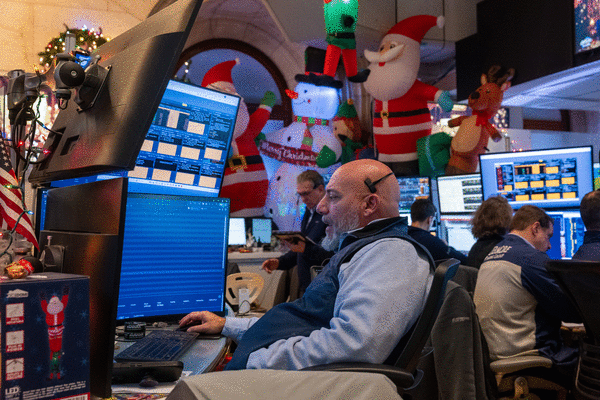
A relatively quiet session on Wall Street before Christmas saw stocks hitting all-time highs, with more signs the jobs market is not quickly deteriorating supporting bets on a soft economic landing.
Investors hoping for a “Santa Claus Rally” — which typically encompasses the last five trading days of the year and the first two of the new one — saw the S&P 500 rising in a shortened session ahead of the holiday. Treasury yields edged lower. The dollar barely budged.
The subdued action contrasts with the extreme turbulence driven by the tariff storm earlier in the year that put the equity benchmark on the brink of a bear market. Since then, stocks have surged, with every dip being bought at a record pace and the fear of missing out dominating sentiment.
While the impressive rally briefly stalled as exuberance over artificial intelligence was questioned in the final stretch of the year, bets the Federal Reserve will have further room to cut rates in 2026 kept fueling optimism over Corporate America’s profits.
“Investors should position for further advances in equity markets,” Ulrike Hoffmann-Burchardi at UBS Global Wealth Management said this week. “We maintain our attractive rating on U.S. equities. We find compelling opportunities in tech, health care, utilities, as well as financials, which should broaden the foundation for further gains.”
As traders parsed the latest economic data, they’ve kept their call that the Fed makes two quarter-point reductions in policy rates next year, one more than officials’ median forecast.
Applications for U.S. unemployment benefits fell last week, highlighting the seasonal swings in the data at this time of year. Wednesday’s figures are consistent with a labor market seeing relatively low layoffs, a trend that has remained intact throughout the year despite heightened economic uncertainty.
“For now, we expect two rate cuts next year, likely in the first half, and, provided unemployment doesn’t spiral, a resilient economy, cooling inflation and easier policy should be supportive for risk assets,” Magdalena Ocampo at Principal Asset Management said this week.
In a fifth straight day of gains, the S&P 500 topped 6,930. A closely watched volatility gauge — the VIX — hit the lowest this year. The yield on 10-year Treasuries slid three basis points to 4.13%.
Gold wavered after a rally that took the precious metal to an all-time high above $4,500 an ounce.
“The stock market is finally starting to eke out some gains for December after a choppy few weeks, and just in time for the market’s Santa Claus rally, which we expect to take place in its typical format,” said Paul Stanley at Granite Bay Wealth Management.
Meantime, breadth is becoming healthier, with an increasing number of stocks participating in the rally.
“Markets remain constructive, but selective,” said Craig Johnson at Piper Sandler. “The combination of improving breadth and easing inflation supports the call for a Santa Claus rally.”
Seasonal tailwinds may help, but confirmation via breadth and participation is still required, Johnson noted.
“If the historical pattern holds, it puts the market right around a 20% year,” said Mark Hackett at Nationwide. “But, while there’s clearly more to like than not right now, be careful about extrapolating another 20% run next year once momentum cools.”
The S&P 500 has risen nearly 18% so far this year, heading toward a third consecutive double-digit gain, also known as a “three-peat,” according to Sam Stovall at CFRA. A “four-peat” is highly unlikely, he said.
Since 1945, Stovall noted the S&P 500 recorded only one four-peat (1949-1952) and one five-peat (1995-1999). Of course, past performance is never a guarantee of future results, he warned.
Sell-side strategists across major firms have issued year-end targets for the S&P 500 that are clustered the tightest in almost a decade. With the highest forecast from Oppenheimer & Co. at 8,100 and the lowest from Stifel Nicolaus & Co. at 7,000, the gap in their annual outlook is just 16%.
“The consensus among Wall Street investment strategists is that the magic will last,” said Ed Yardeni of eponymous firm Yardeni Research, who has a forecast of 7,700 for the U.S. equity gauge.
“However, the first half of 2026 could see a correction if bond yields rise significantly, given mounting concerns that monetary and fiscal policies might be overly stimulative,” Yardeni said.
Meantime, questions about a shift in leadership have surfaced amid lofty tech valuations and concerns about ambitious AI spending plans.
“Investors often view the Magnificent Seven stocks as a single, unified force, assuming they move in lockstep and that the broader market’s success depends on their leadership,” said Brian Levitt at Invesco. “This perception is understandable given their outsized weight in major indexes, but it oversimplifies reality.”
In fact, Levitt notes that the narrative doesn’t match the numbers. Most of these megacaps are actually rising less than the S&P 500 this year.
“Valuations in tech are high, but some Magnificent Seven names have actually underperformed the S&P 500 this year, which suggests that there is still more room to run and that not all tech stocks are trading at runaway or complacent valuations,” Granite Bay’s Stanley said.
“Seasonals remain favorable, and we see at least 5% upside into year-end,” said Thomas Lee at Fundstrat Global Advisors. “And this is arguably the base case, given that in 2025, the Fed only started cutting in September.”
Lee noted that his mirrors September 1998 and September 2024. In both instances, S&P 500 gained 13% in the fourth quarter.
The Fed’s latest cut on Dec. 10 faced three dissents, the most since 2019. Officials are divided about the appropriate path for rates, with some policymakers more concerned about a cooling labor market and others saying the central bank should prioritize reining in above-target inflation.
President Donald Trump last week said he had narrowed his list for Fed chair nominees to “three or four” candidates and expected to have a decision pretty quickly, with an announcement “over the next couple of weeks.”
“The Federal Reserve will likely refrain from any more rate cuts until there is a new Fed Chair mid-year,” said Clark Bellin at Bellwether Wealth. “We believe stocks can move higher during this time even without additional rate cuts from here.”
Corporate Highlights:
—Intel Corp. fell after a report said that Nvidia Corp. halted a test to use Intel’s production process to make advanced chips.
—Nike Inc. rose after a filing showed that Apple Inc.’s Tim Cook purchased $2.95 million worth of shares on Dec. 22.
—Goldman Sachs Group Inc. warned investors in some of its alternative investment funds that their data may have been exposed in a breach at one of the bank’s law firms.
—Tricolor Holdings founder Daniel Chu collected nearly $30 million in compensation in the year leading up to the subprime auto lender’s collapse amid alleged fraud, according to a lawsuit filed by the trustee overseeing the company’s liquidation.
—Louis Dreyfus Co., one of the world’s largest agricultural traders, said Chief Financial Officer Patrick Treuer died “unexpectedly overnight.” He was 52 years old.
—Sanofi agreed to buy Dynavax Technologies Corp. for about $2.2 billion, as it seeks to expand a vaccines business currently anchored by its flu shot franchise.
—BP Plc agreed to sell a majority stake in its Castrol lubricants division to U.S. investment firm Stonepeak Partners, marking a key milestone as the oil and gas major seeks to reduce debt and reset its business.
—KKR & Co. and PAG agreed to buy the real estate holdings of beermaker Sapporo Holdings Ltd. in one of Japan’s largest property deals this year.
—Honda Motor Co. will buy out LG Energy Solution Ltd.’s facilities and other assets from their joint battery plant in Ohio for about 4.2 trillion won ($2.9 billion) as America’s pullback in electric vehicles continues to ripple across the industry’s supply chain.
—Tokyo Electric Power Co. plans to restart the world’s largest nuclear power plant next month, marking the Japanese utility’s return to atomic energy nearly 15 years after the Fukushima disaster.
—China’s Jiangxi Copper Co. has agreed to buy copper miner SolGold Plc in a deal that values the company at little over $1 billion.
—Chinese home appliance maker Haier Smart Home Co. agreed to sell a 49% stake in its India unit to Bharti Enterprises Ltd. and Warburg Pincus.
Some of the main moves in markets:
Stocks
—The S&P 500 rose 0.3%
—The Nasdaq 100 rose 0.3%
—The Dow Jones Industrial Average rose 0.6%
—The MSCI World Index rose 0.2%
—Bloomberg Magnificent 7 Total Return Index rose 0.1%
—The Russell 2000 Index rose 0.3%
Currencies
—The Bloomberg Dollar Spot Index fell 0.1%
—The euro fell 0.1% to $1.1778
—The British pound fell 0.1% to $1.3500
—The Japanese yen rose 0.2% to 155.96 per dollar
Cryptocurrencies
—Bitcoin fell 0.1% to $87,565.85
—Ether fell 1% to $2,942.88
Bonds
—The yield on 10-year Treasuries declined three basis points to 4.13%
—Germany’s 10-year yield was little changed at 2.86%
—Britain’s 10-year yield was little changed at 4.51%
—The yield on 2-year Treasuries declined three basis points to 3.50%
—The yield on 30-year Treasuries declined three basis points to 4.79%
Commodities
—West Texas Intermediate crude was little changed
—Spot gold fell 0.1% to $4,479.42 an ounce
©2025 Bloomberg L.P. Visit bloomberg.com. Distributed by Tribune Content Agency, LLC.





Comments