South Carolina politicians seek ban on cavity-fighting fluoride in public drinking water
Published in News & Features

COLUMBIA, S.C. — Fluoride has been used in water systems across the country for decades, with multiple studies showing it has slowed the prevalence of tooth decay in children and adults.
But a handful of South Carolina legislators want to ban fluoride in public drinking water. A pair of bills introduced in the past year are challenging the widely accepted use of fluoride as a tool for better dental health.
Sen. Carlisle Kennedy, R-Lexington, and Rep. Lee Gilreath, R-Anderson, sponsored the fluoride legislation, filing separate bills that would prohibit utilities from adding the cavity-fighting mineral to water distributed to millions of people across the state.
The South Carolina legislation has been filed as fluoride bans have been enacted in Utah and Florida and amid criticism by U.S. Health and Human Services Secretary Robert F. Kennedy Jr.
Despite significant evidence fluoride is both safe and effective at protecting teeth, Secretary Kennedy, a skeptic of many long-held medical practices, and some others say fluoride could affect children’s brain development.
Gilreath is one of them. He questions the effectiveness of fluoride in protecting teeth, but said possible health effects are a more pressing concern. He said he did not have access this past week to studies he’s read, but some of them support his position. He said he is “absolutely’’ worried that the government uses fluoride to harm people.
“I don’t call myself a conspiracy theorist, I call myself a conspiracy realist,’’ said Gilreath, who also said “I’m just trying to make sure that I’m doing all I can possibly do for people’s health and awareness.’’
While some studies – many of them in China – have raised questions about the public health impacts of fluoride in drinking water, health researchers have largely found that low levels of fluoride in water are safe, Politico reported in a July 10 story. The amount of fluoride put in drinking water is small, or comparable to 1 minute in 1,000 days, the American Dental Association says. Fluoride is a naturally occurring mineral whose use to treat drinking water dates to the 1940s in some places.
Alaska, Colorado and New York are among the states where studies have been conducted showing fluoride’s success in curbing tooth decay and saving money on dental bills, The State newspaper reported in a 2019 investigative series on small public water systems.
In one study from New York, researchers found that low income residents from communities with little access to fluoride needed one third more root canals, fillings and tooth extractions than those in places with fluoridated water, The State reported, citing a S.C. Dental Association report. An Alaska study found that children in Juneau suffered more tooth decay after the city stopped fluoridating water in 2007, The State’s story said. In 2003, Colorado researchers found that the state saved $149 million in dental treatment costs by fluoridating water, the story said.
More than 100 health organizations, including the Centers for Disease Control and Prevention, the American Medical Association and the World Health Organization support the safety and effectiveness of fluoride, based on “decades of research and practical experience,’’ an American Dental Association fact sheet says. The CDC calls community water fluoridation one of the 10 great public health successes of the 20th century.
The S.C. Department of Public Health had no immediate comment on fluoride, but its website shows agency support for the practice. A key benefit is that all people have access to fluoride when it is injected into drinking water, regardless of their socioeconomic status, the health department website says.
“Community water fluoridation does not discriminate against anyone on the basis of income, education or race,’’ the DPH website says. “Simply by drinking fluoridated water, everyone in a community benefits. Even today, with other available sources of fluoride, studies show that water fluoridation reduces tooth decay by about 25 percent over a person’s lifetime.
‘’A person’s income and ability to get routine dental care are not barriers since all residents of a community can enjoy fluoride’s protective benefits just by drinking tap water and consuming foods and beverages prepared with it.’’
About 92 percent of South Carolina residents served by water systems get fluoride in their drinking water, the CDC has reported. Among them are residents served by major water systems, including Columbia, Greenville, Aiken, Rock Hill and Spartanburg, The State has previously reported.
But about 300 small water systems do not provide fluoride in what they pipe to customers, the newspaper’s 2019 story said. Some of them don’t put fluoride in the water because of the expense. Others do not add fluoride because they already have it in water sources they draw from. In some cases, utilities in eastern South Carolina have pulled from water sources with too much fluoride, meaning they have had to lower the levels through treatment.
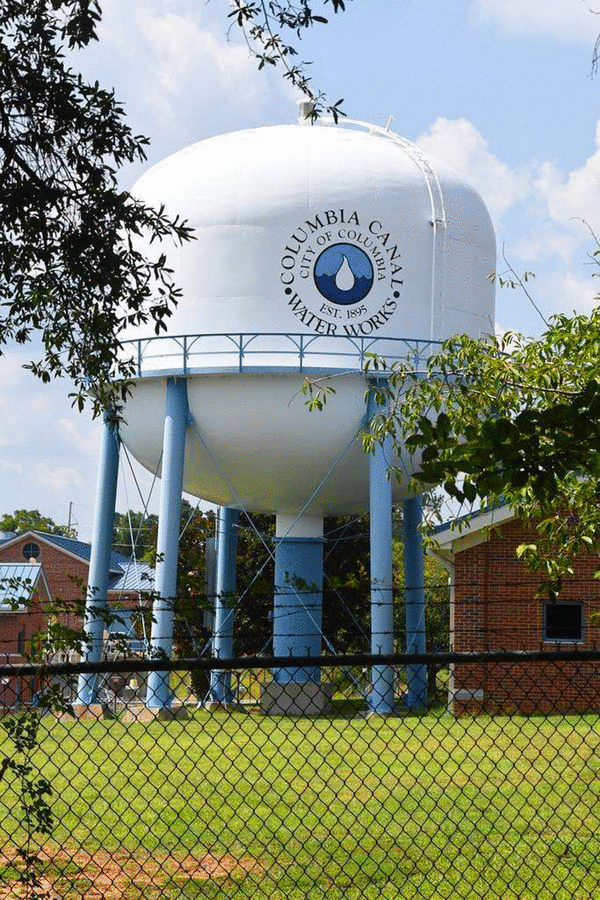
Clint Shealy, an assistant city manager over Columbia’s waterworks, said the city has seen little evidence that indicates Columbia should stop putting fluoride in its water, even though it costs the city about $240,000 annually. Columbia is one of the state’s three largest water utilities, serving some 400,000 people.
The American Dental Association says that through 80 years of research and experience with water fluoridation, “the overwhelming weight of credible scientific evidence has consistently indicated that fluoridation of community water supplies is safe.’’
“There appears to be a documented public health dental benefit,’’ Shealy said. “We’re following the best science and advice that we can. That’s what most utilities are doing.’’
©2025 The State. Visit at thestate.com. Distributed by Tribune Content Agency, LLC.






Comments