In the Caribbean, a dispute over sovereignty and Washington's influence
Published in News & Features
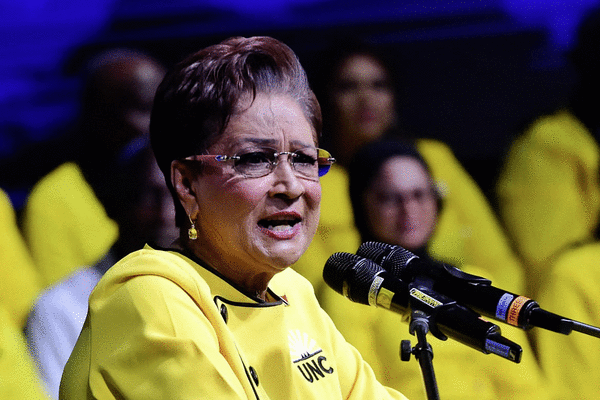
Former Trinidad and Tobago Prime Minister Keith Rowley is accusing his nation’s current leader of “betraying” regional sovereignty on behalf of the United States, warning that she risks reducing the oil-rich twin-island nation to “a vassal state.”
Rowley, who stepped down as leader of both his country and the People’s National Movement in March, is among several Caribbean politicians who on Sunday criticized current Trinidad and Tobago Prime Minister Kamla Persad-Bissessar a day after she dismissed the 15-member Caribbean Community as “an unreliable partner” after leaders questioned the inclusion of two Caribbean nations on a partial U.S. travel ban.
On Friday, Persad-Bissessar told her nationals that the prime ministers of Antigua and Barbuda and Dominica had been “badmouthing” the U.S., triggering their inclusion among 15 countries whose nationals will face restrictions on entering the U.S. as of Jan. 1.
In a scathing Facebook post, Rowley accused Persad-Bissessar of “taking secret instructions” from Washington, and of militarizing Trinidad and Tobago. He also accused her of refusing to disclose the nature of agreements she had made with U.S. authorities, particularly as President Donald Trump deploys warships off the coast of neighboring Venezuela and order boat strikes of alleged drug dealers in the southern Caribbean.
“For the Prime Minister and her hapless government to reduce us to a vassal state, taking secret instructions from another country and issuing dire warnings that we should ‘behave ourselves’ lest we offend the United States and lose our access to U.S. visas is to have torn up our Constitution and declared that the very idea of our existence as a nation is not worthy of defense or vision,” he wrote.
Rowley, 76, then invoked a term, “fifth-columnist,” from the Spanish Civil War to describe a saboteur, to accuse Persad-Bissessar of trying to undermine CARICOM from within.
“To so publicly withdraw from pertinent CARICOM issues and decisions is as close to being a dangerous fifth-columnist as we could get,” Rowley said. “To wear the shame of that in the hope of reward and protection from the United States is as feckless and ignorant as one can be.”
Since the Trump administration’s launch of deadly boat strikes in the region, tensions have been escalating in the hemisphere as Caribbean leaders mull over requests from the U.S. for access to their airports to install radars, and find their relationships with each other, and in some cases, Venezuela, tested as they insist that the Caribbean remains “a zone of peace.”
Antigua PM Browne pulls out receipts to counter Persad-Bissessar’s claims
This week, tensions intensified after the U.S. targeted Antigua and Dominica, citing concerns over their Citizenship by Investment Programs, and Persad-Bissessar, a vocal supporter of the U.S. military campaign, decided to take a public stance. On Sunday, the dispute further intensified when Rowley and his handpicked successor, Stuart Young, condemned her remarks in separate statements. Also a former prime minister, Young, lost the April general elections to Persad-Bissessar and her ruling United National Congress.
Young said she had “harmed CARICOM as an important institution” and had “disrespected and burnt important bi-lateral relations with our neighbors,” referring to Antigua and Dominica.
“Diplomacy is an art form that when properly understood and practiced,” he said, “permits countries to find middle ground and even to take positions without harming others and your own sovereignty long term.”
Leaders from Antigua and Barbuda also pushed back. Prime Minister Gaston Browne cited trade figures to challenge Persad-Bissessar’s claims about CARICOM’s unreliability, noting that Trinidad and Tobago earned more than $1.1 billion in foreign exchange from trade with CARICOM, making it the bloc’s second-largest export market after the United States.
“That trade has not been balanced,” Browne said, adding that Trinidad and Tobago has consistently recorded the largest trade surplus within CARICOM since its founding in 1973. He said this outcome was facilitated in part by protective tariffs imposed by CARICOM states to support Trinidad and Tobago’s manufacturing sector—an economic sacrifice, he said, borne by Caribbean consumers “in the spirit of regional solidarity.”
Sir Ronald Sanders, Antigua and Barbuda’s ambassador to the United States, said there was “much wisdom in Rowley’s remarks.” Trinidad and Tobago, he noted, is a founding member of CARICOM because its early leaders, Prime Minister Sir Eric Williams and opposition leader Rudranath Capildeo, understood that true sovereignty for small states was only possible through collective action.
“Not as a sword pointed at any country,” Sanders wrote, “but as a shield to protect our independence as far as possible and our dignity as a Caribbean civilization.”
U.S. saga in region fracturing CARICOM
Disagreements among Caribbean leaders are not new, nor are questions about CARICOM’s relevance more than 50 years after it was established by the Treaty of Chaguaramas on July 4, 1973, by the leaders of Barbados, Guyana, Jamaica and Trinidad and Tobago.
But Persad-Bissessar’s public rebuke of the bloc, at a moment when fears of renewed U.S. unilateralism are resurfacing, has sharpened concerns about the future of regional unity.
This is not the first such fracturing of the regional bloc. It happened in 1983 with the United States’ intervention in Grenada, which was recently asked by Washington to host a U.S. military installment of a radar system at its Cuban-built international airport.
Caribbean security expert Ivelaw Griffith, who recently gave a lecture in Grenada and discussed both sagas, said the current U.S. military buildup is posing “a conundrum” for Caribbean states.
“The saga we are experiencing currently is fracturing CARICOM,” said Griffith, a fellow with the Caribbean Policy Consortium and senior associate with the Center for Strategic and International Studies in Washington, D.C., said. “Part of that fracturing is a result of a conundrum that exists within CARICOM; CARICOM is not a unitary body. It’s a collection of sovereign states.”
As such, Griffith sees Persad-Bissessar, whose country is experiencing high-levels of organized crime including female-headed gangs, as exercising her “sovereign right to do differently or say differently or act differently in relation to somebody in, or out of CARICOM.”
“Trinidad is exercising that sovereign right to say, ‘Yeah, my CARICOM brothers and sisters, I take a different view in regard to the United States engagement,’” he said.
Yet, he highlighted a number of ironies. Among them is the concept of the Caribbean remaining a zone of peace. It was built on the early principles of Williams, the former Trinidadian leader, who helped established peace as a core principle for the region when CARICOM was founded in the city of Chaguaramas in Trinidad, located just a few miles from the Gulf of Paris from Venezuela.
“I don’t think she is unaware of what was proposed in Chaguaramas,” Griffith said of Persad-Bissessear. “But she’s facing a real life circumstance where there is war within her country.”
©2025 Miami Herald. Visit at miamiherald.com. Distributed by Tribune Content Agency, LLC.




Comments